

Master Thesis Summary:
What is commoditization — and why does it begin in the comparison?
Commoditization is the process by which buyers come to treat competing businesses as interchangeable. It can begin before the businesses themselves become the same: when the market’s method of simplifying choice removes the information that makes one choice meaningfully different from another.
The businesses do not have to become the same. The comparison only has to make them look that way.
You can find out whether this is happening to your business.
Take your homepage, About page, principal service page and strongest case study. Put them beside the equivalents from a competitor buyers genuinely compare you with.
Eight pages, and two things to establish from them: the three strongest reasons to choose each business, and which of those reasons the other could also credibly claim.
The overlap between the two is the Substitution Margin™ — the portion of your case a competitor could make from their own material.
Every business in the category can make those claims. None of them wins on making them better.

In a 2025 Ahrefs study of more than 900,000 new web pages, seventy-four per cent contained some AI-generated material.12 The significance is not that AI now writes the web. It is that many of the artefacts once associated with research, analytical labour and expertise have become dramatically cheaper to produce.
Much of what once signalled a difference is now available without the difference underneath it.
What follows is the evidence — how that gap opens, why more information can make a market less able to tell businesses apart, and what has to be rebuilt for a real difference to survive comparison.
The case begins with three numbers — measured differently, years apart, and resistant to twenty years of improvement.

Stephen Shaw
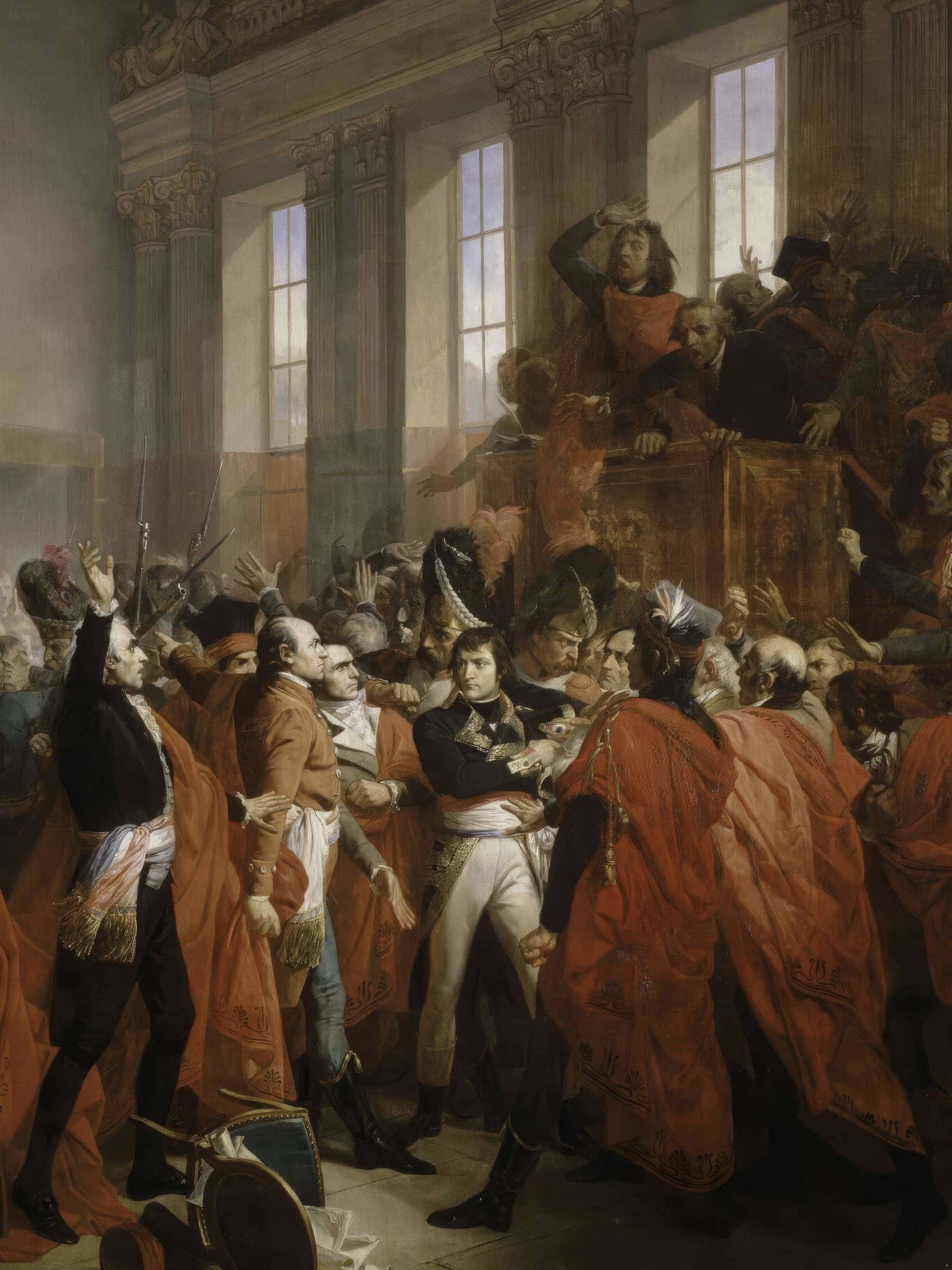
The Comparison Problem 2026. Digital renaissance-style painting.
Why do most business transformations fail?
Seventy percent. Eighty-eight percent. Seventy-five percent. Three numbers from three independent studies — McKinsey,1 Bain,2 and BCG3 respectively — each measuring the same phenomenon across different samples, different methods, years apart.
The finding is convergent: the businesses that invest the most in doing the same things better change the least.
These are businesses that followed the playbook. They hired credible firms, approved serious budgets, and executed against professionally scoped strategies.
McKinsey measured the outcome:
Roughly seventy percent of transformations fail to meet their objectives.1
Their survey of 416 senior executives pointed to a pattern: only twenty-one percent of strategies now pass four or more of the firm’s Ten Tests of Strategy — a diagnostic that evaluates whether a strategy is robust enough to deliver long-term value.
In 2010, thirty-five percent passed. The pass rate has fallen by forty percent in fifteen years.4
Bain measured it differently and the finding was worse:
Eighty-eight percent of transformations fail to achieve what they were approved to achieve.2
BCG confirmed the convergence across 850 companies — between sixty-five and seventy-five percent do not reach their goals.
And BCG added something else: efficiency.
Doing the same things better accounts for only thirteen percent of long-term outperformance. Real structural change (the remaining eighty-seven percent) accounts for the rest.
The investment in strategy has increased. The quality of strategy has deteriorated.

The usual explanation is execution.
The evidence no longer supports it.
Harvard Business Review’s own analysis identified a deeper cause: not execution but interpretation — not understanding the problem the strategy was supposed to solve.5 6
Consider what that means in practice.
You sit in a strategy review. The brand refresh is on the wall. The new website is in staging. Every deliverable in the room is genuinely valuable.
This is the third time in a decade.
New strategy. New website. New content.
Seven figures each cycle.
And each cycle begins as if the previous one never happened — three years of work quietly replaced by the next three years of work.
This is what McKinsey’s declining strategy quality looks like from inside the room.1 This is what the gap between what Bain’s executives approved and what they achieved feels like at the boardroom table.2 This is what BCG’s efficiency trap produces when nobody measures what connects one cycle to the next.3
The danger was never that the model broke. The danger is that it was never designed to accumulate. Each cycle was genuine. Each cycle expired.
And the next one started almost from scratch.

Thomas Cole (1801–1848)
Destruction (from The Course of Empire series), 1836, oil on canvas, 99 × 161 cm (New-York Historical Society, New York).
Then the search interface changed.
And the three-year cycle that was already failing to accumulate was now being read by systems that assemble answers rather than return pages.
Each cycle had produced pages. Services, articles, announcements. No cycle had produced the connections between them.
The shift did not happen all at once — but it had a clear beginning.
In 2012, Google announced the Knowledge Graph.
Five hundred million entities and three and a half billion relationships connecting them.7
The word that mattered was not “entities.” It was “relationships.”
Google was no longer organising the web around pages. It was organising it around the structural connections between ideas.
Then generative AI went a step further.
It stopped organising answers around pages and started constructing them from the relationships it found. Generative search, large language models, machine-mediated recommendation — each one assembling meaning from structural connections between sources.
The interface was no longer retrieving documents. It was interpreting knowledge. The websites that began to exert the greatest influence were no longer those that published most frequently. They were those whose ideas held together.
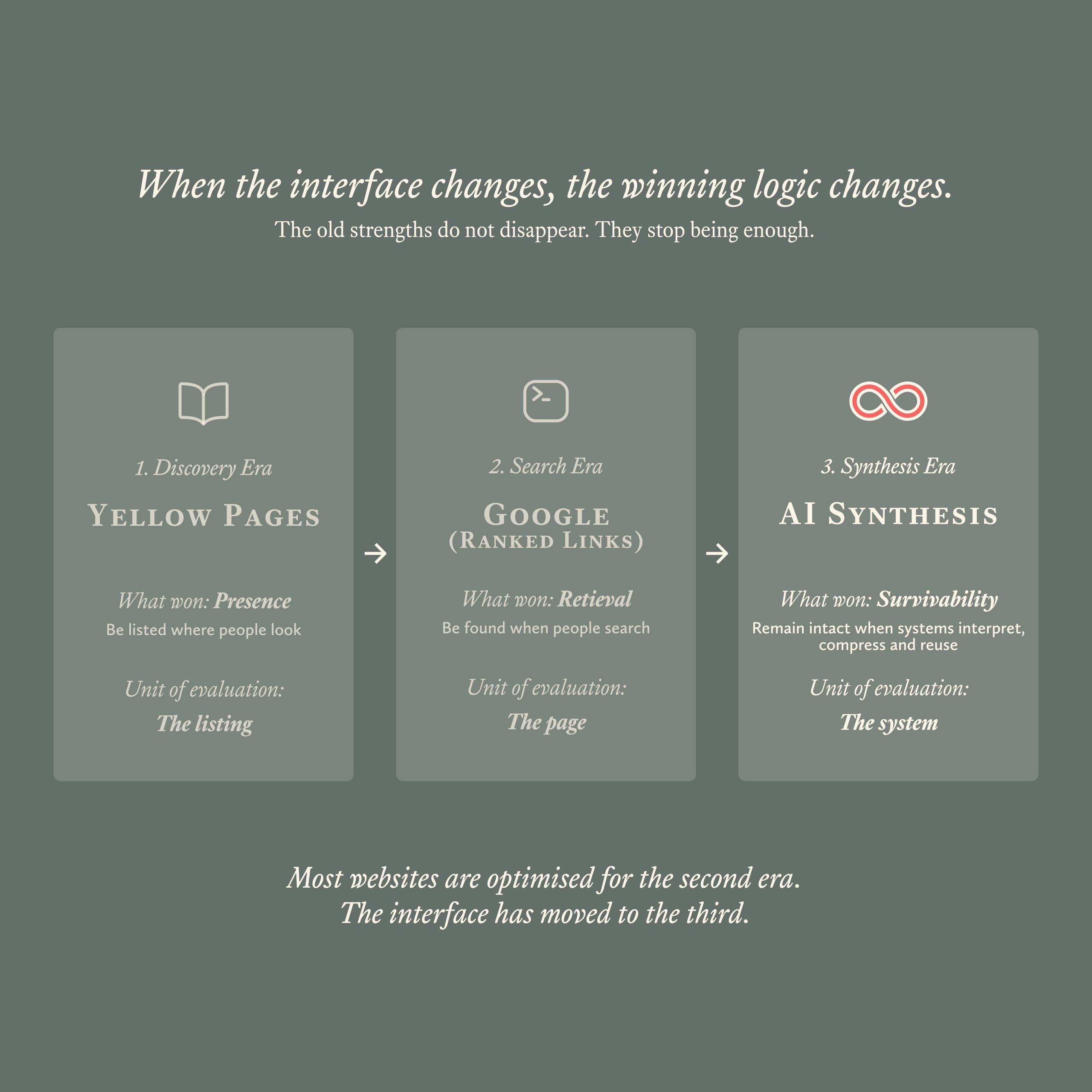
The shift resembles something older than the internet — a structural transformation, centuries before the web, that changed not how much knowledge could be stored but how it could be navigated.
That parallel will matter later.
For now, the finding is this: the businesses investing the most are being commoditized.
Not because their quality has declined. Because the things that used to demonstrate it are no longer scarce — and the systems now assembling the buyer’s answer cannot see a difference that nothing in the material distinguishes.
The question is, why?

Joseph Wright (1734–1797)
An Experiment on a Bird in an Air Pump, 1768, oil on canvas, 183 × 244 cm (The National Gallery, London).
The Attribution Crisis
What is the attribution crisis in AI search?
The attribution crisis is the systematic gap between the sources AI search systems read and the sources they credit.
A professional services firm publishes two hundred articles over five years. Each is well-researched. Each addresses a genuine client problem.
A synthesis system reads the website, extracts the three strongest insights, assembles an answer for the user, and cites none of them. The firm’s thinking is now inside the user’s decision. The firm’s name is not.
This is not a hypothetical.
Strauss et al. (2025), analysing approximately fourteen thousand real-world interactions across search-enabled language models, documented what they termed the “attribution crisis.”8
- Gemini provides no clickable citation in ninety-two percent of its answers.
- Perplexity visits approximately ten relevant pages per query but cites only three to four.
- The average query leaves approximately three relevant websites uncited.
Up to sixty percent of users now stop at the AI-generated answer without clicking through to the source (what the industry calls zero-click search).9 Click-through rates for traditional organic results have dropped thirty-four and a half percent as AI results have become more prominent.10
An idea can now spread farther than the name attached to it.
What these measurements reveal is a mediation chain.

Expertise no longer moves directly from the business to the buyer.
Between the source and the decision now sits a sequence of mediating systems — AI synthesis, algorithmic comparison, generative search, machine-mediated recommendation — each of which evaluates, compresses, and redistributes quality before the buyer encounters it.
Each layer is an opportunity for the business’s distinctive qualities to be preserved — or to be abstracted away until the buyer sees no structural reason to choose one source over another.
The problem was never only how to get seen.
It was how to remain intact once seen.

Rembrandt van Rijn (1606–1669)
The Storm on the Sea of Galilee, 1633. Oil on canvas. 160 × 128 cm. Isabella Stewart Gardner Museum, Boston.
Where does a real difference stop being visible?
Mediation is where the loss becomes measurable. It is not where it begins.
By the time a synthesis system reads a website, the question of whether that business is distinguishable from its competitors has largely been settled — by decisions made years earlier, in engagements that had nothing to do with technology.
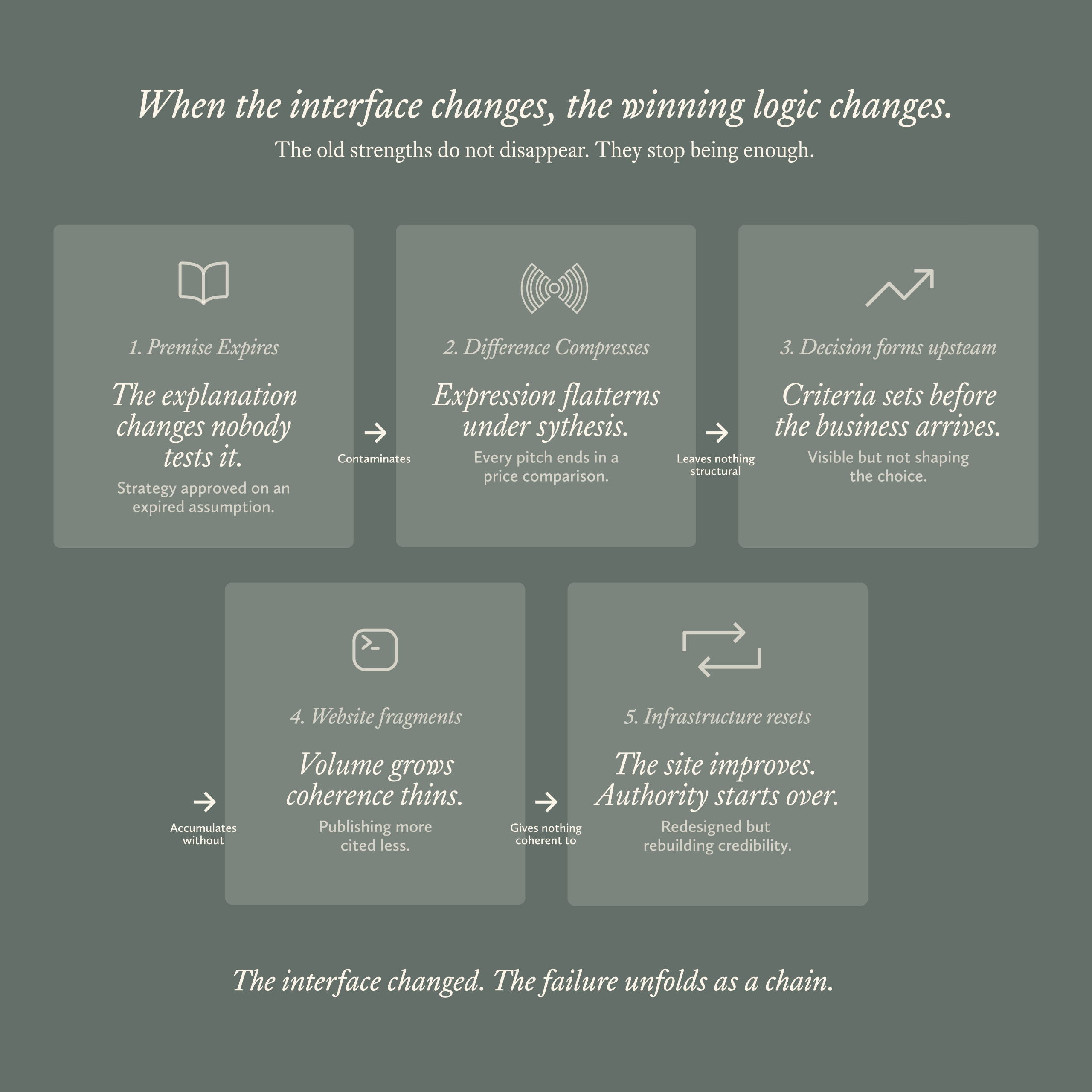
The failure is not a single event. It can occur at five thresholds — each capable of weakening what follows. Each is a point at which something genuinely distinctive about a business stops being something the market can see.
The first is interpretive.
The premise the business strategy is built on expires. Nobody is accountable for testing it.
The strategy is reviewed every year. The assumption underneath it has not been examined since.
Every subsequent improvement makes the business more efficient at pursuing a conclusion the market may have already moved past. The team has the signals. They have the data. What they do not have is distance from the explanation that used to make those signals make sense.
The danger is not ignorance. It’s fluency.
And fluency inside an expired premise produces the most expensive form of stasis: a three-year strategy plan built on assumptions the market no longer holds, approved by a leadership team that has no mechanism to test them.4 5
An expired premise does not only misguide strategy. It contaminates everything built on top of it.
There are two questions here and most businesses only ask one. Is our advantage still hard to copy? And: does the market still pay for it? A business can pass the first and fail the second for years without noticing.
A difference that was commercially relevant when you built it is not necessarily commercially relevant now.
The second is structural.
Expressive differentiation — language, visual identity, messaging architecture — is particularly vulnerable to compression.
When multiple sources present similar positions, synthesis can consolidate them into a common explanation — and expressive differences are often what disappear. Google’s own guidance for AI search environments calls for “unique, non-commodity content.”11 The strategic question goes further: what remains unique once the presentation itself becomes easy to reproduce?
In a 2025 study of 900,000 new web pages, Ahrefs estimated that seventy-four per cent contained some AI-generated material.12
The cost of producing persuasive expression has collapsed. It is no longer scarce enough to separate reliably.
Markets rarely punish what is different. They punish what becomes easy to compare.
Which leaves an uncomfortable question.
A named framework wrapped around conventional practice does not survive it. Its appearance is proprietary. Its mechanism is not — and the appearance is precisely the layer that has become cheap to reproduce.
What survives is difference a competitor cannot copy by reading about it. Evidence you hold and they do not. Rules you worked out from cases they have never run. Thresholds you only know because you have been wrong about them before.
There is a test, and it takes about thirty seconds.
If a machine can reconstruct the apparent uniqueness of your methodology from its description alone, how much of the uniqueness was structural?
Named methodologies are now commonplace enough that having one is no longer evidence the method underneath it is distinctive. A difference that lives only in expression remains available to imitation — and a business whose difference is copyable spends its margin defending one.
The third is comparative — and it is what happens when a real difference reaches a comparison that cannot represent it.
Ninety-four per cent of buying groups rank their shortlist before they speak to a seller, and first contact now happens around sixty-one per cent of the way through the journey.13
Before that contact, buyers have already researched, narrowed and ranked the field. Whatever criteria produced that ranking are already doing their work.
The business is publishing. But it is publishing into a comparison rather than shaping one — and there is no single argued position underneath any of it that the market could have met earlier.
The pitch was strong. The proposal was sharper than the competition. The team left the room confident.
What they could not have known from inside the process was that the criteria by which they were being evaluated had been assembled months earlier, during a research phase they were never part of. And the criteria did not include the thing they were best at.
Not because anyone excluded it. Standardised scorecards tend to privilege what every business can be scored against — response times, credentials, scope, rate. A real advantage may not be one of them.
So the buyer builds a fair test out of the things everyone has in common, and runs it accurately.
The buyer did not choose against them. The buyer chose before them.

That is why strong teams can be better and still lose.
And the loss is not the deal. It is what happens to the price of the next one. Repeatedly losing on criteria a business cannot influence creates pressure to compete on the criteria it can — and price is one of the easiest to change.
The team improves the answer. But someone else has already shaped the question. The greatest risk is no longer neglect. It is precision applied to the wrong layer.
A real difference earns no premium if the comparison cannot show why it matters — however real it is, and however well it is described.
The fourth is evidential — and it is what happens when a business responds to all of this by publishing more.
When a signal stops separating, businesses do not publish less. They publish more. More credentials. More articles. More guides. And many of them are now dramatically cheaper to produce.
So the buyer’s load rises. A buyer facing more material compresses harder — shorter shortlists, simpler scorecards, heavier reliance on the names they already know. They’re right to. Nobody has time to read everything, and a procurement process is itself a compression technology.
When signals stop separating, markets rarely become quieter. They become louder.
Most businesses publish. Very few assemble.
An article answers a question and is finished. The next one starts again. Each piece is scoped as a standalone brief; few are designed to reference what came before. The website grows and the relationships between the ideas stay invisible.
It is like watching bricks dropped into water. Each one vanishes beneath the surface before the next arrives.
A hundred articles is a hundred different claims. It is not a hundred times the evidence — and most of those claims were assembled from work somebody else had already done.
One is a claim. Three is a pattern. Several compounding is a permanent record.
That is the difference between a body of work and a backlog.
Which is why the obvious remedy is not one.
In July 2023, Reddit ranked sixty-eighth for US Google visibility. A year later it was fifth.14 By August 2026, one analysis recorded an eighty-six per cent fall in its citations in ChatGPT — the retrieval had not stopped; it had moved toward primary sources.15 Platform visibility is not accumulated evidence. It is a position on a leaderboard.
The retrieval moved toward businesses that knew something first. Most are repeating what they read.
Publishing creates volume. Coherence creates structure. Accumulated evidence makes the claim testable.
The fifth is infrastructural — and it is what happens when the architecture cannot hold the meaning together.
The attribution crisis is measured at the point of transmission. But those two hundred articles were vulnerable long before a synthesis system read them.
Not being cited is a different problem from not being found. The work was found. It was read, understood and used. What did not arrive was the business that produced it — and little in the way that work had been published was designed to preserve the connection.
Most websites were designed for an era when humans navigated to pages via ranked links. The page still matters. But the page alone cannot preserve every relationship the work needs to survive transmission — who produced the idea, what method it belongs to, what evidence supports it, and where the authoritative version lives. Google describes structured data as providing “explicit clues about the meaning of a page”16 — one mechanism among several, not a solution in itself.
Fresh paint. Straighter lines. Brighter glass.
And somewhere behind the wall, the frame has already started to split.
Most websites improve. Very few compound. After a decade of website investment, a business may own a current website — not the institutional asset a decade of thinking should have produced.
And this is the fracture most often mistaken for a visibility problem. It is not. A business that responds to it by publishing more has produced more work to be detached from.
A good website is no longer judged only by what it says. It is judged by what survives after others handle it.
The thresholds do not have to occur in order. But left unresolved, each makes the next harder to correct.
- ↓ Is the world still as the strategy assumes?
An expired premise leaves a business defending an advantage the market no longer values. - ↓ Is there something real beneath the claim?
A difference that exists only in expression becomes easy to imitate. - ↓ Can the market recognise that difference?
A real difference the comparison criteria cannot represent remains commercially invisible. - ↓ Does evidence accumulate around it?
Evidence that does not accumulate leaves the claim difficult for a stranger to verify. - ↓ Does the accumulated system survive when it travels?
Provenance that does not survive compression allows the evidence to travel without the source.
These are not five marketing problems. They are five places where a commercially meaningful difference can disappear.
The business experiences the commercial consequence — commoditization, pricing pressure, the inability to explain structural difference — but cannot diagnose the cause, because the cause is not in any single engagement.
It is in the architecture that connects them. Or rather, in the absence of one.
Bruegel painted the diagnosis in 1563.
His Tower of Babel, now in the Kunsthistorisches Museum in Vienna, shows an enormous spiral tower under construction.
Hundreds of workers occupy every level — masons, carpenters, engineers — each executing their craft with visible expertise.
The investment is monumental.
The ambition is unmistakable.
But look closer.

Pieter Bruegel the Elder (1525–1569)
The Tower of Babel, Oil on wood panel, (Kunsthistorisches Museum, Vienna).
The lower levels are built in one architectural style. The middle levels shift to another. The upper levels differ again. Each level was constructed by teams who never examined what the level below was structurally doing.
The tower is leaning.
The common reading of Babel is about language — the tongues were confused, the workers could not communicate.
The structural reading is different.
The problem was never communication. It was inheritance.
Each level was built independently, without reference to the structural logic of the levels beneath it. The craftsmanship on every level is excellent. The tower leans anyway — because no level was designed to bear weight for the levels above it.
That is the challenge rendered in oil on oak panel.
Five engagements. Five levels of the tower. Each expertly constructed. Each built without structural reference to the engagement below.
The businesses that have been investing in streams — individual pages, standalone briefs, independent engagements, disconnected redesigns — have been investing in quality that is structurally incapable of surviving the mediation chain.
The architecture is a stream when the interface now rewards systems.
Streams compete. Systems compound.™
In the book Competitive Strategy, Michael Porter did not influence how the world thinks about competition because he published more than his contemporaries.
He introduced a structured system of ideas — five forces, value chains, competitive positioning — where each concept reinforced the others.
The system held together.
It survived decades of compression, reinterpretation, and mediation through textbooks, consultancies, and now AI synthesis.
Clayton Christensen introduced disruptive innovation, the innovator’s dilemma, jobs to be done — and the framework reorganised how the entire domain was understood. Competitors could publish on the same topics. They could use the same vocabulary. What they could not replicate was the architecture that held the ideas together.
Kahneman’s System 1 and System 2 became the architecture through which decision-making itself was interpreted.
Six words. Two numbers. An entire discipline restructured.
These are not collections of ideas. They are systems of thought.
Content informs. Systems of thought reshape the categories through which information is interpreted.
Content depreciates as newer content replaces it. Systems of thought compound as new evidence reinforces them. Content is volume. Systems of thought are territory.
Competitors respond to it. Industries adopt its language.
Students study the framework.

Raffaello Sanzio da Urbino (1483–1520)
The School of Athens, 1509–1511, fresco (Stanza della Segnatura, Vatican City).
Every time a synthesis system compresses Porter’s framework, the compression points back to Porter. Every time an AI reinterprets Christensen’s model, the reinterpretation reinforces Christensen as the origin.
A system of thought does not merely withstand mediation. It is the part that gets carried — because there is something underneath the summary to carry, and every compression has to work from it.
Compress a stream and there is nothing underneath. The summary is all that survives. And what compression cannot carry is a name — which is what the attribution crisis measures, and why the connection between an idea and its origin has to be built rather than assumed.
The mechanism that commoditizes streams is the mechanism that compounds systems.
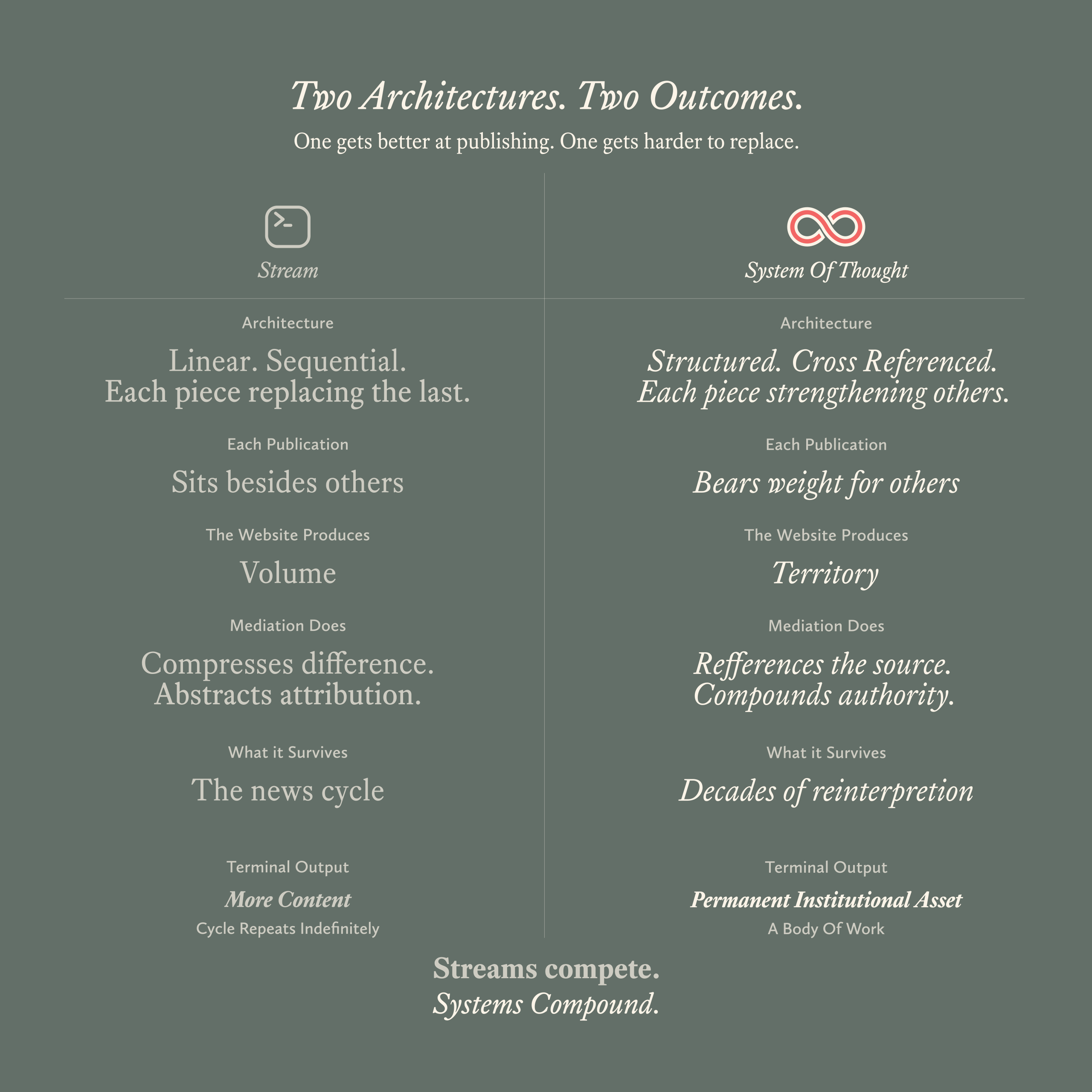
This pattern is older than the internet.
For centuries, knowledge was recorded on scrolls — linear, sequential, each section accessible only by unrolling from the beginning. The codex — the bound book with pages — replaced the scroll not because it held more information but because it made knowledge navigable.
Pages could be turned to directly. Sections could be cross-referenced. An index could exist.
The scroll distributed information. The codex represented knowledge.
The internet solved distribution. It never solved intellectual structure.
Most publishing architectures behave like scrolls — linear feeds of content, each piece disappearing beneath the next, nothing cross-referenced, nothing accumulating into something larger than the sum of its parts.
What survives mediation is the codex: structured, cross-referenceable, accumulating — each piece strengthening every other.

Stephen Shaw
The House That Keeps the Name 2026. Digital renaissance-style painting.
What would need to replace the improvement cycle?
The evidence points to six conditions.
The first condition is a tested premise.
Somebody accountable for retesting, on a cycle, the claim the difference rests on. Not a strategy review — a strategy review asks whether the plan is being delivered. A test asks whether the plan still describes the market. Who the buyer is. What they are comparing. Why they chose you last time. Each was true once. Any can stop being true without anybody noticing.
Without it, a business executes flawlessly against a conclusion the market has moved past.
The second condition is structural difference.
An advantage that survives being described — a different business underneath the description, not a better description of the business. When Hoover’s Triple Vortex was found to infringe Dyson’s patent, the difference was not an adjective or a position. It existed in something identifiable enough to protect.
A claim can be copied without reproducing the capability behind it. Structural difference sits beneath the claim — proprietary evidence, diagnostic logic, sequencing, accumulated knowledge, decision rules, intellectual property that changes what the client actually gets. Hard to copy is not enough. It has to matter.
Without it, a business whose difference is copyable spends its margin defending one.
The third condition is discriminating criteria.
A real difference earns no premium if the comparison cannot show why it matters. The buyer already has a way of deciding: a category, a shortlist, a scorecard, an idea of what good looks like. Each simplifies the choice. The problem begins when what gets removed is the thing that justified choosing differently.
The publication work upstream is therefore not to describe the business more clearly. It is to establish the criteria through which its difference becomes visible, before formal comparison begins. Criteria cannot create a capability. They can only make an existing capability legible.
Without it, the better business becomes the best-explained option in the wrong comparison.
The fourth condition is a compounding body of work.
Most businesses publish. Very few assemble.
An article answers a question and is finished; the next one starts again. A body of work does the opposite. One argument is tested by the next. One case adds evidence to another. Old thinking becomes more useful because later work extends it, qualifies it, or proves it wrong.
A stranger can test a body of work across time. A stream gives them isolated claims.
And a body of work dense enough eventually produces something a stream cannot. Porter’s became Competitive Strategy. Christensen’s became The Innovator’s Dilemma. Kahneman’s became Thinking, Fast and Slow. Each was the crystallisation of a system of thought built across years of research, argument and application — not written to a deadline, but emerging once the work behind it could support one.
Without it, thirty years of judgement can remain thirty years of assertion.
The fifth condition is a permanent institutional asset.
The thinking has to survive the format that first carried it.
An idea is quoted. Summarised. Taught. Compressed. Repeated by somebody who encountered it three intermediaries after its source. The thinking can travel farther than the name attached to it.
Porter’s ideas are everywhere now — quoted, summarised, taught by people who have never read him. They are still Porter’s. Competitive Strategy gives the argument a durable point of origin.
A business has no spine to put a name on. What it has instead is infrastructure — the evidence connected to the method, the method to the argument, the argument to the business that produced it, structured so that the connection survives quotation, compression and transmission.
That is permanence: not the preservation of files, but the survival of the connection between them.
Without it, the thinking survives and the attribution leaks.
The sixth condition is sequential inheritance.
Each condition’s output designed as the next one’s structural input. Not coordination in the holding-company sense. Inheritance in the architectural sense.
The premise is tested and the finding never reaches whoever builds the difference. The difference is established and the buyer is still comparing on the old criteria. The criteria are changed and nobody builds the evidence they now require. The evidence accumulates and its provenance disappears in transmission.
Five budgets. Five scopes. Five deliverables. None building on the last.
Ask whether the work should connect and everybody agrees. Ask whose job it is to connect it, and you get silence. What is missing is not talent. It is what happens between the engagements.
And Bruegel’s tower leans again — each part built, none inheriting enough from the last.
Pieter Bruegel the Elder (1525–1569)
The Tower of Babel, Oil on wood panel, (Kunsthistorisches Museum, Vienna).
Five independent improvements make five parts better. Six conditions make the difference accumulate.
- Premise → Is the world still as the strategy assumes?
Establishing whether the conditions that once sustained an advantage still hold is the work of The Fontainebleau Protocol™. - Capability → Is there something real beneath the claim?
Moving a commercially relevant difference out of description and into structure is the work of The Uniqueness Protocol™. - Criteria → Can the market recognise that difference?
Establishing the criteria through which that difference becomes visible before formal comparison is the work of The Pre-Decision Advantage™. - Inheritance → Does evidence accumulate around it?
Building a body of work in which each piece adds evidence to what came before is the work of The Canon Effect™. - Provenance → Does the accumulated system survive when it travels?
Building the infrastructure that keeps the evidence, the thinking and the name connected as they travel is the work of The Compounding Website™. - Ordering the five so that each can inherit from the last is Degrees of Change™.

Any architecture that meets all six conditions — a tested premise, structural difference, discriminating criteria, a compounding body of work, a permanent institutional asset, sequential inheritance — can produce something a stream of independent improvements cannot: a commercially meaningful difference that survives comparison.
Each investment builds on the last. Each compounds the value of every prior investment.
The Codex Sinaiticus was written on prepared vellum in the fourth century. Seventeen centuries later, much of it is still legible.

Unknown scribes, Codex Sinaiticus (c. 325–360)
Page from facsimile edition (1862); 1 Chr 9:27–10:11.
The pages survived. So did the structure that held them together.
The conclusion is clear.
Streams compete. Systems compound.

Stephen Shaw
The Five Thresholds 2026. Digital renaissance-style painting.
Frequently asked questions
What is a differentiation strategy?
A differentiation strategy is a plan to make a business meaningfully different from its alternatives, so that buyers have a reason to prefer it beyond price.
That assumes the difference gets assessed once it exists. The sequence runs the other way.
In 2025, 6sense asked more than four thousand B2B buyers how their purchases actually ran. Ninety-four per cent of buying groups had ranked their shortlist in order of preference before speaking to a single supplier.
Ninety-five per cent then bought from a firm already on that list on day one. And they had direct experience of roughly four of the five names on it.
So the comparison is built from firms the buyer already knows, scored on criteria assembled without them, and settled before anyone gets to make a case.
Which makes a differentiation strategy something narrower than the definition suggests. Not a plan to be different. A plan to be different in a way that registers in a comparison you are not present for.
A difference the market cannot see behaves like no difference at all.
Five things have to hold for it to register.
- The premise it rests on has to still be true.
- The difference has to be structural rather than expressive.
- The criteria in use have to be capable of representing it.
- The evidence has to have accumulated somewhere the buyer looks.
- And the work has to travel with the name attached.
Most differentiation work goes into the first half of that — being different. Almost none goes into the second.
What is the difference between commodification and commoditization?
Commodification is the process by which something that was not previously bought and sold becomes a marketable good. Commoditization is the process by which a differentiated offering becomes increasingly interchangeable with its competitors. One creates a market. The other flattens one.
The two describe different commercial movements. Commodification brings something into a market that was not previously traded as a commodity. Commoditization erodes the distinction within an existing market. One expands what can be exchanged. The other weakens the premium attached to difference.
Sociology tends to use commodification. Strategy and marketing use commoditization. The confusion is not academic. A business that is commodifying something is creating or expanding a market. A business being commoditized is losing the premium attached to difference.
Why do buyers choose a competitor we know is weaker?
Buyers can choose a weaker competitor when the comparison they ran was fair, accurate, and measured the wrong things.
6sense’s 2025 B2B Buyer Experience Report, drawing on nearly four thousand buyers, found that 94% of buying groups rank their shortlist in order of preference before speaking to any seller. First contact now happens around 61% of the way through the journey — and the vendor contacted first wins the business 77% of the time.
The obvious reading is that first conversations are persuasive. 6sense tested it. In the rare cases where a buying group had not ranked its shortlist in advance, the first vendor they spoke to won 57% of the time. If first contact itself were doing most of the persuasive work, we would expect the effect to be stronger among buyers who had not already ranked the field. It is not.
Their conclusion is unambiguous: being contacted first indicates that you are the preferred vendor. It does not cause it.
What 6sense establishes is when preference forms. The comparison problem explains how it can form around the wrong criteria.
Scorecards tend to privilege what every candidate can be scored against. Response times. Credentials. Scope. Rate. A genuine advantage may not be one of those, so it never enters the total. The buyer built a fair test out of the things everyone had in common and ran it accurately.
The buyer did not choose against you. The buyer chose before you.
That is a comparison problem, not a sales one.
An Artful Science calls the work of establishing those criteria before formal comparison The Pre-Decision Advantage™.
What are points of parity?
Points of parity are the claims a business must make to be considered credible in its category — and which every serious competitor can make equally well. Kevin Lane Keller, who introduced the term in brand-equity theory, calls them the “green fees” to play the game: necessary to be at the table, and not sufficient to win anything.
They are not weaknesses. They are entry requirements — a business that cannot claim them is not considered at all. The error is treating them as differentiation: sharpening the language around a claim four competitors make identically.
Keller distinguishes category, competitive and correlational points of parity. The first two matter most here.Category points of parity are what a business must claim to be a legitimate member of its category. Competitive points of parity are associations adopted specifically to neutralise a competitor’s point of difference.
The logic is sound when one business does it: neutralise their advantage, win on yours. The strategic problem begins when both sides repeatedly do it. Each neutralises the other’s difference, the shared ground grows, and the category can converge by mutual construction — neither business having intended the result, and neither benefiting from it.
Their opposite is a point of difference — an association buyers strongly link to one business and believe they could not get to the same extent anywhere else. A business needs both: parity to be admitted, difference to be selected. Much published material is parity written as though it were difference.
Category parity gets you considered. Competitive parity can neutralise somebody else’s advantage. Neither substitutes for a point of difference.
What is competitive parity?
Competitive parity is a state in which rival businesses are close enough — in capability, or in how that capability appears — that buyers see no structural reason to prefer one over another.
It is rarely where a category starts. It is usually what two firms build while trying to escape it.
Gillette launched the first three-blade razor in 1998. Schick answered with four in 2003. Gillette’s reply was not four but five. “There was never a plan to go to four,” its razors president said. The escalation was profitable for years. Each generation cost more than the last, and buyers paid.
What it also did was teach a whole category what to compare — and blade count has a ceiling.
Once it was reached, one axis was left.
By 2016 Gillette’s share of the US market had fallen to 54%, while two discount subscription brands held 12.2% between them. In April 2017 it cut prices by an average of 12%. Neither firm set out to build a shared comparison. Each acted to defeat the other’s difference, and the common ground grew with every move.
And parity contains a trap, because two conditions produce identical symptoms. Two businesses can be genuinely interchangeable. Two businesses can be materially different and merely appear so. Same shortlists, same price pressure, same lost work — and the remedies are opposite. The first has to become something. The second has to be seen for what it already is.
The term also names a budgeting method: setting spend by matching competitors. Matching a rival’s budget does not make two businesses equivalent. It does keep the loop turning.
Apparent parity and actual parity produce the same symptoms and require opposite responses. Establishing which one you have is the first piece of work.
How do you stop being commoditized?
You stop being commoditized by changing what the comparison measures, rather than describing your existing difference better.
An Artful Science calls the pattern The Commoditization Loop™, a self-sustaining cycle in five stages:
- The claim. A business states that it is different.
- The sameness. It states that difference in the language its category shares.
- The compression. Buyers, reading several businesses saying much the same thing, cannot separate them.
- The default. The comparison falls to the attribute that always differs: price.
- The return. Price pressure sends the business back to stage one, to claim its difference more emphatically than before.
Sharpening the positioning, strengthening the proof, publishing more: each is work at stage two, which is why each returns the business to where it started. Better description is available to everyone in the category. The cycle breaks at stage three.
In the mid-1990s, ready-mix concrete was the archetypal commodity, bought on price per cubic metre. CEMEX fitted its trucks with satellite dispatch and guaranteed delivery inside a twenty-minute window, with money off every cubic metre if it missed.
The product was not what changed. The comparison was. CEMEX had stopped measuring itself against cement companies and started measuring itself against a pizza chain — it printed miniature pizza boxes reading “Now, the concrete is faster than the pizza.”
A rival could have matched the claim in an afternoon. Matching the guarantee required a fleet, a dispatch system, and the willingness to pay for being late.
You do not stop being commoditized by proving you are different. You stop by changing what the comparison measures — and then being able to stand behind it.
What is the difference between a body of work and a content library?
A content library is a collection of pieces that answer questions independently. A body of work is a structure in which each piece makes the earlier ones more useful. The difference is inheritance, not volume.
The closest analogy is precedent. In a common-law system, a later judgment inherits reasoning from earlier authoritative decisions. The earlier work does not disappear when the next case arrives — it becomes part of the structure through which the new case is understood.
A body of work behaves the same way. The 2019 argument is not replaced by the 2024 one. The later piece tests it, extends it, qualifies it, or gives a reader a reason to reject it.
Most publishing systems encourage the opposite. Each piece answers its question and closes. Little in the archive is designed to become structural input for what follows.
A single claim asks to be believed. A connected sequence asks to be checked — and a reader who can trace one argument across six years is auditing a record rather than evaluating a claim.
A stranger can test a body of work across time. A library gives them isolated claims.
An Artful Science calls the work of building an archive where each piece adds to the last The Canon Effect™.
Is this the same as what a brand or positioning agency does?
This overlaps with brand and positioning work, and the overlap is worth stating plainly. Strong positioning practices already work on category framing and evaluation criteria. Strong content practices already build evidence. None of that is disputed — and a business whose failure sits at one of those layers should buy that work.
A better brief helps. It does not solve the inheritance problem.
A brief compresses reasoning into instructions. It can record why a conclusion was reached. It rarely preserves the whole evidentiary chain, the alternatives that were rejected, and the constraints that produced the answer — because a brief is written to be acted on, not interrogated.
So the next supplier can inherit “our advantage is X” without inheriting enough of the reasoning to retest whether X still holds. Each engagement is executed correctly against a premise nobody in the room can examine. The work is good. The inheritance is missing.
Coordination moves information between engagements. Inheritance preserves the reasoning each engagement needs to build from rather than restart.
What is the Substitution Margin?
The Substitution Margin is a measurement of how much of one business’s strongest published case a credible alternative could also substantiate.
It establishes the three strongest independent reasons to choose each business from four matched published pages, then separates every reason into five published layers weighted according to how much each contributes to a buyer’s ability to distinguish the two. A high margin means most of the published case is reproducible by the alternative. A low margin means little of it is.
It is a stress test rather than a league table. It establishes substitutability, not which business is better, and missing published evidence is never treated as evidence of missing capability.
The margin measures the comparison, not the business.
What are the five thresholds?
The five thresholds are the five points at which a commercially meaningful difference can stop being visible to a market.
- Premise — the premise the strategy rests on has expired, and nobody is accountable for testing it.
- Capability — the claimed difference does not survive beneath the expression.
- Criteria — the criteria in use cannot represent the difference, and they were settled before the business arrived.
- Inheritance — the work has not accumulated into evidence a stranger can test.
- Provenance — the evidence travels without its source.
They are not stages and they do not have to occur in order. A business can hold four and fail at one.
All five can converge on the same commercial symptoms — price pressure, weakening differentiation, and difficulty explaining why the business deserves a premium. Which is why the symptom rarely tells you where the fault is.
The diagnosis locates where separation is failing.
What are the six conditions?
The six conditions are what must be true for a commercially meaningful difference to survive comparison.
- A tested premise — somebody accountable for retesting the claim the difference rests on.
- Structural difference — an advantage that survives being described.
- Discriminating criteria — a comparison capable of showing why it matters.
- A compounding body of work — evidence that accumulates rather than resets.
- A permanent institutional asset — infrastructure that keeps the evidence connected to the method, the method to the argument, and the argument to the business that produced it.
- Sequential inheritance — each condition’s output designed as the next one’s structural input.
They are not a sequence of purchases. Where a business needs to intervene depends on which condition is failing — the failure is systemic, and the response rarely has to be.
Five independent improvements make five parts better. Six conditions make the difference accumulate.
An Artful Science calls the ordered sequence Degrees of Change™.
What does “streams compete, systems compound” mean?
Streams compete. Systems compound™ means that independent publications create value one piece at a time, while connected work allows each new piece to increase the usefulness, context and evidential value of what came before.
The mechanism is inheritance. A new argument refers back to an earlier one. A case tests a method. A diagnostic turns an argument into something observable. Contradictory evidence forces the system to change. The archive becomes more valuable because later work gives earlier work additional context, evidence and application.
Porter’s work did not endure because every intermediary reliably cited him. It had a stable intellectual architecture — named concepts, arguments and authoritative sources — that subsequent books, cases and teaching could return to. Stable names, authoritative sources and repeated attribution helped keep those ideas connected to their origin.
Compounding is not automatic. Without evidence, a system accumulates claims. Without provenance, the ideas travel and the attribution leaks.
A stream starts again. A system gives the next piece something to inherit.
Index
Sources referenced.
- McKinsey & Company. “The Science of Organizational Transformations.” McKinsey & Company, December 7, 2021. Convergent finding across two decades of original McKinsey research: approximately seventy percent of transformations fail to meet objectives. Confirms the paradox: investment intensity does not predict structural change.
- Bain & Company. “88% of Business Transformations Fail to Achieve Their Original Ambitions.” Bain & Company, April 15, 2024. Primary research: only twelve percent of transformations achieve their original ambition. The most stringent measurement in the field. Survey of 400+ executives and senior leaders.
- Boston Consulting Group. “How CEOs Can Beat the Transformation Odds.” BCG, February 7, 2025. Analysis of 850+ companies: cost reduction accounts for only thirteen percent of outperformance. Structural change drives the remaining value. Confirms that the market has separated improvement from reinvention commercially.
- McKinsey & Company. “How Strategy Champions Win.” McKinsey Quarterly, July 14, 2025. Strategy Method Survey, 416 senior executives, December 2024–January 2025. Twenty-one percent pass rate on the Ten Tests of Strategy — down from thirty-five percent in 2010. Quantifies the deterioration of strategy quality despite increasing investment.
- Olson, Andrea Belk. “4 Common Reasons Strategies Fail.” Harvard Business Review, June 24, 2022. Reframes strategy failure from execution to interpretation: “not understanding the problem” is the primary cause. Supports the thesis’s first fracture — the premise expires, not the execution.
- Carucci, Ron. “Executives Fail to Execute Strategy Because They’re Too Internally Focused.” Harvard Business Review, November 13, 2017. Confirms that strategic failures are misdiagnosed as execution problems when the root cause is interpretive — inability to see the competitive landscape from outside the existing premise.
- Google. “Introducing the Knowledge Graph: Things, Not Strings.” Google Official Blog, May 16, 2012. 500 million entities, 3.5 billion relationships at launch. The structural shift from organising the web around pages to organising it around the relationships between them.
- Strauss, Ilan, Jangho Yang, Tim O’Reilly, Sruly Rosenblat, and Isobel Moure. “The Attribution Crisis in LLM Search Results.” arXiv:2508.00838, June 27, 2025. Analysis of ~14,000 real-world LLM search interactions. Gemini: no citation in 92% of answers. Perplexity: visits ~10 pages, cites 3–4. Average query: ~3 relevant websites uncited. Quantifies the gap between the sources synthesis systems read and the sources they credit.
- Bain & Company, cited in Airbridge. “How LLMs Are Rewriting Mobile App Attribution in 2025.” Airbridge, January 26, 2026. Up to sixty percent of users stop at the AI-generated answer without clicking through to the source.
- Ahrefs. “How AI Overviews Impact Organic CTR.” Ahrefs Blog, 2025. 34.5% drop in click-through rates as AI results become prominent.
- Google. “Top Ways to Ensure Your Content Performs Well in Google’s AI Experiences on Search.” Google Search Central Blog, May 21, 2025. Google directs creators toward “unique, non-commodity content.”
- Ahrefs. “74% of New Webpages Include AI Content (Study of 900k Pages).” Ahrefs Blog, 2025. Ahrefs’ own detection model applied to 900,000 newly detected English-language pages: 74.2% contained some AI-generated material; 2.5% classed as purely AI-generated.
- 6sense. “The B2B Buyer Experience Report for 2025.” 94% of buying groups rank their shortlist before speaking to a seller; first seller contact occurs around 61% of the way through the buying journey; the vendor contacted first wins the business 77% of the time. Where a buying group had not ranked its shortlist in advance, the first vendor spoken to won 57% of the time.
- Amsive. “Reddit’s SEO Growth: A Deep Dive into Reddit’s Recent Surge in SEO Visibility.” Amsive Insights, February 2, 2026. Reddit’s visibility increased from 68th to 5th in US domain rankings within a single year (Sistrix data).
- Business Insider. “What Reddit’s ChatGPT Citations Collapse Means for Marketers.” August 2026. Reddit citations within ChatGPT fell by approximately 86% from mid-August 2026.
- Google. “Introduction to Structured Data Markup in Google Search.” Google Search Central. Structured data provides “explicit clues about the meaning of a page.”
About the author
Article by Stephen Shaw, brand strategy consultant and founder of An Artful Science.