Stephen Shaw
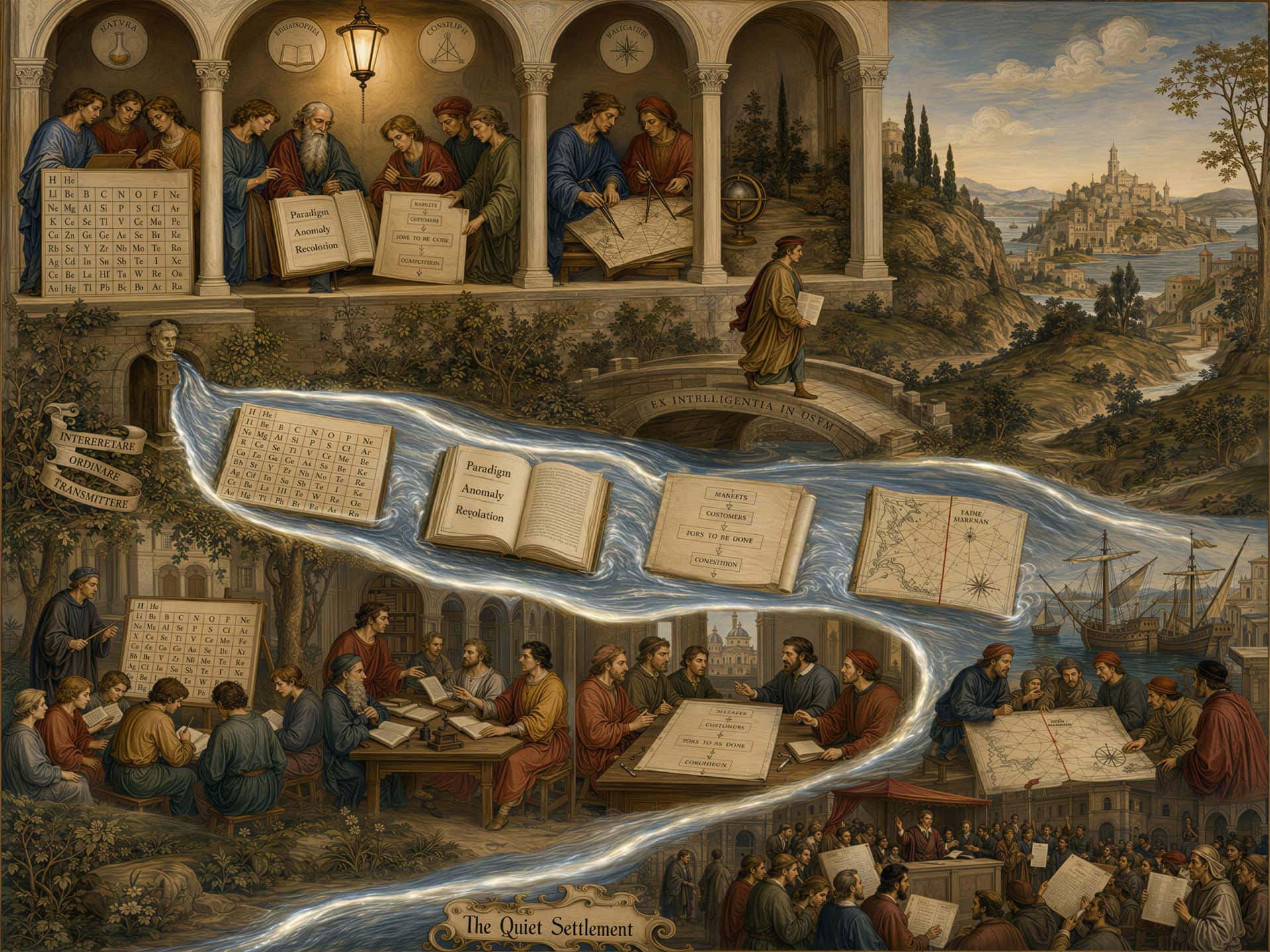
The Quiet Settlement 2026. Digital tempera-style painting.
Govern the Category
Competitors define themselves in response to your work — not the other way around.
Once your distinctions become the category's grammar, what others say reads as commentary.
Start Defining
Your work sets the questions the category will spend the next decade answering.
Authoring the contest itself becomes the work — not publishing into a contest someone else is authoring.
Make the Work Inevitable
Build a career-defining body of work on a terrain no one else thought to occupy.
Porter named competitive strategy. Forty years on, the boardroom still asks his five questions.
Service Definition:
Whose criteria are your potential clients already using to judge you?
Before buyers decide who to choose, they decide what choosing well means. By the time the shortlist appears, the criteria, vocabulary and assumptions behind it have often been forming for months — beyond the part of the buyer journey most marketing and sales can see.
The Pre-Decision Advantage™ is An Artful Science’s upstream B2B demand generation and buyer-journey strategy service for professional-services firms that need to influence how buyers define the problem before a shortlist forms.
The Master Reading™ finds the market question worth owning. The Master Thesis™ turns that opening into the argument, vocabulary and evaluation frame. The Compounding Blueprint™ provisions the publishing territories through which that frame can reach analysts, peers, internal champions and other upstream readers before formal evaluation begins.
The result is The Quiet Settlement™: buyers reach formal evaluation already carrying the firm’s vocabulary, distinctions and criteria into the decision — so the business is no longer competing only to win the pitch, but has helped shape what the pitch will be judged against.
Read the field. Author the frame. Settle the category.
For years, the question has been how to publish better. Better topics. Sharper editorial standards. More frequency, smarter SEO, tighter distribution.
After two decades of this, the work has produced exactly what it was designed to: visibility.
And the deals still go elsewhere.
Gartner ran the numbers in 2024.
Eighty-three percent of the buyer journey happens before the vendor is ever in the room. 6sense ran them in 2025. Ninety-five percent of eventual winners are already on the buyer’s Day-One shortlist.
Slack threads. Notion docs. Peer DMs.
Conversations happening in private.
That is where the criteria are set. Where the vocabulary is absorbed. Where the framework — the lens the buyer will bring to the shortlist — is installed.

Stephen Shaw
Strong work no longer wins the shortlist. Earlier work does. 2026. Digital tempera-style painting.
By the time the business enters the conversation, eighty-three percent of the decision has already happened.
The question was never how to publish better. Timing was.
This ‘quiet settlement’ condition was also visible in 1884 — but at the scale of the planet.
In October 1884, in a hotel in Washington DC, twenty-five nations argued for a week about a question that, on its face, was about astronomy.
It wasn’t.
The world had no zero point.
Every empire had been running its own prime meridian line — Paris, Cádiz, Pulkovo, Naples, Philadelphia. Every nautical chart used different coordinates. Every aviation chart yet to be drawn would have inherited the chaos.
The conference voted. Greenwich won! France abstained and kept using Paris time for another twenty-seven years.
It made no difference.
The Royal Navy had been publishing charts in Greenwich longitude for a century.
By the time twenty-five nations sat down in Washington, more than seventy percent of the world’s shipping was already navigating relative to Greenwich.
The vote did not establish the meridian. It ratified what had already happened — quietly — in the publications of the prior century.

Stephen Shaw
The question was never how to publish better. Timing was. 2026. Digital tempera-style painting.
What happened in 1884 was not unique.
It is the clearest version of something that has been happening in every market, for centuries.
In 1869, Dmitri Mendeleev published a paper arranging the chemical elements into a table. Competing arrangements were proposed in the years that followed and quietly forgotten. Every chemistry classroom on Earth still teaches the elements his way.
In 1962, Thomas Kuhn published a hundred-and-seventy-two-page book naming what nobody had named: paradigm shift. Every subsequent argument about how science changes — including by Kuhn’s critics — was conducted inside his vocabulary.
In 1997, Clayton Christensen published The Innovator’s Dilemma. Within a decade, every consulting deck, every board paper, every business school case study about innovation reorganised around his vocabulary.
Four cases. Different fields. Different centuries. Different men.

Stephen Shaw
The Four Settlements 2026. Digital tempera-style painting.
You may have noticed it.
Each of them was writing for the upstream.
Mendeleev for the chemists who would shape the syllabus. Kuhn for the philosophers who would shape the discourse. Christensen for the advisors who would shape the boards. The Royal Navy for the navigators who would shape the trade routes the empires would later compete on.
From those upstream readers, the frameworks travelled.
Mendeleev’s table reached every chemistry student downstream. Kuhn’s vocabulary reached every working scientist downstream. Christensen’s categories reached every executive on every board downstream. Greenwich coordinates reached every ship downstream.
The downstream reader inherited what the upstream reader had already settled on.
They settled the field — quietly, before the visible contest even began. The contest that followed only ratified what had already been ‘settled’.
This is ‘The Quiet Settlement’.
Most industries publish for the downstream. The Quiet Settlement is written upstream.
The eighty-three percent Gartner measured is the gap between.

Stephen Shaw
The Current Of Inheritance 2026. Digital tempera-style painting.
Every market has its Quiet Settlement. Most miss the opportunity to author theirs.
What Christensen named for innovation. What Kuhn named for science. What the Admiralty did for cartography.
This is its name in commerce.
Imagine a cartographer in 1700 publishing the most beautiful maps in the world — accurate, detailed, definitive — and selling them to ships whose captains had already studied charts drawn by someone else.
The work is excellent. The captain’s mental map of the world was made elsewhere.
The Pre-Decision Advantage™ is the methodology that produces The Quiet Settlement™.
A master strategic foundation — eight master artefacts in a connected inheritance pipeline — engineered for the upstream reader. The analyst at the briefing. The peer in the Slack channel. The internal champion in the Notion doc. The reader whose mind shapes what the buyer will believe by the time evaluation begins.
The buyer is downstream.
Your work begins upstream.

1. Skip The Defence
Pipelines fill on time. Deals close at the asking number. Sales cycles compress — not because the team improved, but because the buyer arrived already convinced.

2. Hold The Premium
Price negotiations end at the opening number. Discount requests stop arriving. The premium stops being defended — it becomes the expectation.

3. Set The Criteria
The shortlist always forms around an argument written first. Author that argument — and every decision in the category gets measured against terms set upstream.

4. Build An Appreciating Asset
Marketing spend depreciates the moment the campaign ends. The intellectual asset compounds — each chapter inheriting from the last, appreciating with every publication.

5. Become The Reference
Analysts quote it. Competitors argue inside it. Buyers arrive carrying it. The framework the market borrows is the framework that wins.

6. Outlast The Leadership
Campaigns reset. Teams change. Editorial direction shifts. The architecture that survives all three is the legacy worth building — and the only one that compounds.

7. Be Seen First
Not the one who responded fastest. Not the one who built the best team. The one who saw it before anyone had the language for it.
Three Movements. Three beats each.
The Pre-Decision Advantage
From publishing into the field — to authoring the field before the contest.

Stephen Shaw
The Pre-Decision Advantage™ 2026. Digital tempera-style painting.
Reclassify The Field
Publisher → Cartographer
Surface the structural vulnerabilities the market cannot yet name.
Occupy The Territory
Cartographer → Author
Define the borders, the readers, and the multi-year horizon — before anyone publishes against them.
Compound The Authority
Author → Authority
Convert the archive into permanent positioning the market commissions from a single source.

Tier 1 — Market intelligence maps what a market is. This finds what a business could be first to own.
The Master Reading
The Master Reading™ is the market intelligence that finds the position no one has claimed — the one a market analysis misses by describing what a market is, not what it could become. It returns the opening worth owning first.

Tier 2 — A positioning statement tells the market where a business sits. This tells the market how to think.
The Master Thesis
The Master Thesis™ is the positioning statement for an entire field — the argument, vocabulary, and evaluation frame a market adopts to judge every option against. It is a strategic narrative built to become the default lens, not one more point of view.

Tier 3 — A mission statement says who a business is for. A manifesto names who it is against.
The Master Manifesto
The Master Manifesto™ is the brand manifesto that draws a line — naming the buyers a business is not for and the beliefs it refuses, so the right buyers recognise themselves and the wrong ones leave. Its brand purpose is stated as a boundary, not a slogan.

Tier 4 — Niche marketing finds a corner to compete in. This creates a category to be first in.
The Sovereign Domain
The Sovereign Domain™ is the category a business creates to be first in — a bounded territory with named borders and exclusions, so buyers judge every alternative in its terms. It is topic authority as ownership: a word in the market's mind that only one business holds.
Tier 5 — Demand generation captures buyers in the market. This reaches the ninety-five percent who aren't.
The Upstream Brief
The Upstream Brief™ is the demand generation aimed at the ninety-five percent of buyers not yet in the market — the analysts, peers, and champions who shape belief in the dark funnel before a shortlist exists. It is thought leadership marketing pointed upstream, not at the deal.

Tier 6 — A content strategy fills a calendar. This claims the category.
The Compounding Blueprint
The Compounding Blueprint™ is the content strategy that pre-provisions three to seven territories a business will own, each inheriting from the master thesis, so no publication starts from scratch. It is an editorial calendar built as a land claim, not a to-do list.

Tier 7 — A customer journey ends at a purchase. This ends at a conclusion the buyer can't unthink.
The Reader's Crossing
The Reader's Crossing™ is the customer journey rebuilt for belief — the sequence that carries an upstream reader through a business's worldview until it is no longer a position they encounter but one they hold. It is storytelling engineered to change what a buyer assumes.

Tier 8 — Customer retention keeps a buyer buying. This keeps a mind believing.
The Reader's Inheritance
The Reader's Inheritance™ is the customer retention that deepens vertically — further into a business's worldview, not wider across its content — so loyalty compounds through conviction, not frequency. It is community building around a belief the member now owns and defends.

Tier 9 — Mindshare is usually measured after the pitch. This is decided before it.
The Quiet Settlement
The Quiet Settlement™ is the state where a market's criteria and vocabulary are settled in a business's favour before the shortlist forms — the business first in the mind, top of mind by authorship rather than frequency. It is market leadership that looks, from outside, like the obvious choice.
The Pre-Decision Advantage™ is the instrument. Each beat inherits from the one before it.
MAP (the faultlines) → LOCK (the frame) → DRAW (the line) → CLAIM (the territory) → REACH (upstream) → PROVISION (the inheritance) → TRANSFORM (the reader) → DEEPEN (the engagement) → SETTLE (the field).
The work begins with the Reading. The legacy ends with the Settlement — authored, signed, and inherited under the firm’s own name.
Everything in between is the architecture every later contest is fought across.
Scroll →
SEO / Content Agencies (e.g. Contently · Brafton · Animalz)
PR / Thought-Leadership Firms (e.g. Edelman · Weber Shandwick · FT Longitude)
GEO / AI Visibility Providers (e.g. Profound · Otterly · Scrunch AI)
Category Design Firms (e.g. Play Bigger · Category Pirates)
The Pre-Decision Advantage™ — Read the field. Author the frame. Settle the category.
Shape The Conversation Before The Shortlist Forms
You're buying discoverability. Keyword research, topic clusters, search-intent briefs, editorial calendars, and backlink programmes improve odds of being found when buyers begin looking. Properly executed, rankings move and inbound discovery rises. The traffic arrives where the keyword research said it would. The structural limit is positional: even when SEO creates demand, it does so through the search behaviour the engine measures. The methodology operates within a system the firm did not author — Google's ranking logic, the buyer's existing query patterns, the search engine's category taxonomy. SEO is structurally downstream of where the category gets formed.
You're buying recognition. Bylines, media placements, podcast appearances, and executive profiling raise perceived stature at senior level. Visibility compounds. The audience expands. Recognition accrues across each placement. The structural limit is the carrier: placements amplify a frame the firm already holds. They are not, themselves, the infrastructure that holds the frame. When sustained programmes do install a frame — Andreessen on software, Collison on progress — the installation came through the executive's own publishing architecture, with PR amplifying it. Recognition refreshes. It does not install.
You're buying inclusion in AI-mediated discovery. Schema markup, retrieval tuning, citation readiness, and answer-optimised formatting improve surfacing inside synthesis environments. Inclusion rises measurably. The firm appears more often in answers buyers receive, and citation frequency tracks alongside the technical investment. The structural limit is altitude: GEO competes for the right to appear inside answers to questions the buyer has already arrived at. The methodology is downstream of the cognition that brought the buyer to the synthesis system in the first place. The question was settled before the buyer arrived at the search.
You're buying a category claim. Workshops, archetype mapping, naming exercises, POV development, and lightning strikes produce a sharper sentence the firm can deploy at board level. The naming lands as a credibility moment. The structural limit is scope: even sophisticated category design installs the claim through concentrated events. What's not engineered is the multi-year publishing infrastructure that holds the category between the lightning strike and the category's eventual adoption. The word is delivered. The territory is not.
The Ordnance Survey didn't draw maps. It published the substrate every later contest had to be fought across. By 1820, the work was no longer reference material — it was the ground itself. Decisions made in 1880 happened on terms set in 1820. The Pre-Decision Advantage™ begins where the Survey did — with the terrain, not the contest. The Master Reading surfaces the structural faultlines before the market has language for them. The Master Thesis locks the argument the field is later evaluated through. By the time the visible contest forms, the criteria are already published — and the publication belongs to the leader who arrived first. You are not buying more visibility, better content, or stronger placements. You are buying the substrate every contest in the category is later fought across. The map is published long before the contest is fought across it.
Become The Framework The Field Adopts
You're buying topic authority. Pillar-page architecture, entity-based SEO, internal-linking plans, and depth-of-coverage strategies build measurable authority signals across a domain. Topic clusters mature into recognisable expertise zones. The pillar architecture delivers what its design promises. The structural limit is origin: the authority being built is conferred by the ranking algorithm, not authored by the firm. Topic authority is a measure of position within someone else's hierarchy. The firm becomes authoritative inside search — not across the category itself.
You're buying executive prominence. Op-ed placements, conference keynotes, board-level profiling, and narrative architecture deliver the leader to the rooms where reputation accrues. The work runs on schedule. The audiences listen. The leader's name circulates among the analysts, hosts, and conference programmers who decide who speaks next. The structural limit is focus: the methodology centres on the leader's audibility — the rooms entered, the audiences reached, the impressions accumulated. Sophisticated PR programmes wrap a narrative around the leader, but the narrative is in service of the leader's prominence, not the field's inheritance of the leader's thinking. The buyer leaves with an impression of the speaker. The field thinks the way it always has.
You're buying machine-readable authority. Structured-data optimisation, entity disambiguation, knowledge-graph integration, and authority-signal aggregation make the firm legible to AI systems performing synthesis. The infrastructure works as designed — schema is parsed, citations are issued, authority signals register. The structural limit is weight: synthesis systems answer using the frameworks they've learned to trust. A firm that has optimised its schema appears in the citations. A firm whose framework the synthesis system has learned to reason through appears in the answer itself. The firm becomes footnote-eligible — not source-eligible.
You're buying a category claim that lands. Legend workshops, niche-down sessions, POV development, and category-defining narratives produce deliverables designed to be quotable. The category name installs as a claim. The structural limit is completeness: a POV is the reasoning at the moment of category claim — a document, typically 30 to 60 pages, that justifies the category at one point in time. What's not produced alongside is the ongoing publication architecture that lets the reasoning evolve, accumulate weight, and inherit across years. The label is installed. The reasoning that holds it up is not.
Mendeleev's periodic table didn't win on accuracy. It won on inheritability — every refinement built on his foundation rather than replacing it. Competing arrangements weren't refuted. They simply had nothing to compound from. The structure that lets successors inherit is the structure that survives. The Pre-Decision Advantage™ is engineered for that one property. The Sovereign Domain declares the bounded knowledge territory with named exclusions. The Compounding Blueprint™ provisions three to seven territories that inherit from the master foundation. Each new publication strengthens the foundation it draws from — until the foundation becomes the substrate every later refinement in the category has to use. You are not buying topic authority, executive prominence, machine-readable signals, or category claims. You are buying the foundation every later refinement in the field will have to inherit from. Vocabulary is rented. Grammar is inherited.
Hold A Position Without Rebuilding It Each Cycle
You're buying recurring content production. Editorial calendars, refresh schedules, ongoing keyword-led commissions, and monthly retainer programmes create predictable output across the year. Traffic accrues across the archive. Leads can be sourced to specific pieces. Rank movements show in the analytics dashboard. The structural limit is period: the production economics are OPEX by design. Individual pieces depreciate as soon as they're published — search competition, content decay, and ranking volatility ensure value erosion. Domain equity accumulates, but it accumulates on top of the recurring spend, not because of it. The accounting period dictates the strategy. Quarterly cycles only measure quarterly returns.
You're buying retainer-based visibility. Monthly campaigns, ongoing media relations, sustained executive-profile management, and rolling pitch programmes maintain presence in the conversation. The pipeline of bylines maintains its rhythm. The placements add up. The firm does not disappear from the trade press. The structural limit is horizon: individual placements decay quickly. Sustained campaigns produce cumulative positioning that compounds — but the positioning attaches to the executive who built it, not to the firm. When the executive moves on, the positioning largely moves with them. By the time the CFO assesses ROI, most of the value has already decayed.
You're buying ongoing optimisation against shifting systems. Schema audits, retrieval-layer tuning, synthesis-format monitoring, and platform-update adaptation maintain machine-legibility as the synthesis layer evolves. The audits complete. Each platform shift gets absorbed. The firm remains discoverable through each new system release. The structural limit is generativity: GEO maintains legibility against a moving target. Schema standards endure, content stays valuable, entity definitions hold across shifts — fair to acknowledge. What the methodology does not produce is a position the firm would hold even without ongoing optimisation. The CFO is funding visibility hygiene. Nothing appreciates on the balance sheet.
You're buying a strategic engagement. Multi-week category-design sprints, executive workshops, naming intensives, and category-narrative documents deliver a definitive output the firm can take to market. The workshops conclude on schedule. The narrative document arrives at the agreed length. The firm leaves with a sharper category claim than it had on commissioning day. The structural limit is terminus: the deliverable is a category statement, not a foundation. Refresh engagements update the statement — at shorter cycles than the original — but each refresh produces a new statement, not a deeper archive. Revision happens. Inheritance doesn't. The deliverable was final. The position wasn't.
Compound interest is well understood for capital. The same arithmetic applies to ideas — but only when each new piece inherits from the last. Episodic publishing breaks the chain. Each piece is its own cycle, its own line on the budget. Volume accumulates. Position rarely compounds. That arithmetic governs The Pre-Decision Advantage™ architecture. The master thesis is produced once at the upstream foundation. Each subsequent territory draws from it and adds to it — the way compound interest grows the principal rather than replacing it. After five years, the company doesn't have a content archive. It has an appreciating intellectual position that survives personnel change and outlasts every budget review. Without compounding, every additional spend produces less than the spend before it. With it, every additional publication strengthens every previous one. The arithmetic that's invisible across one cycle is decisive across five. You are not buying marketing. You are buying the only kind of intellectual asset that strengthens with every additional publication — instead of weakening with every additional spend.
Settle The Decision Before The Meeting
You're buying conversion mechanics attached to content. Gated assets, nurture sequences, lead-scoring frameworks, intent-data integration, and retargeting orchestration create paths from attention to opportunity. The funnel performs. Conversion rates track inside their projected ranges. The intent-to-opportunity pipeline produces volume the sales team can work. The structural limit is the seam: even when the mechanics are subtle, they're a layer added on top of the content. The informational layer is editorial. The conversion layer is operational. The two are produced by different functions and connect through deliberate handoffs. The buyer crosses the seam. They arrive at the meeting conscious they're being moved through a path — not conscious they've already decided. No Compounding Blueprint™ provisions the field they would have moved through; only conversion mechanics.
You're buying the managed path from recognition to commercial action. Communications planning, PESO-model integration, narrative continuity, and integrated campaign architecture connect visibility to revenue motion. The campaign moves through its planned phases. The narrative tracks across channels without contradiction. Visibility translates into pipeline at the intervals the plan projected. The structural limit is the handoff: the methodology integrates channels but does not dissolve registers. PESO sequencing improves the timing of the transition between editorial and promotional voice — it does not eliminate the transition itself. The reader felt the moment they stopped being informed and started being approached. No Reader's Crossing™ was authored; only campaign architecture connecting two registers that remain separate.
You're buying optimisation for the citation surface. Answer-optimisation, citation positioning, AI-discovery readiness, and conversational-search optimisation place the firm earlier in the buyer's AI-mediated research. The firm gets surfaced. Citation frequency rises. The first surface mention is more often the firm's own. The structural limit is the missing upstream: synthesis renders answers using the frameworks it has learned to reason through. Without an authored framework upstream of the synthesis, the company is cited inside someone else's framework — referenced, not reasoned through. The decision is settled before the meeting. It is settled inside the framework of whoever authored upstream of the synthesis. No Master Thesis™ anchors the firm's body of work; no Sovereign Domain™ bounds the territory the synthesis would learn to reason through. The synthesis cites the firm. It reasons through someone else.
You're buying a category claim sales can deploy. Once named, the category becomes a positioning sentence the sales team can open with. The sentence is clearer; conversations begin from a stronger frame. The structural limit is the opener: the category claim does pre-resolve persuasion for buyers who encounter it upstream of the sales conversation. The methodology produces the claim; it does not distribute the claim. Most buyers encounter the category sentence in the meeting itself — opened by sales, deployed in the deck. No Reader's Inheritance™ forms; no Compounding Blueprint™ provisions the published territory the category claim would inhabit. The persuasion burden is sharper. It is not pre-settled.
Roman roads didn't transport. They continued. The destination simply arrived as the natural continuation of the way — no seam, no transition, no moment of "we have crossed over." The road stayed. Because the road never declared itself complete. The Pre-Decision Advantage™ operates on the same logic. The buyer is moved through the companies framework — vocabulary, criteria, the way the field is reasoned through. There is no transition. There is only continuation. By the time the meeting happens, The Quiet Settlement™ has formed around the buyer. You are not buying a sales funnel. You are buying a body of work the buyer is already inside when the meeting begins. Persuasion happened upstream. The meeting is paperwork.
Every market has its Quiet Settlement. The Reading names whose.
The Quiet Settlement
The reading. The framing. The settlement. Three movements. One advantage.
Stephen Shaw
Strong work no longer wins the shortlist. Earlier work does. 2026. Digital tempera-style painting.
The hesitation is rarely about the methodology. It is about what the methodology might find.
FAQ
Twelve residual questions — and the structural answer beneath each.
Stephen Shaw
The Four Settlements 2026. Digital tempera-style painting.
What is the B2B buyer journey?
The B2B buyer journey is the sequence a buying group moves through from recognising a problem to selecting a supplier — usually drawn as awareness, consideration and decision.
Which is a map of the part a supplier can observe. It is not most of it.
Gartner put the question to 750 B2B buyers and asked where the time actually went.
- 27% per cent on researching independently online.
- 22% on meeting with the buying group.
- 18% on researching offline.
- 16% on everything else.
The remaining 17% per cent went on meeting potential suppliers. All of them, combined. Split across a shortlist, that leaves any one supplier with about 5% of the buyer's attention.
So a buying group spends more time talking to itself than to every supplier in the running — and in that time it is not choosing a vendor. It is settling what the problem is, what a good answer looks like, and which questions matter.
Before buyers decide who to choose, they decide what choosing well means.
By then the group has a definition of the problem and a list of what counts. A supplier arrives to answer questions it never saw being written. Most marketing budget is spent getting better at answering them.
What is the Quiet Settlement™?
The Quiet Settlement™ is the outcome the Pre-Decision Advantage is built to produce: the condition in which a market's criteria, vocabulary, and sense of what matters have settled in a business's favour before the visible contest begins — so the shortlist merely ratifies a decision the field has already made.
History has a clean example.
By 1884, when 25 nations met in Washington to choose a single prime meridian for the world, 72% of global shipping already navigated by Greenwich. The conference voted 22 to 1 for Greenwich — but the vote decided nothing; it ratified a standard the world had already adopted in practice. The settlement had happened quietly, years earlier, in the charts sailors actually used.
That is the distinction the term names.
Recognition measures what an audience has noticed; settlement measures what the field has been calibrated to — and the two are earned separately.
A business can be the best-known name in its category and still be measured against someone else's frame. Recognition is being seen. The Quiet Settlement™ is being the standard everyone is measured against — decided before the vote is taken.
How does the Pre-Decision Advantage™ engagement work?
The Pre-Decision Advantage™ runs in three moves, each building the upstream architecture a market absorbs before a shortlist forms.
- First, the Master Reading: the market intelligence that finds the position no one has claimed — the question a business could be first to own, which a conventional analysis misses by describing what the market is, not what it could become.
- Second, the Master Thesis™: that position turned into the argument, vocabulary, and evaluation frame a market adopts as its default lens — the business's frame made load-bearing.
- Third, the Compounding Blueprint™: every future publication given a defined role in carrying buyers through that frame, so the body of work inherits and compounds instead of resetting each quarter.
Read the field. Author the frame. Settle the category.
What it produces is not a campaign that runs and ends, but an owned position that accrues. The engagement does not compete for the shortlist. It authors the frame the shortlist forms inside.
Isn’t this just lead generation or inbound marketing?
A lead generation agency, an inbound marketing agency or an account-based marketing programme works the demand that already exists: the buyers already in-market, already comparing, already judging by criteria someone else set.
That work has its place, and it works best once the criteria are settled. The Pre-Decision Advantage™ works upstream of all of it.
Before a buying group writes a brief, it spends months forming its view in private — deciding what the problem is and which criteria matter. A demand generation agency competes to be chosen against those criteria; the Pre-Decision Advantage™ shapes the criteria themselves, so the proposition reaches the shortlist already carrying the position the group built its decision around.
Put plainly: demand generation, lead generation and sales enablement help you win the pitch. The Pre-Decision Advantage™ decides the criteria the pitch is judged by — winning the decision before the shortlist exists.
Our buyers read specifications, not narrative — does this apply to technical categories?
Specifications matter. But a specification is never read in a vacuum — it is evaluated inside a framework the buyer already accepted, and that framework is absorbed upstream, before any vendor is in the room.
Gartner measured the room: a B2B buyer spends 17% of the buying journey meeting suppliers at all, and as little as 5–6% with any single vendor. The requirements that decide the deal are set everywhere else — the independent research, the peer conversations, the buyer enablement content a business never sees.
Technical categories are not exempt from this.
They are where it runs hardest, because the more a buyer trusts the literature, the more the framework that organises the literature decides the outcome.
The Upstream Brief™ is built for that other 94% — the analysts, peers, and champions who set the frame before the shortlist exists. The specification is read. The framework that reads it was written upstream.
We refreshed our positioning — why hasn't it changed how buyers decide?
A brand refresh sharpens how a company describes itself. It does not touch the framework that description is read inside — and the framework is the thing that decides.
Consider who authored the framework for fine dining: Michelin. A tyre company, with no restaurant of its own, published a guide in 1900 and began awarding stars in 1926 — and every serious restaurant on earth is now judged by criteria Michelin set.
A restaurant can refresh its menu, its room, its story; it is still evaluated inside Michelin's frame.
Positioning works the same way.
A refresh calibrates the presentation. It does not calibrate the framework the presentation sits inside — the logic that makes the description load-bearing, authored upstream by whoever moved first.
The Master Thesis™ is that framework, authored on purpose. A repositioning changes the description. The question is who wrote the frame it is read inside.
What makes this different from other strategic investments?
Strategic spend falls into three kinds.
- Marketing produces performance — output the budget cycle consumes, measured in the quarter's marketing ROI.
- Operations produce efficiency — savings that compound inside the existing system.
- Product and IP produce assets — proprietary positions the business continues to own.
The Pre-Decision Advantage™ sits in the third kind, and the difference is ownership.
Ask a buyer to name the safe car, and one brand answers: Volvo. It invented the three-point seatbelt in 1959 and gave the patent away to every rival — paying for the position by surrendering the product — because the position was worth more than the part. Sixty years on, a competitor can build the same belt; it cannot build the six decades that made Volvo the answer.
That is what an owned position is: not spend that is consumed, but a Sovereign Domain™ that accrues. Marketing is a cost the budget absorbs. A position is an asset the business keeps.
Our internal team produces strong work — why add this?
The stronger the internal team, the more it has been performing without a score.
The Funk Brothers — Motown's session band — played on more number-one records than the Beatles, Elvis, the Beach Boys, and the Rolling Stones combined.
They were virtuosos; they did not write the songs. They performed compositions authored for them, and turned those compositions into the sound of a generation.
A strong content team is the Funk Brothers. It has the talent, and usually a capable content marketing strategy. What it lacks is the composition both are meant to serve.
Without an authored thesis, every publication is partly re-derived — from the founder’s last call, the brand guidelines, the memory of what the business stands for. The translation tax is paid every cycle.
The Compounding Blueprint™ authors the score; the team performs it, and the composition is fixed while only the performance varies. A strong team is the precondition. The architecture is the multiplier. The talent was never the constraint. The missing thing was the score.
We're already recognised as thought leaders — what does this add?
Recognition and authorship are not the same asset, and thought leadership usually buys the first.
Cadillac called itself “the Standard of the World,” and in America it was — the recognised name for luxury, the one every rival was measured against. Then Mercedes and BMW re-authored what luxury meant: engineering, precision, the way a car drove. Cadillac kept the recognition and lost the frame — still the known name, now judged by criteria it had not written.
Recognition is a measure of attention; authorship is a measure of whose criteria the field decides in.A thought leadership strategy builds the first; it rarely produces the second — and AI synthesis is making the gap visible, because engines cite the frame, not the frequency.
Recognition is the precondition. The Quiet Settlement™ is the position authored above it. The best-known name in a category is not always the one that wrote the rules it is judged by.
Is the Pre-Decision Advantage a GEO or AI-visibility service like Profound or Otterly?
No — it works one layer above where GEO operates. GEO and AI-visibility providers like Profound, Otterly, and Scrunch make a company legible to AI synthesis: schema, citation readiness, retrieval tuning, so it appears in the answers buyers receive.
That is real, and increasingly necessary — but it competes for inclusion in answers whose logic was written elsewhere.
Ask an AI about disruption and it reasons through Christensen; about paradigm shifts, through Kuhn — neither optimised their schema; they authored the framework the answer is built from.
Optimise perfectly and a company is still reasoned about in someone else's terms.
The Pre-Decision Advantage™ authors those terms: the Master Thesis™ builds the argument, vocabulary, and evaluation frame a synthesis engine learns to reason through, so the company is not cited inside a rival's frame — it is the frame.
GEO gets you cited in the answer. The Pre-Decision Advantage makes you the reasoning behind it.
What is the difference between thought leadership, category design, and influencing buyers before the shortlist?
Thought leadership earns attention. Category design names the field. Pre-decision buyer influence decides which criteria the buyer carries into the shortlist.
Each is a real discipline. Thought leadership — the work of firms like Edelman or FT Longitude — publishes ideas that build trust and stature. Category design — Play Bigger, Category Pirates — gives a market problem a name and a frame, usually through a concentrated launch.
Both are valuable, and both stop short of the same thing: neither guarantees the buyer inherits the frame early enough to use it when they decide what matters. Thought leadership builds recognition but not the criteria; category design installs the name but rarely the multi-year architecture that holds it.
The Pre-Decision Advantage™ authors the frame and builds what holds it — the Compounding Blueprint™ provisions the multi-year architecture that keeps the argument compounding long after a launch would have faded, so that by the time the shortlist forms, it forms around criteria the business set years earlier.
Thought leadership gets you noticed. Category design gets you named. The Pre-Decision Advantage gets you inherited.
How is this different from another methodology fad?
Before this Reading was offered to a client, it was run on each of our five services. The argument was made. The position claimed. The boundaries drawn. The reasoning sequenced.
The argument you have been reading is the argument The Pre-Decision Advantage™ produces. The boundaries are its boundaries. The position is its position. The sequence is its sequence. The page is the methodology.
- The Pre-Decision Advantage™ built the upstream architecture — the master foundation every later publication inherits from.
- The Uniqueness Protocol™ authored the proprietary framework the architecture is built around — the method we now operate with.
- The Fontainebleau Protocol™ surfaced the market fractures the framework operates inside — the gaps we can legitimately claim.
Three layers, one chain, each upstream of what compounds.
Most methodologies cannot survive being run on themselves. This one was built by it.

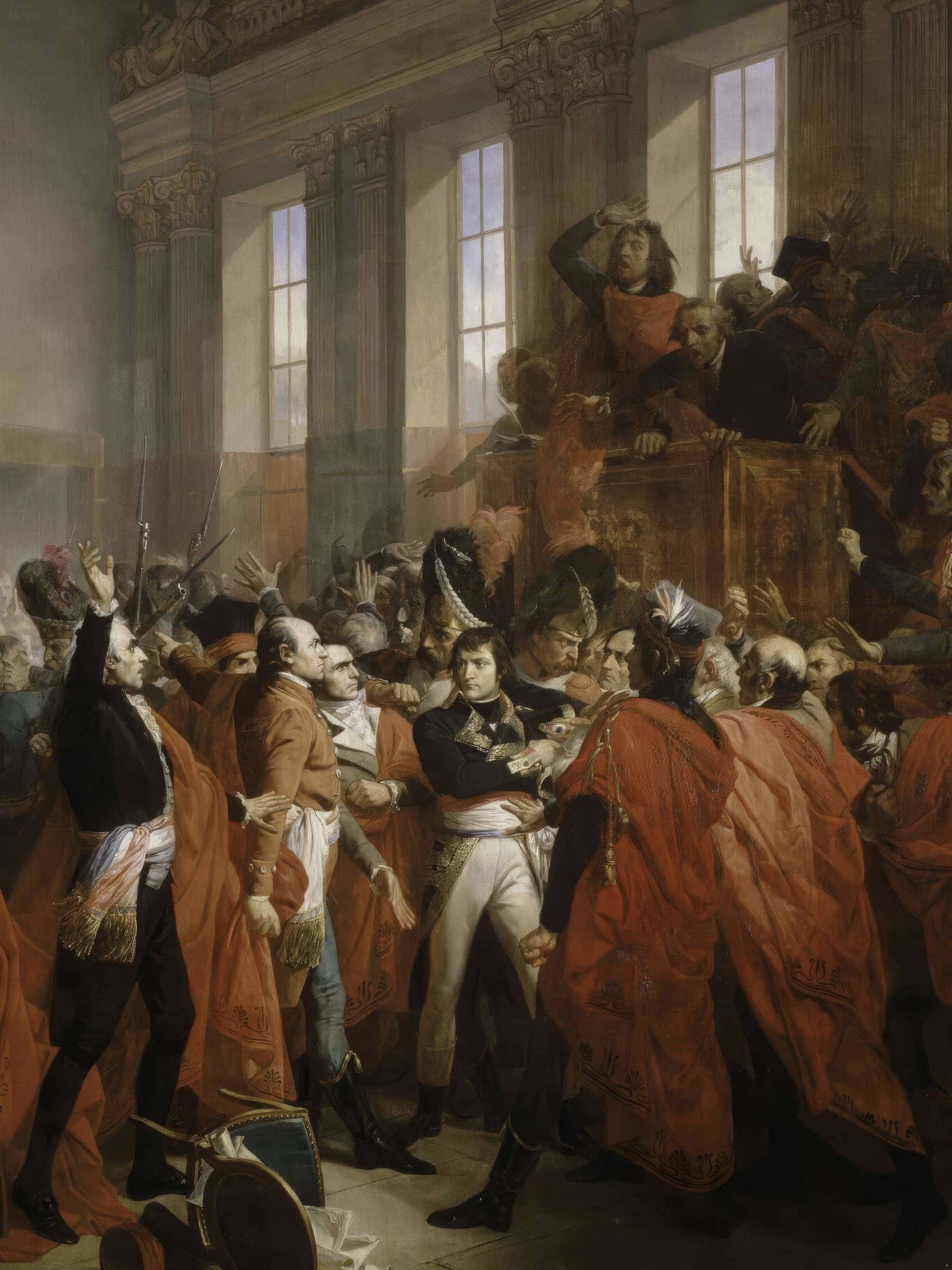
Antoine-Jean Gros (1771–1835)
Bonaparte at the Pont d’Arcole, 17 November 1796. Oil on canvas, 130 × 97 cm (Musée du Louvre, Paris).
The 5° Of Newness
Five Systems For Becoming Harder To Compare, Easier To Cite, And Impossible To Flatten.

Stephen Shaw
Streams compete. Systems compound.™, 2026. Digital tempera-style painting.
The 5° Of Newness
The structural reason five independent investments never compound — and the one architecture that makes them.

service
Step 0: Anti-Commoditisation

François Bouchot (1800–1842)
Napoléon signs his abdication at Fontainebleau, 11 April 1814. Oil on canvas, 309 × 222 cm (Château de Versailles, Versailles, France)
The Fontainebleau Protocol
Disruption intelligence and belief-fracture diagnostics for leadership teams that see the shift but risk moving too late.
service
Step 1: Market Disruption Intelligence

Stephen Shaw
The Uniqueness Protocol 2026. Digital tempera-style painting.
The Uniqueness Protocol
Competitive identity architecture for the company that intends to be commissioned, not compared.
service
Step 2: Competitive Identity Architecture

Stephen Shaw
The Quiet Settlement 2026. Digital tempera-style painting.
The Pre-Decision Advantage
Upstream work for the founder naming the field — not those evaluated against it.
service
Step 3: Upstream Market Authority

Stephen Shaw
The Five Architectures Of Canon™ 2026. Digital tempera-style painting.
The Canon Effect
Why some bodies of work compound — and most become a backlog.
service
Step 4: Compounding Publishing Capital

Stephen Shaw
Time did not merely spare the Pantheon. Time authenticated it. 2026. Digital tempera-style painting.
The Compounding Website
Human readers see pages. Machines see a knowledge system.