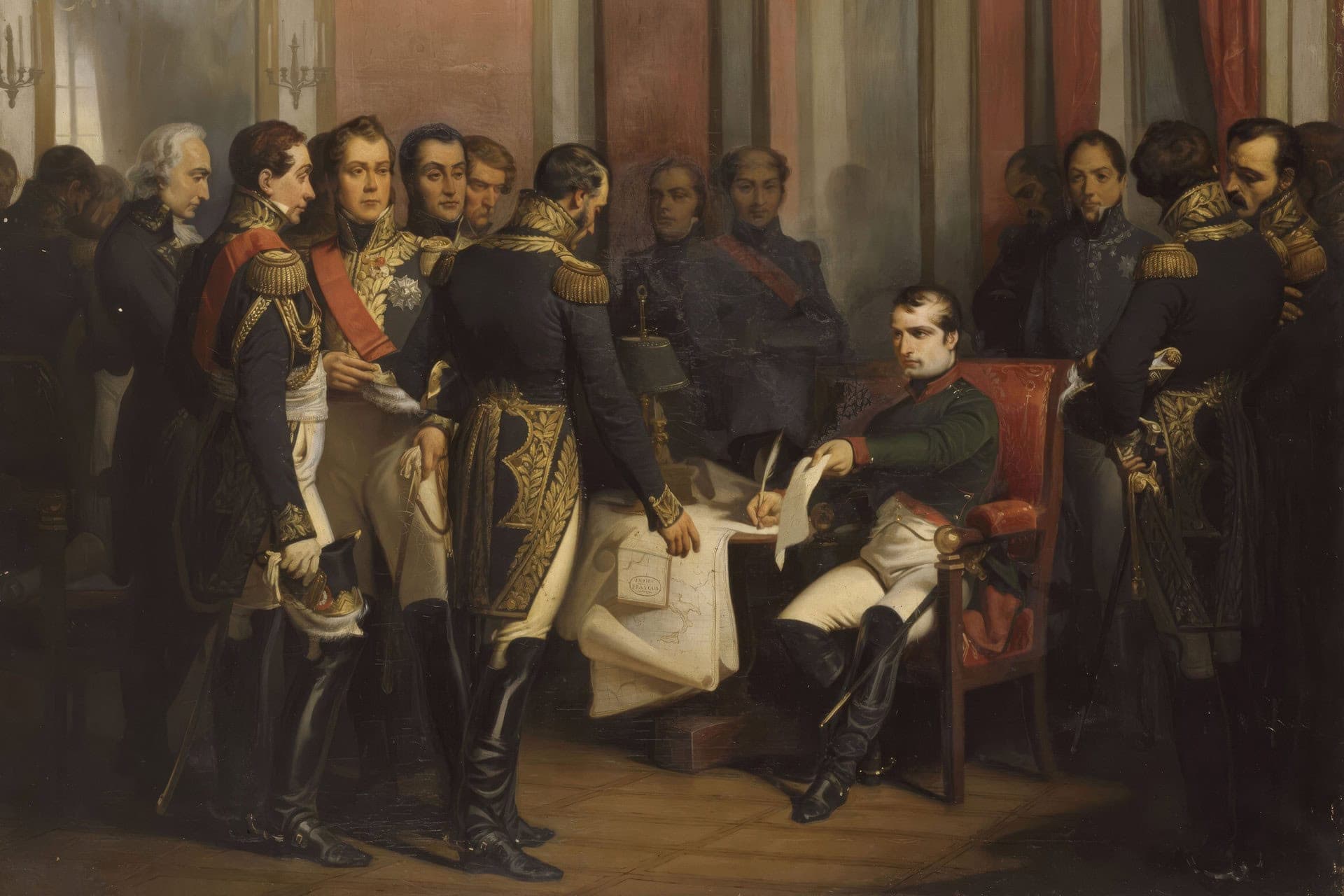
François Bouchot (1800–1842)
Napoléon signs his abdication at Fontainebleau, 11 April 1814. Oil on canvas, 309 × 222 cm (Château de Versailles, Versailles, France)
see tomorrow sooner
Spot collapse signals before they normalize.
Whether capital, infrastructure, or brand equity — insulate against black swans and collapsing assumptions.
Replace Heroics With Logic
Move On Evidence. Not On Nerve.
Not the executive who saw it, raised it, and waited for proof. The one who had documented the trigger before the proof arrived.
Author the next story
Be Studied, Not Taught As Cautionary Tale.
Join Reed Hastings, not John Antioco in business history.
Service Definition:
How do you know when a market shift requires a change in strategy — before proof closes your options?
Every strategy rests on a premise about the world. The danger is not simply that the premise becomes wrong. It is that the strategy can keep working long enough to make the old premise look right.
The Fontainebleau Protocol™ is An Artful Science’s market disruption intelligence service for professional-services firms that need to determine whether early changes in customer behaviour, competitor movement and category language signal temporary variation or structural change in the premise beneath their strategy.
The methodology runs from diagnosis to response. The Antioco Test™ tests the strategic premise and produces the Reality Distance Score; the Strategic Advantage Operating System™ converts that diagnosis into triggers, owners and thresholds; the Strategic Repositioning Architecture™ establishes the position required when the existing premise no longer holds.
The result is a board-defensible decision on what to preserve, stop or reposition — made while time, capital and strategic options remain.
Test the premise. Map the shift. Move while options remain open.
Imagine perfecting the horse-drawn carriage the year Ford built the Model T. That’s how most industry collapses begin.
It’s what Kodak did with film.
Not with confusion. Not with ignorance.
And not with slow reaction.
But with experience doing exactly what it had been trained to do.
- Kodak didn’t ignore digital photography. It invented it.
- Blockbuster didn’t misunderstand Netflix. Its leadership ran the numbers, studied the model, and walked away.
- Swiss watchmakers didn’t miss quartz. They built it — and dismissed it as the wrong kind of watch.
In each case, the data was sound.
The logic was defensible.
The decisions made sense.
That’s what makes the pattern so unsettling.
Because the most dangerous failures don’t come from being wrong. They come from being right — at exactly the wrong moment.

Steven J. Sasson (Kodak)
Prototype Digital Camera, 1975, mixed electronic components and optics (Smithsonian National Museum of American History, Washington, D.C.).
- Kodak understood that digital photography would destroy margins.
- Blockbuster understood that streaming would upend stores.
- Swiss watchmakers understood that quartz would change the industry.
They didn’t misread the future.
They predicted it accurately.
And still couldn’t move.

Seiko Corporation
Seiko Quartz Astron 35SQ, 1969, quartz wristwatch (Seiko Museum, Tokyo).
In the case of Blockbuster, this wasn’t abstract. It came down to interpretation.
John Antioco saw the same data everyone else did — and interpreted it as something to contain.
So did the founder of Netflix, Reed Hastings — and interpreted it as something that demanded abandonment.
The difference wasn’t knowledge. It was what that knowledge was allowed to invalidate.
Because when collapse begins this way, the warning signs don’t feel like warnings. They feel like good judgment.
They surface quietly — in how leaders explain what they do, in the language they reach for without thinking.
“Traditional.”
“Full-service.”
“Premium.”
“Relationship-based.”
These words don’t signal decline.
They signal certainty.
They appear when a business is still working, still respected, still winning — but beginning to explain itself more than it questions itself.
At that point, nothing feels broken.
Revenue still arrives.
Customers still renew.
The strategy still holds.
And this is where interpretation begins to slip.
Not dramatically. Just enough to matter.

Pieter Bruegel the Elder (c. 1525–1569)
The Blind Leading the Blind (De blinden), 1568, oil on canvas, 86 × 154 cm (Museo di Capodimonte, Naples).
Because the better you get at yesterday’s game, the harder it becomes to see tomorrow arriving.
Excellence doesn’t create blindness.
Excellence is blindness.
Over time, that expertise stops guiding decisions and starts defining identity.
- Kodak became film.
- Swiss watchmakers became craftsmen.
- Blockbuster became stores.
And once identity fuses with the business model, alternatives don’t merely seem risky. They stop sounding legitimate.
Change no longer looks like progress. It looks like self-betrayal.
This is how belief systems take hold.

Dave Gray
The Pyramid of Belief (Experience–Assumptions–Conclusions–Beliefs), hand-drawn conceptual model illustrating belief formation and constraint, associated with Liminal Thinking.
Markets aren’t economic systems. They’re belief systems. As long as belief holds, nothing changes. When belief breaks, everything breaks.
- Everyone believes taxis need medallions — Uber is impossible. Until belief shifts. Then it’s inevitable.
- Everyone believes photos need printing — Instagram is absurd. Until it isn’t.
- Everyone believes work requires offices — remote work can’t work. Until suddenly it does.
WeWork proved this in reverse.
Worth $47 billion one week.
Worth $8 billion the next.
Same offices.
Different belief!
And that fracture doesn’t first announce itself in the numbers.
It appears first in people.
- Employees sense it before anyone else. You hear it in how they speak—less future tense, more defense of what already exists.
- Then customers feel it. They stay, but without conviction. Loyalty becomes performance.
- Only later does the market make it official. What once sounded radical becomes reasonable. Then inevitable.
By the time that shift becomes obvious,
the outcome is no longer being decided.
It resolves, on a clock.

1. Win the Right Game
Stop being celebrated for mastering a market that is quietly disappearing. Be remembered for redefining the arena before anyone else realised it was changing.

2. Compete Where Advantage Compounds
Move into positions where strength multiplies on its own — and rivals exhaust themselves trying to catch up. Win from structure, not stamina.

3. Move Before It’s Obvious
Act while the future is still discounted — not after consensus makes the price irreversible. The move feels justified before it feels obvious.

4. Make Wins Repeatable
Build performance that survives cycles, scrutiny, and leadership change — not momentum that fades when conditions shift. Be known for durability, not timing.

5. Become What’s Next
Redefine what the company is — before the market forces that decision. Be named in the companies internal mythology as the cohort that saw it first.

6. Leave a System, Not a Story
Install advantage that strengthens after headlines fade and tenure ends. Build something that outlasts personality — and compounds long after the room that built it has changed.
May 1812. An empire at its peak. November 1813. The empire could not be held. April 1814. Napoleon signed his abdication.
The Fontainebleau Protocol™
Empire, Abdication, and the Architecture of Strategic Response.

Paul Delaroche (c. 1797–1856)
Napoleon at Fontainebleau, 31 March 1814, oil on canvas, 69.2 × 53.2 cm (Royal Collection UK).
Recognition × Design
From Observer to Detective
Identify which competitor is engineering your collapse.
Momentum × Navigation
From Detective to Architect
Transform disruption paranoia into competitive certainty.
Evolution × Permanence
From Architect to Legacy
Be remembered as the architect, not the archaeologist.
Tier 1: The numbers were never wrong. The interpretation was.
The Antioco Test
The Antioco Test™ is a single-session diagnostic that scores a company's strategy against its market on six dimensions — a strategic review of the premise, not the plan, calibrated against thirty years of inflection points and delivered as an instrument, not an opinion.

Tier 2: David beat Goliath by design, not luck.
The Reality Distance Score
The Reality Distance Score is the Antioco Test's six-dimension output — Identity, Threat, Permission, Economic, Timing, Interpretation — a single read on the strategic alignment between belief and evidence. Most score 14 or higher; decline begins at 16.

Tier 3: Groupthink never feels like groupthink. It feels like consensus.
Belief-Fracture Detection
Belief-Fracture Detection is the method that finds the gap between what a company says and what it does — the blind spot where an expired belief is still funded and still defended. It names the fracture, and the date it opened.

Tier 4: Ordinary business failure is being wrong. The dangerous kind is being right — at the wrong moment.
The Antioco/Fontainebleau Pattern
The two patterns the Antioco Test™ separates are the innovator's dilemma made diagnosable: Antioco misread the shift; Fontainebleau read it right but moved too late. The Test returns which one a company faces — the two demand opposite responses.

Tier 5: Risk appetite usually measures how much a leader will bet. This measures how much reality they will accept.
The Antioco–Hastings Spectrum
The Antioco–Hastings Spectrum places a leadership team between two documented responses to the same evidence — Antioco, who moved to contain the threat; Hastings, who abandoned the model for it. It turns risk appetite from a temperament into a marked position on a scale.

Tier 6: Analysis paralysis looks like rigour. It is usually a belief the room cannot say aloud.
The Signal & Paralysis Register
The Signal & Paralysis Register maps the forces threatening a company's advantage against the points where its own response is stuck — a ranked grid separating genuine caution from the decision paralysis of a threat that attacks the profit centre.

Tier 7: Red teaming attacks the plan. This attacks the belief the plan is built on.
Scrutiny-First Evidence Validation
Scrutiny-First Evidence Validation puts every finding through three adversaries — a defender of the status quo, a contrarian challenger, a neutral analyst — so the diagnosis has already survived attack before a leadership team stakes a decision on it. Red teaming aimed below the strategy, at the assumption beneath it.

Tier 8: Most companies see the shift in time. Almost none move in time.
The Strategic Advantage Operating System
The Strategic Advantage Operating System™ converts the diagnosis into corporate strategy a company can run — the triggers, owners, and thresholds that fire a response on evidence, not nerve. It is the difference between seeing the game change and being built to move first.

Tier 9: Business transformation redesigns the operation. This redesigns the premise the operation serves.
The Strategic Repositioning Architecture
The Strategic Repositioning Architecture™ establishes the new strategic positioning and the materials to hold it — the business transformation that follows a diagnosis, not a fashion, built so the position survives the market it was made for.
Each capability doesn’t just add to the previous—it builds on it.
SEE (what’s changing) → DESIGN (your position) → BUILD (momentum) → NAVIGATE (paradox) → TRANSFORM (completely) → LOCK (permanently).
The transformation begins with recognition.
The legacy ends with permanence.
Everything in between is the architecture of evolution.
Scroll →
Market & Competitive Intelligence Services (e.g. AlphaSense · Owler · CB Insights)
Trend & Foresight Consultancies (e.g. Future Today Institute · Foresight Factory · The Future Laboratory)
Strategy, Advisory & Management Consultancies (e.g. McKinsey · BCG · Bain)
The Fontainebleau Protocol™ — Test the premise. Map the shift. Move while options remain open.
What you’re actually buying
You're buying visibility. Competitive tracking, earnings-call parsing, pricing monitors, transcript analysis, signal dashboards, and AI summaries help you see more, faster. That is precisely what these platforms are built to do. Information scales. Judgment does not. The system tells you what moved. It does not tell you when the explanation inside the business has stopped matching the world outside it.
You're buying structured thinking. Horizon scanning, Delphi methods, scenario planning, transformation roadmaps, and stakeholder alignment processes create a disciplined way to explore uncertainty. The work is rigorous, logically sound, and defensible under scrutiny. But assumptions are often refined, extended, and modelled — rather than fundamentally reclassified. The strategy becomes more coherent. The underlying logic may already be outdated.
You're buying defensibility. Industry frameworks, capital allocation models, transformation roadmaps, governance gating, and stakeholder alignment processes make strategic action easier to justify. The logic is robust. The slides are rigorous. But timing is often calibrated to consensus and governance thresholds. The recommendation survives scrutiny. The window may not.
In May 1940, the Maginot Line still stood in cold concrete confidence, facing the direction France had been trained to fear, while the real war moved through the Ardennes. The flaw was not intelligence. It was an explanation that remained convincing after it had stopped being true. You are not buying more information, better frameworks, or increased visibility. You are buying interpretation discipline. Intelligence platforms give you weather reports. The Fontainebleau Protocol™ gives you a compass. Weather tells you what is happening. A compass tells you whether you are still heading in the right direction. It does this through belief-fracture detection: identifying where multiple signals can no longer be explained by a coherent model, exposing where current assumptions fail under new conditions, and revealing when the old explanation is still polished, still respected, and already beginning to betray the future.
Know when delay becomes irreversible
You're buying confirmation. S-curve inflection points, adoption benchmarks, competitor capital reallocation, analyst upgrades, and category movement create a stronger basis for confidence. That feels prudent. But market repricing often begins before visible consensus forms — which means the evidence arrives just as freedom begins to narrow.
You're buying optionality. Scenario matrices, strategic option mapping, and plausible-futures modelling keep multiple pathways open in theory. That is useful when the aim is to avoid premature commitment. But capital budgets, hiring decisions, platform choices, and organisational habits narrow flexibility in practice. Optionality exists on paper. Path dependency compounds in reality.
You're buying disciplined delay. Stage-gate governance, steering committees, hurdle rates, and investment refinement improve justification over time. That can make the decision path look increasingly responsible. But while justification improves, strategic freedom quietly contracts.
Strategic failure rarely begins with collapse. It begins when leaders believe time is still flexible. Napoleon did not lose Russia because of one bad decision. He lost because he misread winter as delayable. The first snow was not fatal. The retreat was. That is the hidden law at work here. People call it prudence while time remains and foresight once time has gone. Delay keeps the scent of discipline long after it has become expensive. The Fontainebleau Protocol™ identifies the point at which delay shifts from reversible to irreversible — when belief fracture turns into option loss, when the room still feels calm, the map still looks complete, and the campaign is already being decided somewhere else. By the time consensus forms, the retreat may already have begun.
Avoid Having To Explain Why You Were Late
You're buying a timeline of visibility. Archived alerts, competitor filings, pricing changes, investor transcripts, and signal histories preserve what was visible and when it surfaced. That creates a strong record of observation. It also creates a sharper question later: if the signals were present, why was the interpretation not decisive?
You're buying documented breadth. Probability bands, scenario ranges, and explored futures show that multiple outcomes were considered. That protects against narrow thinking. In hindsight, though, scenario breadth can begin to resemble strategic hedging when one path was already hardening into reality.
You're buying procedural proof. Governance logs, alignment workshops, risk committee validation, and documented board processes make it clear that the decision path was serious and disciplined. That protects the organisation institutionally. The decision may remain procedurally sound. Timing is harder to defend.
History is full of elegant losers — people who could narrate events beautifully once events had made the choice for them. Nokia did not lack data. It lacked reclassification. Executives saw the iPhone. They benchmarked it. They modelled it. But they interpreted it as a device, not a platform. By the time that distinction became obvious, market share had already migrated. Most post-mortems focus on execution. The real failure was interpretive. The Fontainebleau Protocol™ creates a documented logic trail — naming which assumption broke, when it broke, and when delay stopped being stewardship and became exposure. Signals are no longer just inputs to be analysed. They become tests of whether the current explanation still holds. That is how timing becomes defensible before hindsight rewrites it.
In 2000, the offer was fifty million dollars. In 2010, the company that declined it filed for bankruptcy.
The Antioco Test
The outside-in diagnostic that separates Blockbuster from Netflix. Antioco from Hastings. The disrupted from the disruptor.

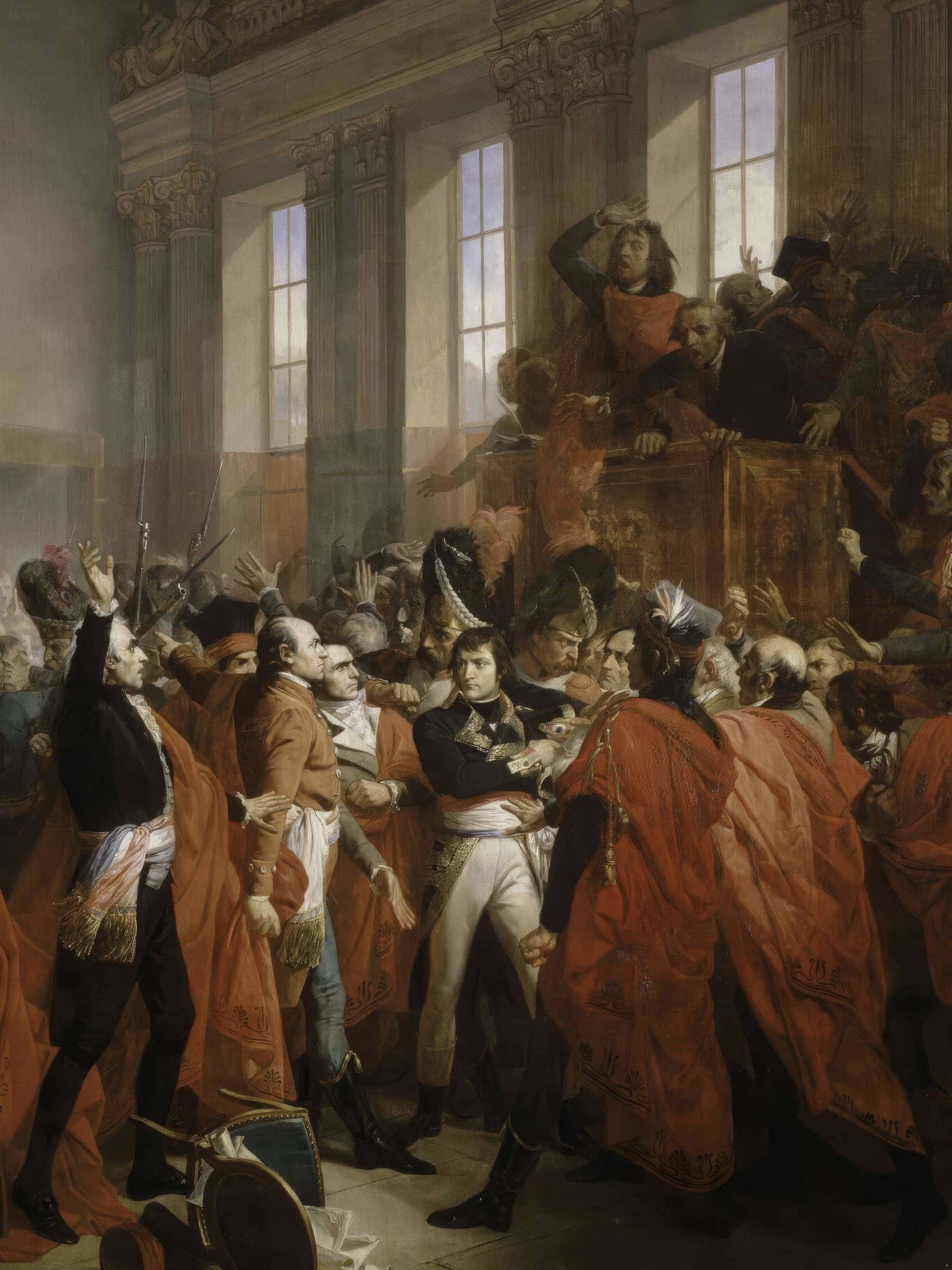
François Bouchot (1800–1842)
General Bonaparte Surrounded by Members of the Council of Five Hundred during the Coup of 18 Brumaire. 1840, oil on canvas, 380 × 521 cm (Château de Versailles).
Take the Antioco Test
A quantified Reality Distance Score across six dimensions — Identity, Threat, Permission, Economic, Timing, Interpretation. Most CEOs score 14+. Decline begins at 16.
A Story About Seeing
FAQ
Write tomorrow's rules while others perfect yesterday's.

Joseph Beaume (1796–1885)
Napoleon’s Departure from Elba. 1836, oil on canvas, 600 × 972 cm (Musée de l’Armée, Paris).
What is the innovator’s dilemma?
The innovator's dilemma is Clayton Christensen's finding that successful companies can fail by doing exactly what has always worked — serving their best customers and protecting their strongest margins — while a cheaper, worse alternative takes the market from underneath them.
That describes a company that did not see the shift coming. There is a second failure, and it looks nothing like the first:
- Kodak built the first digital camera in 1975 — and shelved it to protect film.
- Blockbuster was offered Netflix for $50 million in 2000 — and declined to protect stores.
- Swiss watchmakers built the first quartz wristwatch in 1967, two years before Seiko shipped one — and sold it as jewellery to protect mechanical.
None of them misread the shift. Each predicted it accurately, wrote down what it meant, and could not act on their own analysis. Kodak filed for bankruptcy in 2012. Blockbuster in 2010. Swiss watch employment fell from ninety thousand to thirty thousand.
What stopped them was not the evidence. By then film, stores and mechanical were not what these companies made. They were what the companies were.
So the dilemma is not really about missing a shift. It is about what a correct prediction is allowed to invalidate.
The two demand opposite responses, and they look identical in a boardroom. One company needs to be shown what it is missing. The other needs permission to act on what it already knows.
What is the Fontainebleau Protocol™?
Every strategy answers one question — how do we win in this market. The Fontainebleau Protocol™ asks the one beneath it: is this still the market we are in?
Through the winter of 1813 and into the spring of 1814, Napoleon was offered peace on terms that worsened with every refusal. He held out for the season's earlier offer, not seeing that each month he waited the deal on the table shrank. By that spring there was none. At Fontainebleau, he signed his abdication.
The Fontainebleau Protocol™ is An Artful Science’s market disruption and competitive intelligence service for that exact moment. A diagnostic that tests whether the premise a company's strategy rests on has quietly expired — because winning a game whose rules have changed is not a strategy, it is a faster way to lose.
It runs in three phases, each commissioned on its own.
- The Antioco Test™ scores a market's disruption signals across the six dimensions of the Reality Distance Score in a single session.
- The Strategic Advantage Operating System™ converts that diagnosis into a decision architecture — the triggers, owners, and thresholds that fire a response on evidence rather than nerve.
- The Strategic Repositioning Architecture™ establishes the new position and what it takes to hold it.
Most commissions never run the full chain; each phase stands alone. It is a scored instrument, not a recommendation — it does not tell a company what to do, but what game it is actually in.
What evidence is the Antioco Test calibrated against?
The Antioco Test™ is calibrated against the documented behaviour of executives at structural inflection points across thirty years of business and military history — leaders who faced a shift, whose decisions are now a matter of record.
Dick Fuld in the final months of Lehman Brothers; John Antioco at Blockbuster, the case that gave the Test its name; and others where the archive preserves both the executive's reading at the time and the responses then available to them.
That second condition is what makes the calibration unusual.
A conventional situation analysis or strategic review records what a leader did; it rarely records what they could have done, and the exact moment that option closed.
The six dimensions of the Reality Distance Score — Identity, Threat, Permission, Economic, Timing, Interpretation — correspond to the failure conditions these cases make visible, and are calibrated on the cases, not asserted from theory — the Protocol's discipline of Scrutiny-First Evidence Validation. A company's own situation is the variable measured against them.
It measures a company not against its own assumptions but against those who faced the same shift — which is why the output is a score, not an opinion.
Is the Fontainebleau Protocol an alternative to competitive-intelligence platforms like AlphaSense or CB Insights?
The difference is easy to miss until you have watched it play out. Picture the best-resourced team in the category: a full AlphaSense subscription, CB Insights dashboards, every filing and funding round the moment it lands.
They see everything — and they are still late, because they are reading all of it through a picture of the market that stopped being true a year ago. That is the distinction.
Competitive intelligence services sell a standing data feed — a sharper, faster picture of what competitors and markets are doing. They answer what is happening? The Fontainebleau Protocol™ answers the prior question: is the frame you are reading it through still correct? More coverage does not close that gap. The disconfirming signal arrives — the competitor move, the shift in the numbers, the customer who stops behaving as the model predicts — but a frame that has quietly expired files it as noise, and confidence rises as the error compounds.
You were not under-informed. You were confidently wrong — the more expensive of the two, and the one no feed can price.
A company reading its market through a dead premise is the turkey that logs a thousand data points confirming the farmer is benevolent, right up to the week before Christmas: the data was never missing; the frame it was read through was.
This is why the Protocol is market disruption intelligence, not competitive intelligence software — and why it is scrutiny-first, not data-first. It adds nothing to what you already see. It tests what you have concluded from it: the one dimension a platform cannot score — not the Threat, the Timing, or the Economics of the market, but your Interpretation of it.
The Fontainebleau Protocol™ does the one thing it cannot. A competitive intelligence platform improves what you see. The Fontainebleau Protocol™ tests whether you're still reading it correctly.
When is it too late to reposition after a market shift?
Rarely as late as it feels — and the reason is counterintuitive.
Repositioning runs on a two-window model. In the first, the premise has expired but the responses that would work remain open, and repositioning is comparatively cheap. In the second, the premise and the options have both gone, and only damage control remains.
Most companies wait for certainty before they move — the trap, because the proof they wait for is the same event that closes the window.
Intel has occupied both.
In 1985 it read the first window exactly: as Japanese memory chips overwhelmed it, profits fell from $198 million to under $2 million, and Andy Grove — the premise expiring, the response still open — left the memory business Intel was built on for microprocessors. Within a decade that move had made Intel the defining company of the personal-computer era; the memory it left became a commodity it would have died defending.
The second window is the harder one, because it can close while every number says it is still open. In 2025, Intel raised $20.36 billion from strategic and government backers; the customers its entire strategy exists to win — companies paying to have their chips made in Intel's factories — paid it $307 million.
That is 66 to 1: for every dollar from a customer, sixty-six came from a government or investor who just needs Intel to exist.
Our diagnosis reads the gap as interpretive, not executional — the assumption that customers will come if the execution holds may already have settled as false, while Intel keeps funding it as though it holds.
By the time you can prove which window you are in, you are already in the second. The question is never how late — only whether the window is still open, and whether you can still tell.
Isn't this just another strategy consulting service?
It shares the rigour — and turns it on the one question strategy consulting skips.
Conventional strategy consulting services — McKinsey, BCG, Bain, or a boutique built on the same model — sell defensibility: frameworks, capital models, and a recommendation built to survive the board’s scrutiny.
Strategy consulting of that kind assumes the company already knows which problem it is solving, and optimises the answer. The Protocol assumes nothing of the kind — the Antioco Test™ tests whether the company is solving the right problem at all. And here rigour is no protection; it is the risk.
In 1985 Coca-Cola tested a new formula on roughly 200,000 people, 61% preferred it, and the company launched — then reversed within 79 days. The research was flawless; the premise was wrong. The question was never which cola tastes better but what the brand meant — and every additional test only deepened the company's confidence in the wrong question.
The output is a scored diagnosis, not a slide deck. A strategic advisory or corporate strategy consulting helps a company answer its question better. This asks whether it is the right question.
We have a strategy team and a recent review — why commission this?
A strategy team is essential — and it is also why the frame goes unexamined.
A strategic review stress-tests execution within the strategy: the plan, the targets, the resourcing. What it cannot test is the premise the strategy rests on, because that premise is the assumption the team reasons from, not one it reasons about — the eye the company sees with, not an object in its field of view.
That divergence, the operating belief already false but still defended, is what Belief-Fracture Detection isolates.
And this is not a competence problem: sharper strategists make it worse, because the better the team, the more coherently it defends the frame.
In 1967 the Swiss CEH laboratory built the first quartz movement — two years before Seiko shipped one — and Switzerland's master watchmakers dismissed it, because "mechanical" was what watchmaking meant to them. Swiss watch employment fell from roughly 90,000 to 30,000. They were not out-thought; they were defended by their own expertise.
The businesses that commission this do not doubt their strategists — they know the costliest blind spot is the one invisible from where they stand. A review tests the strategy. It cannot test the assumption the strategy is made of.
What if our premise is still sound?
Then the fee has bought the most valuable result a diagnosis can return — and the assumption hidden in the question is worth naming: that a diagnosis earns its keep only by finding something wrong.
The Antioco Test returns a Reality Distance Score across six dimensions, and a low score is not a null result. It is the company's governing premise tested against thirty years of documented failure, rather than assumed — and an untested belief and a verified one feel identical from the inside, right up until the moment they diverge.
Most businesses have never run that test; they trust their premise because they have never checked it. A result that finds nothing is not nothing.
In 1887 Michelson and Morley set out to measure the Earth's motion through the aether and detected none — and that null result dismantled the premise of classical physics and made relativity necessary. It was the experiment that found nothing and remade the field.
And the economics are asymmetric in a way a CFO reads at a glance: the Test is a fixed, modest fee; the strategic risk it checks for — a governing premise that has quietly expired — is the kind that ends companies. A small known cost set against a large unknown one is not an expense. It is insurance.
A diagnosis that finds nothing is not a wasted fee. It's the cheapest insurance a company can buy against the most expensive mistake it can make.
How is confidentiality handled?
Confidentiality is governed by a mutual non-disclosure agreement signed before the Antioco Test™ session.
Every finding, document, and discussion is confidential to the commissioning executive and anyone they explicitly authorise, and no client is named publicly without written permission.
This matters more for a disruption diagnostic than for most engagements, for a structural reason: the instrument's value is that it names an uncomfortable truth plainly — that a governing premise has expired, that the most profitable line is now the vulnerability — and it can only do that if the diagnosis stays private.
A finding written to be safe to circulate is a finding written to be ignored. Where the work extends into repositioning, the constraints that must be respected — the actors that cannot be named, the claims that cannot be made — are captured at kickoff and adhered to throughout.
The diagnosis is delivered to the commissioner, in writing, as a private document. Candour is the whole product — and candour and exposure cannot occupy the same page.
Why is it called the Fontainebleau Protocol?
Fontainebleau is the palace where Napoleon signed his abdication, in April 1814. By then his intelligence was excellent and his own marshals had told him plainly, for months, that the empire could not be held.
The terms had been there to take: the natural frontiers offered at Frankfurt in November 1813, then — as those lapsed — the narrower borders pressed at Châtillon in February 1814, the offers contracting one to the next until only abdication remained.
His reading of the situation was correct the entire time. What defeated him was that the architecture of available responses closed faster than his willingness to commit to any of them.
That is the Fontainebleau pattern — the more dangerous of the two failure modes the Protocol detects, and the counterpart to the Antioco pattern of simply misreading the shift. Not the failure to see, but the failure to act while the options are still open.
The service is named for the failure it exists to prevent: the leader who reads the situation correctly, and still moves too late.
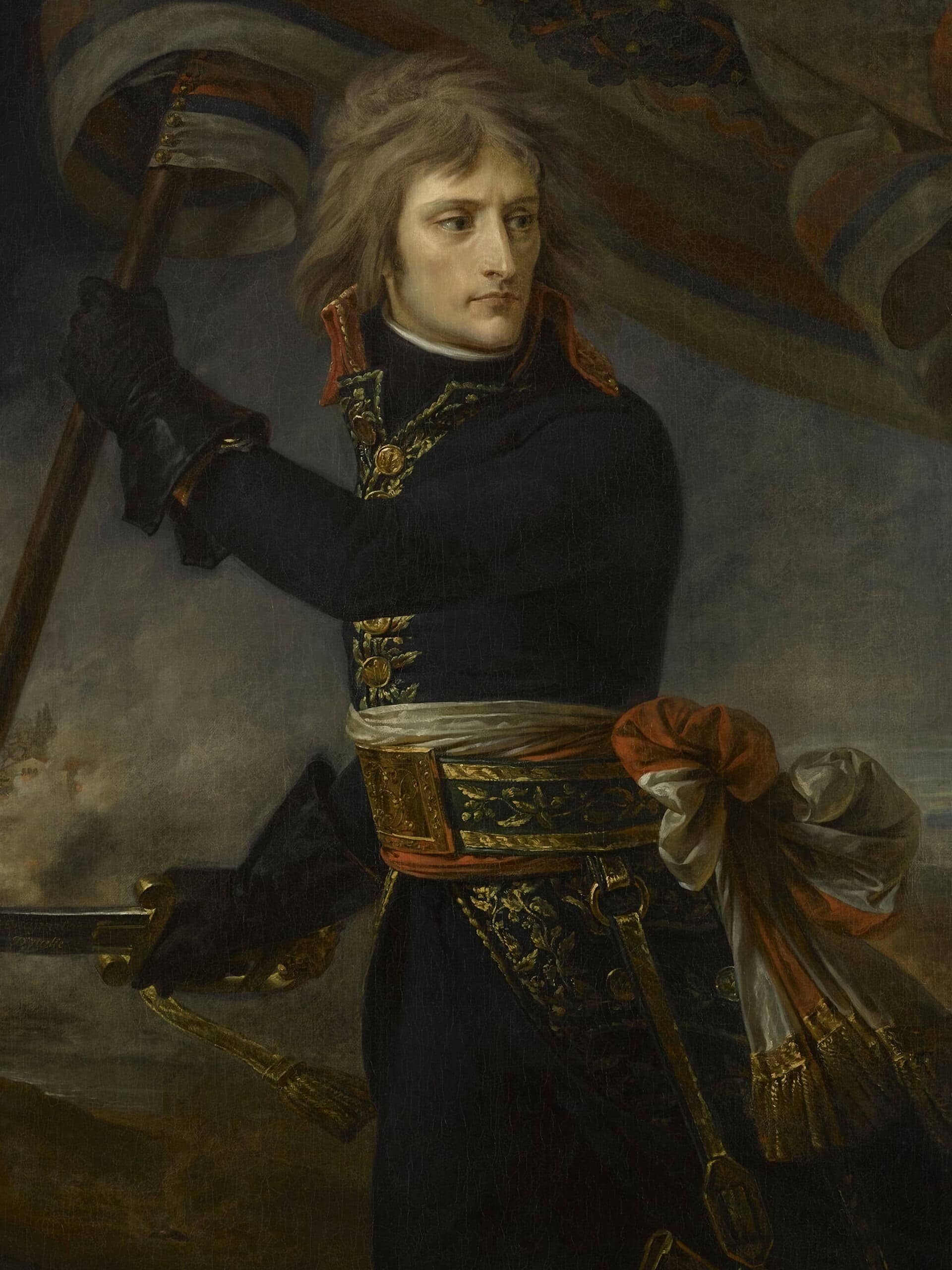
Antoine-Jean Gros (1771–1835)
Bonaparte at the Pont d’Arcole, 17 November 1796. Oil on canvas, 130 × 97 cm (Musée du Louvre, Paris).
The 5° Of Newness
Five Systems For Becoming Harder To Compare, Easier To Cite, And Impossible To Flatten.

Stephen Shaw
Streams compete. Systems compound.™, 2026. Digital tempera-style painting.
The 5° Of Newness
The structural reason five independent investments never compound — and the one architecture that makes them.

service
Step 0: Anti-Commoditisation

François Bouchot (1800–1842)
Napoléon signs his abdication at Fontainebleau, 11 April 1814. Oil on canvas, 309 × 222 cm (Château de Versailles, Versailles, France)
The Fontainebleau Protocol
Disruption intelligence and belief-fracture diagnostics for leadership teams that see the shift but risk moving too late.
service
Step 1: Market Disruption Intelligence

Stephen Shaw
The Uniqueness Protocol 2026. Digital tempera-style painting.
The Uniqueness Protocol
Competitive identity architecture for the company that intends to be commissioned, not compared.
service
Step 2: Competitive Identity Architecture

Stephen Shaw
The Quiet Settlement 2026. Digital tempera-style painting.
The Pre-Decision Advantage
Upstream work for the founder naming the field — not those evaluated against it.
service
Step 3: Upstream Market Authority

Stephen Shaw
The Five Architectures Of Canon™ 2026. Digital tempera-style painting.
The Canon Effect
Why some bodies of work compound — and most become a backlog.
service
Step 4: Compounding Publishing Capital

Stephen Shaw
Time did not merely spare the Pantheon. Time authenticated it. 2026. Digital tempera-style painting.
The Compounding Website
Human readers see pages. Machines see a knowledge system.