
Stephen Shaw
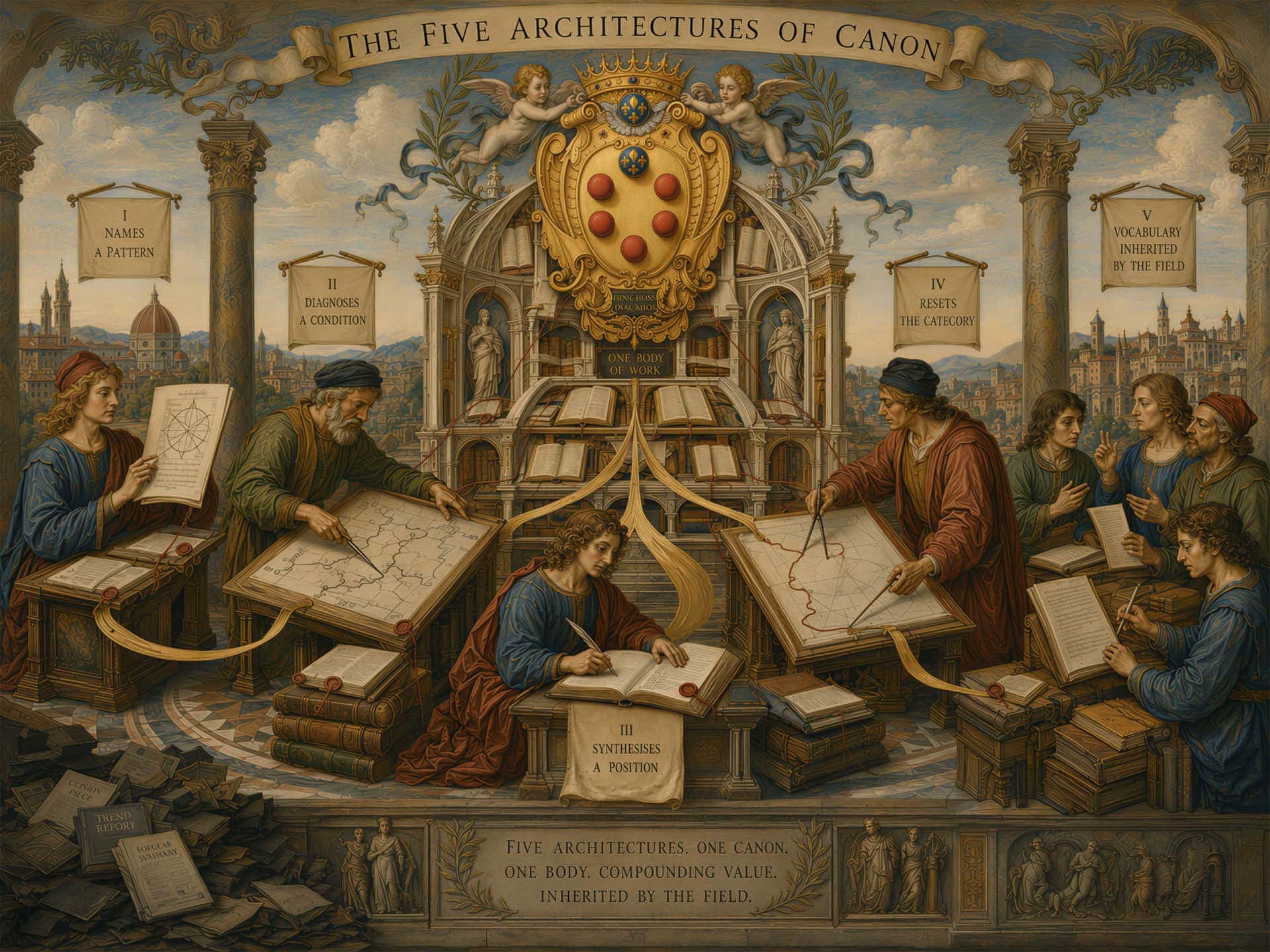
The Five Architectures Of Canon™ 2026. Digital tempera-style painting.
Stop the Depreciation
Each new post strengthens every prior one — marketing expense becomes a balance-sheet asset.
What competitors expense as marketing, you compound as intellectual capital.
Be Interpretable
Most companies publish bulletins. The winners build canons.
Design for the reasoning interface — so AI systems recognise your domain as an integrated authority, not isolated pages.
Author The Canon
The body of work the architecture sustains — long after the founder has stepped back.
McKinsey Quarterly: sixty years, hundreds of authors. The architecture compounded, not the editor.
Service Definition:
After years of publishing, what commercial asset does your company actually own?
Publishing creates an archive automatically. It does not create authority automatically. When every article, case study or framework begins again, the library gets larger while the value of everything already published stays much the same.
The Canon Effect™ is An Artful Science’s thought leadership and B2B content marketing service for specialist consultancies, advisory practices and professional-services firms that need their published expertise to accumulate into a coherent body of work.
The Canon Diagnostic™ finds where publishing has produced output without cumulative authority. Inheritance Architecture™ connects the work so each new publication strengthens what came before, while the Nine Gates™ determine whether a new contribution earns its place in the body of work at all.
The result is intellectual capital the business can keep extending: new thinking makes the existing body of work more useful, authority accumulates around a position rather than individual publications, and future leadership inherits something larger than the archive it was given.
Diagnose the break. Shape the field. Crystallise the authority.
In 2004, Google formalised a new kind of power. Ten blue links. One scoreboard. An industry reorganised itself.
Climb the list and you were seen. Be seen often enough and you were trusted. Optimise the page. Rank higher. Capture attention.
It worked.
Because under ranked search, visibility was advantage. The underlying assumption was simple: win position, win authority.
For nearly two decades, that assumption held.
Then, in November 2022, OpenAI released ChatGPT to the public.
Within months, users were asking it questions they had once typed into search engines. In 2023, generative summaries appeared above the links.
The answer no longer required a click. Users stopped scanning ten options. They read one synthesis.
The interface shifted from ranking to reasoning. And when the interface shifts, the advantage shifts with it.
Most organisations are still optimising for the previous interface.
That is the fracture.

Stephen Shaw
The Scoreboard Breaks 2026. Digital tempera-style painting.
A Fortune 500 CFO opened ChatGPT in October 2025 and typed a question about a strategic shift in her industry.
The model returned a synthesis — three named sources, a structural argument, an institutional recommendation. Her firm had published over five hundred pieces on that topic.
None appeared in the response.
ChatGPT had crawled it, indexed it, processed it. It had simply chosen not to reason through it.
The problem was not visibility. The problem was the form the body of work took.

Stephen Shaw
Read But Not Chosen 2026. Digital tempera-style painting.
In Forrester’s 2026 State of Business Buying research, ninety-four percent of B2B buyers now use AI in their purchasing process.
AI synthesis does not read individual pieces. It reasons through bodies of work — looking for the shape of an integrated position. And it treats publishing the way the common law treats precedent.
To understand what the new interface rewards, watch what one legal tradition does that another cannot.
In England, a 1750 ruling can decide a case in 2026. Common law accumulates — each ruling read in light of every prior one. The body of law grows more relevant as it grows older.
In France, the code forbids it.
Article 5 of the Civil Code — written in 1804 and still in force — prohibits judges from deciding by general rule. A ruling settles the case in front of it. It does not become law for the next one.
Common law compounds. Civil law applies.
The architecture decides which is which.

Stephen Shaw
The Court Of Precedent 2026. Digital tempera-style painting.
Most operations publish like civil law. Each piece settles its own question and stops there.
The operations that compound publish like common law. The 2015 essay is still the foundation of arguments being made today.
Three organisations have done this for decades.
- Buffett wrote his first Berkshire letter in 1965 and has been building inside the same architecture ever since.
- Thompson published the first issue of Stratechery in 2013 and has been writing inside one continuous framework ever since.
- McKinsey Quarterly launched in 1964 and has compounded across hundreds of authors since.
Three operations. Three time horizons.
One architecture.
Each piece inherits from every prior piece. The vocabulary deepens through cross-reference. The body of work compounds as a single intellectual object — not because the writing is exceptional, but because the inheritance architecture between the pieces is.
The mathematics make this visible.
Most archives operate on The Accumulation Function:
A = nV
Each piece adds a fixed value. A 500-piece content operation with average per-piece reach V produces total reach 500V. The 2019 article does not strengthen the 2024 one. The archive sums.
Canon-form bodies operate on The Canon Function:
A = V × (1 + ρ)ⁿ
Each piece inherits from prior pieces at inheritance density ρ — and each prior piece accrues value as later pieces extend it.
Stratechery, thirteen years on, has produced over 2,000 publications. The body of work cross-references at high density. The authority value scales exponentially with n.
The two functions produce different outcomes.
At piece 10, they look similar. At piece 100, they diverge. At piece 500, they belong to different asset classes.
Most companies publish at A = nV.
Canons build at A = V × (1 + ρ)ⁿ.

Stephen Shaw
The Canon Function™ A = V × (1 + ρ)ⁿ 2026. Digital tempera-style painting.
But the equation alone does not explain how ρ gets produced.
Look closer at the publications themselves.
The methods are not the same.
- Thompson’s Aggregation Theory (2015) did one thing — it named a pattern. It was eight hundred words. It gave the field language for what hundreds of thousands of words had failed to.
- Buffett’s annual letter does something else. Each one synthesises Berkshire’s position on whatever the market is currently arguing — interest rates, indexing, succession, the dollar. The letter is the firm’s current reading of the field.
- McKinsey’s War for Talent (1998) did something different again. It diagnosed a condition — the structural shortage of executive talent that would reshape corporate strategy for two decades. The HR discussion has been conducted in McKinsey’s vocabulary ever since.
The pattern is older than the interface.
The Royal Society has compounded since 1665. Euclid’s Elements for two thousand three hundred years.
The search era was the historical anomaly.
Twenty years in which ranked search rewarded discrete artefacts over coherent bodies of work.
AI synthesis is not introducing a strange new requirement. It is returning commerce to how authority has been recognised throughout most of recorded time.
The interface no longer asks: “Which page ranks highest?”
It asks: “Which body of work best explains the field?”
That shift reorganises authority itself.
Because bodies of work that compound begin to organise themselves predictably.
- One form names the pattern.
- Another diagnoses the condition.
- Another returns repeatedly to reinterpret the field as conditions change.
- Another reframes the category entirely.
- And eventually, from the interaction between them, something else emerges. The inherited vocabulary of the field itself.
Five architectures.
One body of work.
Most operations cannot publish this way — not because the content is weak, but because the architecture that produces inheritance was never installed.

Stephen Shaw
The Five Architectures Of Canon™ 2026. Digital tempera-style painting.
Look closer at the painting.
Not at the five figures.
Above them.
The Medici crest.
Five red Medici spheres — the palle — arranged above five recurring forms beneath them.
A Florentine merchant in the fifteenth century could walk from the cathedral to the river and encounter the Medici spheres dozens of times before reaching the bridge. Fading above chapel ceilings. Pressed into wax contracts. Cut into weathered banking halls.
The spheres themselves were simple. What mattered was the relationship between them.
Each appearance strengthened the last.
Over time the spheres came to signify something much larger — banking, patronage, political power, dynastic inheritance, Florence itself.
That is The Canon Effect™
Not through interruption. Through publication inheritance.
The Medici did not build power because the symbol appeared everywhere. The symbol appeared everywhere because the architecture compounded.

1. Target the Belief
Classify every customer belief before a single word is written. Stop publishing topics. Start moving minds. The question was never how to publish more. The equation was. A = V × (1 + ρ)ⁿ is what closes the fracture.

2. Compound Each Piece
Publish without filler. Every publication carries a structural job. The first names a pattern. The second diagnoses a condition. The third synthesises a position. The fourth resets the category. The fifth is what emerges. The calendar stops counting publications. It starts compounding them.

3. Become the Reference
Industry analysts cite your frameworks. Competitors quote your terms. Clients arrive already convinced — the first conversation was won upstream of it.

4. Hold the Moat
Each publication adds intellectual territory. The moat compounds across years — competitors quote the work but cannot replicate the position. Late entrants find the ground already taken.

5. Reach Without Showing Up
Publications enter boardrooms, Slack threads, internal memos. Each piece carries the operation's accumulated thinking with it — readers encounter not a single article, but the body of work behind it.

6. Confirm, Don’t Convert
No CTAs. No lead magnets. No conversion moment. The commercial relationship is confirmed across publications the buyer was already absorbing — by the time the meeting happens, the case is already made.
5 canons. 9 gates. 1 equation
A = V × (1 + ρ)ⁿ
Most companies publish posts. The winners build canons. The math decides which.

Stephen Shaw
The Canon Fundamentals 2026. Digital tempera-style painting.
Stake The Ground
Publisher → Editor
Two architectures move the upstream reader and hold the commercial relationship.
Publish The Reader Funnel
Editor → Canon-builder
Five publication methods move the upstream reader through the body of work.
Compound The Canon
Canon-builder → Author
The Nine Gates produce ρ. The book emerges from density.

Tier 1 — A content audit counts what a business has published. This measures whether any of it earned authority.
The Canon Diagnostic
The Canon Diagnostic™ is the content audit that reads a business's publishing the way an AI does — as one connected body, not a list of posts — and finds where a content strategy produced output but no authority. It returns the fracture that stops the work compounding.

Tier 2 — A content hub stores what a business knows. This makes each piece increase the worth of the last.
Inheritance Architecture
Inheritance Architecture™ is the knowledge management that connects a business's publications so each inherits from and strengthens the ones before it — the structure that turns a pile of content into topical authority. Without it, the archive grows but its value never does.

Tier 3 — Evergreen content lasts. This compounds — the difference between saving money and investing it.
The Canon Function
The Canon Function™, A = V × (1 + ρ)ⁿ, is the mathematics of a compounding body of work: each publication inherits from prior ones at density ρ, so a business's intellectual capital scales exponentially with publication count, not one piece at a time.

Tier 4 — A content funnel sorts readers by intent. This changes what they know at each rung.
The Reader’s Ladder
The Reader's Ladder™ is the content funnel built as a sequence of publications, each taking a reader further than the last until they reason in a business's terms. It is lead nurturing by education — qualified by what a reader now understands, not what they clicked.

Tier 5 — Thought leadership content is written to be read. This is written to change one thing.
The Five Methods
The Five Methods are the content types the Canon Effect™ uses, each doing one cognitive job — revealing a pattern, diagnosing a condition, resetting an assumption, naming a threshold, or installing vocabulary. A piece that does none of the five is activity, not authority.

Tier 6 — Content governance sets rules for publishing. This decides what never gets published at all.
The Nine Gates
The Nine Gates™ are the nine adversarial checks every publication passes before release — the editorial guidelines that judge not how a piece is written, but whether it earns its place in the body of work.What they reject is what keeps the canon compounding.

Tier 7 — A brand voice controls how a business sounds. This controls the words a market thinks in.
The Canon Codex
The Canon Codex™ is the operating vocabulary every publication cross-references — a messaging framework raised to the level of a field's language, the terms a market adopts to reason about the category. When an audience argues in a business's words, the argument is already won.

Tier 8 — Lead generation chases strangers. The already-convinced arrive on their own.
The Commercial Bridge
The Commercial Bridge™ is the lead generation architecture that carries a known reader from editorial relationship to commercial engagement with no promotional seam — demand generation replaced by demand that already exists. The customer is the result of the body of work, arriving when ready.

Tier 9 — Most people write a book to build authority. This extracts the book from authority already built.
The Book Extraction Blueprint
The Book Extraction Blueprint™ inverts how to write a book — not starting from a blank page, but crystallising the argument a business's published body of work already proves. The business book is extracted from the canon: evidence of authority the market granted, not a claim to it.
The Canon Effect™ is the instrument. Each beat inherits from the one before it.
ENGINEER (the ladder) → LAY (the bridge) → REVEAL (the fracture) → DIAGNOSE (the condition) → SHIFT (the belief) → REDRAW (the category) → INSTALL (the vocabulary) → VALIDATE (the canon) → EXTRACT (the book).
The work begins with the Diagnostic. The legacy crystallises in the Book — extracted, signed, and inherited under the firm’s own name.
Everything in between is the architecture every later publication inherits from.
Scroll →
SEO, Content Marketing Agencies (e.g. Contently · Brafton · Animalz)
Thought Leadership, Digital PR Agencies & Editorial Services (e.g. Edelman · Weber Shandwick · FT Longitude)
Newsletter & Media Operations (e.g. Substack · beehiiv · Morning Brew)
Content Ops & AI Tools (e.g. Copy.ai · Jasper · Contentful)
The Canon Effect™ — Diagnose the break. Shape the field. Crystallise the authority.
Make Every Publication Strengthen Every Other
You're buying discoverability. Topic clusters, keyword research, search-intent briefs, editorial calendars, and backlink programmes drive ranking and inbound traffic. Properly executed, rankings move into target positions and organic discovery rises across the funnel. Domain authority accrues as the catalogue grows. The structural limit is unit-level optimisation: every piece is engineered to perform on its own search term, against its own competitor set. The architecture between pieces is the internal-linking strategy — useful for crawlers, not for compounding authority. The publications don't structurally inherit from each other. Piece 100 is not more powerful than piece 1. The accumulation is real. The compounding is not.
You're buying executive prominence. Bylines in HBR, conference keynotes, executive profiling in trade press, branded content hubs, and narrative architecture deliver ideas to the audiences that confer recognition. The placements happen on schedule. The audiences listen. The leader's name circulates across the analyst community. The structural limit is the carrier: placements amplify a position the operator holds — commissioned individually, calibrated to each outlet's editorial expectations. Even where a coherent thesis runs through the operator's work, it lives in positioning — not as an architectural property that compounds publications across years. The portfolio of moments adds up. The body of work does not.
You're buying audience engagement on cadence. Subscription growth campaigns, open-rate optimisation, list-building programmes, and audience analytics maintain reader attention week after week. The cadence runs. The subscriber base grows. Engagement metrics improve quarter on quarter. The structural limit is the operating model: weekly delivery requires weekly output, regardless of whether the work has matured. Even in the best newsletters, the archive mixes essays that compound with pieces that maintain. Publishing only when the work meets a canon-grade threshold cannot fill a weekly calendar. The newsletter stays alive. Some pieces compound. The system doesn't engineer which ones.
You're buying production scale. AI generation tools, content workflows, topic-clustering software, automated drafting pipelines, and editorial automation reduce per-piece cost and accelerate throughput. The production scales. The output appears on schedule. Cost-per-piece drops 60-80%. The structural limit is the input: the tools amplify whatever architecture exists upstream. If the upstream is topic-led production, efficiency hardens that fragmentation into a permanent system. No diagnostic runs before the first word to classify the reader's belief. The AI generates against a topic prompt — not against a diagnosed belief state. Faster topic-driven production produces faster archive accumulation. The compounding mechanism was never built — and the tools cannot build it.
The Oxford English Dictionary didn't compound through volume. It compounded through reference. Each entry inherits from the entries it cross-references — etymology trees branching across the dictionary, definitions strengthened by neighbouring definitions, the structure becoming more useful as the lexicon grows. After 150 years, the OED is not a list of words. It is the integrated reference the field reasons through. The Canon Effect™ engineers The Inheritance Architecture™ explicitly. Every publication targets a classified belief, inherits from the validated thesis foundation, and cross-references the operating vocabulary The Canon Codex™ installs. Piece 100 is not piece 1 plus 99 unrelated pieces. Piece 100 strengthens every prior piece through structural inheritance — and the body of work scales exponentially with publication count. You are not buying more content, faster production, or wider distribution. You are buying the Inheritance Architecture that turns publication count into compounding authority. Volume scales linearly. Inheritance scales geometrically. The architecture decides which.
Move Readers Through Belief States, Not Just Awareness
You're buying awareness-stage traffic. Top-of-funnel content for search queries, mid-funnel comparison pieces for evaluation queries, and bottom-of-funnel decision content for branded queries map to the buyer's research journey. The funnel exists. The taxonomy is recognisable. Pieces match the intent classification SEO platforms assign them. The structural limit is the targeting unit: awareness-stage content addresses where the buyer is in the funnel — not which specific belief is blocking the buyer's progression. The reader becomes more informed about the category and more sophisticated in their evaluation criteria. What's running in this taxonomy is intent classification — not belief classification. The reader exits informed. They do not exit reframed.
You're buying perceived authority. Position papers in trade journals, opinion pieces in industry publications, executive commentary, signature frameworks, and content series position the operation as a category expert. The authority signals install. The reader recognises the voice. The framework gets adopted at conferences. The structural limit is the addressing direction: thought leadership tells the reader what the operator thinks. A byline delivers a position. It does not engineer the reader's transition from one belief to another. The architecture that would shift a reader's worldview lives upstream of any single placement — not within it. The reader exits more impressed with the operator. They exit with the same operating beliefs they arrived with.
You're buying ongoing engagement. Weekly briefings, market analysis from established voices, curated commentary, and trend reports keep readers in the editorial relationship. Engagement metrics hold. Open rates exceed industry benchmarks. The audience returns reliably. The structural limit is the engagement form: newsletters read their audiences through engagement signals — open rates, replies, what resonates. These are interest diagnostics, not cognitive diagnostics. Reading where the reader's belief actually sits — and what would shift it — has no equivalent in the operating model. The reader returns next week because they enjoyed last week's piece. Engagement is high. The cognitive progression is missing.
You're buying output volume. AI-generated topic coverage, automated brief production, prompt-based drafting, and high-throughput content generation fill the editorial calendar at scale. The production runs. The pieces appear. Per-piece cost falls below offshore freelance pricing. The structural limit is what AI tools cannot diagnose: the specific belief blocking the specific reader at the specific moment. AI produces topical content fluently. Nothing in the brief targets the specific cognitive transition — the AI receives a topic prompt, not a brief tied to where the reader actually is. The output is fluent. The cognitive targeting was never there.
Cognitive Behavioural Therapy doesn't work because therapists are persuasive. It works because the protocol is engineered. Each session targets a specific cognitive shift in a defined sequence — the architecture, not the eloquence of any individual session, produces the change. The patient walks in believing one thing. The protocol walks them out believing another. The Canon Effect™ engineers the equivalent for publishing. The Belief Diagnostic Architecture™ runs before the first word. Each of the five Methods is engineered for a specific cognitive transition the architecture moves the reader through. The protocol, not the prose of any individual piece, produces the shift. You are not buying awareness-stage content, perceived authority, ongoing engagement, or production volume. You are buying the diagnostic discipline that engineers cognitive transitions on classified beliefs. Awareness adds to what readers know. Belief classification changes how they think.
Convert Without The Promotional Seam
You're buying conversion mechanics layered onto content. CTAs at strategic positions, gated lead magnets, retargeting pixels, content-to-pipeline tracking, and nurture sequences convert visitors into known leads. The conversion rates measure within projected ranges. The pipeline fills. Marketing-qualified leads route to sales on schedule. The structural limit is the layering: the conversion mechanics sit on top of the content, not inside it. The reader learns to identify the promotional moment — the moment a piece stops being analysis and starts being a funnel. Nothing in the funnel layer bridges anonymous reading into known relationship — only CTAs that interrupt the editorial register. The reader trusted the analysis. Then the analysis turned into a funnel.
You're buying brand-led demand generation. Branded content campaigns, executive narratives, sponsored research, and integrated brand programmes link content authority to revenue pipeline. The campaigns run. The pipeline tracks against content engagement metrics. Sales cycles compress modestly where brand recognition precedes the conversation. The structural limit is the register break: brand-led campaigns transition from authority to promotion at some point — the gated whitepaper, the executive briefing offer, the call-to-action. Even when professionally executed, the reader registers the pivot. Without a continuous architecture carrying the reader from editorial into commercial register, the brand campaign arrives at the CTA — and the editorial relationship ends there. The brand investment built recognition. The CTA changed the relationship.
You're buying monetised audience. Sponsored placements, premium subscriber tiers, advertising slots, and partnership integrations extract revenue from audience attention. The revenue arrives. The audience continues subscribing. Sponsorship rates rise with subscriber count. The structural limit is the model: paid tiers and sponsorship transact access — the reader pays for content, the advertiser pays for audience. No architecture builds the known member toward commercial engagement beyond content access — service work, consulting, strategic engagement. The newsletter doesn't run that model. Engagement converts to revenue. The model ends at content consumption.
You're buying funnel automation. Lead scoring, marketing automation workflows, AI chatbots, predictive conversion modelling, and behavioural-trigger sequences route prospects through the funnel. The automation runs. The prospects route. Marketing-attributed pipeline accelerates by 30-40%. The structural limit is the addressing layer: the automation operates on behavioural data, not on the cognitive state that produces the behaviour. Engineering a layer that addresses cognitive state — instead of triggering on behaviour — is not what the automation does. The reader who needs a specific belief to shift receives a sequence of behaviourally-triggered messages — not an architectural progression. The funnel converts the ready. The unready remain unmoved.
A Savile Row tailor doesn't have a sales moment. The relationship begins with the first fitting and continues through alterations, second commissions, generational handovers — the customer's son commissioned in the same shop as the customer himself. The commercial action is woven into the craft relationship: a new suit is the natural continuation of an existing relationship, not a transaction interrupting it. The architecture is the absence of a seam. The Canon Effect™ engineers The Commercial Bridge™ on the same logic. The Reader Funnel moves anonymous readers through the publications. The Relationship Funnel sustains the known member. The Reader Orientation Mechanism is the crossing point — and the architecture between them is one continuous progression. No CTAs. No lead magnets. No register break. The commercial relationship is not converted. It is confirmed. You are not buying conversion mechanics, brand-led campaigns, monetised audience, or funnel automation. You are buying the architecture that makes the commercial moment feel like continuation rather than transaction. The funnel announces itself. The architecture never has to.
Crystallise The Founder's Defining Work
You're buying ongoing topic coverage. Continuous content production, refreshed cornerstone pages, topic-cluster expansions, and SEO maintenance keep the archive performing across organic discovery channels. The production runs indefinitely. The rankings hold quarter on quarter. The catalogue grows monthly. The structural limit is the artefact horizon: content marketing produces a steady stream of optimised pieces — but no terminal artefact. Nothing in the production system shapes the archive toward an extractable book. The pieces were never written to a book-grade standard. The archive grows. The defining work never emerges.
You're buying executive book projects. Ghostwritten manuscripts, signature frameworks turned into chapters, keynote material assembled into books, PR-anchored launch programmes, and audiobook editions deliver named authorial output. The book ships. The author tour runs through industry events. The Wall Street Journal review appears. The structural limit is the source material: the book is built outside the publishing flow — by a ghostwriter, on a separate commissioning cycle, with new material researched specifically for the book. No standard governs the publishing archive to a book-extractable level — so the archive cannot be the source. The book exists. The publishing operation it sits alongside continues producing unrelated content.
You're buying compiled newsletter archives. Annual collections, themed anthologies, best-of compilations, and subscriber-exclusive book editions deliver book-form artefacts to the audience. The collection sells. The audience purchases. Compilation revenue supplements ongoing subscription income. The structural limit is the compilation logic: newsletter archives are assembled chronologically or by popularity — not by structural density toward a coherent argument. No density threshold distinguishes book-grade from filler — every piece in the year was published, so every piece is eligible. The collection is published. The defining work was never being written.
You're buying AI-assisted book production. Automated drafting tools, AI editorial workflows, generated chapter drafts, and AI-assisted manuscript assembly produce book-length output at scale. The manuscripts complete. The drafts deliver on schedule. Manuscript-completion time falls from 18 months to six weeks. The structural limit is the input material: the AI assembles whatever exists upstream into book form. If the upstream archive is fragmented topical content, the AI-assembled book is fragmented topical content in book form. No coherent foundation feeds the manuscript architecture — no validated thesis, no structured belief work, no shared vocabulary. The book ships. The book that should have emerged from the body of work does not.
The Federalist Papers weren't written as a book. They were 85 newspaper essays published under "Publius" between October 1787 and May 1788 — each one written to meet the moment of the New York ratification debate, each one engineered to compound the argument. After ratification, the essays were compiled into book form because the compilation already existed as a coherent intellectual object. The book emerged. The architecture had produced it before anyone collected it. The Canon Effect™ engineers the Book Extraction Blueprint™ as operational output. Every publication is produced to the Canon-Grade Standard™ from the start. As the archive grows, certain publications meet the qualification. The book emerges from those publications. Not commissioned separately. Not ghostwritten on a separate timeline. Crystallised from the body of work the founder was always publishing. You are not buying ongoing topic coverage, ghostwritten manuscripts, compiled archives, or AI-drafted books. You are buying the architecture that makes the defining work extractable from the publishing the founder is already doing.
Most operations accumulate. A few compound.
The Canon Diagnostic
The diagnostic. The fracture. The architecture. The canon begins.
Stephen Shaw
The Scoreboard Breaks 2026. Digital tempera-style painting.
Run the Canon Diagnostic
Run the operation through the same compression AI does. The first time most founders see how machines read their thinking.
The hesitation is rarely about the methodology. It is about what the methodology might find.
FAQ
Ten residual questions — and the structural answer beneath each.
Stephen Shaw
Read But Not Chosen 2026. Digital tempera-style painting.
What is B2B content marketing?
B2B content marketing is the practice of publishing material that informs and attracts a business audience rather than advertising to it — articles, research, case studies, frameworks.
On that definition, publishing more of it should produce more of the benefit. HubSpot tested it.
Studying blog data from over fifteen thousand businesses, it found that about one post in ten goes on gaining traffic after publication. The other nine decay within months. The one in ten generates thirty-eight per cent of all blog traffic — a single compounding post worth six decaying ones.
Some of the blogs in that study had fewer than fifty posts in total and had stopped publishing. They kept their traffic anyway. They just corrected the posts when the facts moved.
Then it happened to HubSpot. Its own blog fell from around fourteen million monthly visits to under three, a drop of roughly eighty per cent, as Google began answering general questions inside the results page. The posts that had been compounding were answers to questions anyone could ask. Once the search engine answered them, there was nothing left to send.
Which sharpens what compounding means. A post that grows because a search engine keeps sending people to it is compounding on a distribution channel, and channels are somebody else's decision. A body of work compounds differently: each piece makes the others more useful, and nobody outside the business can switch that off.
Publishing creates an archive automatically. It does not create authority automatically.
Which is why the question a new publication has to answer is not whether it is good. It is what it makes more useful.
What is the Canon Effect™?
A business can publish for a decade and end up with an archive, not an asset — the difference is whether the work compounds. That is what separates a thought leadership strategy that builds a position from one that only fills a schedule.
The Canon Effect™ makes the work compound: it builds the Inheritance Architecture™ so each publication strengthens the ones before it, turning a growing pile of content into the topical authority a market can find and cite — intellectual capital the business owns, brand authority that appreciates instead of resetting.
It begins with the Canon Diagnostic, which reads a business's archive the way an AI now does, as one connected body rather than a list of posts, and finds where the work produced output but no authority. A city and a rubble pile are built from the same brick; the difference is what connects them.
Most businesses expense their publishing. The Canon Effect™ capitalises it — an archive is a cost, a canon is an asset that appreciates.
What is the Canon Function™?
Most content is counted by addition — more pieces, more reach, summed at the end of the quarter. The Canon Function™ is the mathematics of the other kind: multiplication. A = V × (1 + ρ)ⁿ — each publication inherits from the ones before it at a density ρ, so a business's authority scales with the number of publications compounded, not one piece at a time.
The idea is easier to see than the formula.
In 1997, Jeff Bezos wrote his first shareholder letter and attached a copy of it to every annual letter for more than two decades — twenty-four letters, nearly fifty thousand words, each building on the first, until “Day 1” became the operating vocabulary for long-term thinking across technology.
Every competitor could read every letter; none achieved comparable citation. The letters were the visible output; the inheritance — each one referencing and compounding the last — was the system, invisible in any single letter.
That is why a canon cannot be copied by reading its output: a competitor who reads the publications sees essays; a reader who has moved through them sees a canon. Volume scales linearly. Inheritance scales geometrically. The architecture decides which one a business gets.
How does the Canon Effect™ engagement work?
The honest way to answer this is to show it, not describe it — so begin with the page you are reading.
The engagement starts where every canon does: the Canon Diagnostic, which finds where a business's publishing has produced output but no authority.
From there it builds the Inheritance Architecture™ that makes each new piece strengthen the ones before it, turning an expanding archive into one accumulating position.
The proof is in front of you.
The Nine Gates™ — the nine adversarial checks every Canon publication must pass — were run on this page. Every section inherited from the one before it; the vocabulary stabilised as you read; the argument compounded rather than restarting. Most publishing cannot survive its own standard; this page passed it.
For the business, the engagement changes the Monday-morning question from “what do we write?” to “what does the architecture need next?” — and the bar for what earns publication becomes external to anyone's taste, the founder's included. You have not been reading about the method. You have been reading the method.
How does the Canon Effect relate to the Pre-Decision Advantage — and do we need it first?
The two answer different questions, and that difference decides the order.
- The Pre-Decision Advantage™ authors the territory — the position a business occupies, the bounded intellectual ground, the argument and vocabulary it will own.
- The Canon Effect populates that territory — the publications, the Inheritance Architecture™, the body of work that compounds inside it.
PDA decides what position to hold; the Canon Effect builds the work that holds it.
That is why most businesses commission PDA first: a canon published into shifting ground does not compound, it drifts. But the honest answer depends on what a business already owns, not on which services it has bought — and the trap is holding something adjacent to the foundation and mistaking it for the thing.
A positioning statement is not a master framework. A target persona is not a belief chain. A brand voice is not a contested vocabulary. Each is close enough to be confused for the foundation, and too shallow to compound against.
The Canon Diagnostic™ settles which path a business is on — foundation-first, or ready to build. The Pre-Decision Advantage™ authors the position; the Canon Effect builds the body of work that holds it — and only a diagnosis says whether the ground is ready.
Isn’t this just a content-marketing or thought-leadership agency service?
The word to question in that sentence is “agency.”
A content marketing agency — Contently, Brafton — produces content, priced by the piece. A thought-leadership firm — Edelman, FT Longitude — produces placements and prominence, calibrated to each outlet.
Both are output an agency is incentivised to keep producing. The Canon Effect produces an owned asset: a body of work, and a vocabulary, the business keeps.
Consider the distinction at full size.
Asked to raise a business's standing in customer loyalty, an agency would produce articles about it. Bain produced the Net Promoter Score — a proprietary framework, trademarked, built from years of research and published once in the Harvard Business Review in 2003. Two decades on, two-thirds of the Fortune 1000 use it, and its vocabulary — promoter, passive, detractor — is standard language in boardrooms and earnings calls.
The agency's articles are forgotten; Bain's asset compounds.
That is the Canon Codex™ — not content about a field, but the owned vocabulary a field adopts to reason in, and the brand authority of owning it. An agency helps a business's ideas travel; the Canon Effect builds the asset the travelling was meant to create. An agency rents a business its content. A canon leaves it owning the authority.
How do we justify the investment?
The question is right; the usual way of answering it is wrong.
Content is normally justified the way a campaign is — cost in, leads out, counted this quarter. On that basis a canon looks expensive, because it is not built to pay back this quarter; it is built to appreciate.
The distinction is the one between saving and investing: cash in a drawer accumulates but never grows, while capital that compounds does — slowly at first, then decisively.
The Canon Function™ is that mathematics — A = V × (1 + ρ)ⁿ — where each publication inherits from the ones before it, so a business's intellectual capital appreciates with the number of publications, not merely their length.
Measured as a campaign, the content marketing ROI of any single piece is modest. Measured as an asset, the return is the compounding: a position the business can charge more for, defend, and hand to its successors intact.
The right question is not what a publication returns this quarter, but what the body of work is becoming. A campaign is justified by its return this quarter. A canon is justified the way any appreciating asset is — by what it is worth in ten years.
Can’t we just run a newsletter, or use AI to produce the content?
Both produce publishing. Neither produces a canon. A newsletter platform — Substack, beehiiv — gives a business cadence: a way to reach an audience every week, reliably. AI content tools — Chatbots, Copy.ai, Jasper — give it speed: drafts in minutes, at a fraction of the cost.
Cadence and speed are real, and both mislead in the same way. They scale the number of pieces; they do nothing to the architecture between them. A weekly Substack is still a stack of separate issues; an AI-drafted archive is still separate pages, produced faster.
What compounds is not how often a business publishes, or how quickly — it is whether each publication inherits from the ones before it, and neither a cadence nor a generation tool installs that.
The Canon Effect builds the Inheritance Architecture™ that a newsletter and an AI tool leave out: the structural connection that makes piece 100 strengthen piece 1, so the body of work appreciates rather than accumulates. A newsletter publishes more often; AI publishes faster. A canon publishes so that every piece makes the others worth more.
How does this lead into the Compounding Website — and why two services?
Because a canon can compound editorially and still be invisible to the machines that now decide which bodies of work get cited — failing what The Two-Judge Test calls the Retrieval Verdict.
The Canon Effect produces the substance: the publications, the Inheritance Architecture™ between them, the body of work that compounds as a single object. Stop there, and an AI reads that canon as a collection of related pages — the inheritance is real to a human editor, but it is not encoded where a synthesis engine can see it.
The Compounding Website™ produces the container: the machine-readable infrastructure — the structural relationships encoded, the provenance preserved, the retrieval graph protected from decay — that makes the inheritance legible to AI.
The two are sequential, not parallel: the Canon Effect builds the canon; the Compounding Website makes it survive synthesis. The Canon Effect builds the body of work. The Compounding Website makes sure the machine reasoning about your field can actually see it.
When can we realistically expect the book to emerge?
The book is not a timeline. It is a threshold. Three observable signals indicate the threshold is approaching.
- First — the founder realises they have been writing toward a coherent argument they had not previously named. The thesis stops being a position. It becomes a body.
- Second — the editorial team starts citing each other's prior pieces inside new pieces. The cross-references are no longer editorial choices. They are structural inevitabilities.
- Third — competitors and adjacent operators begin citing the body of work without prompting. The vocabulary moves from internal use to field use.
When all three are observable, the book is being written — even if no one has called it a book yet.

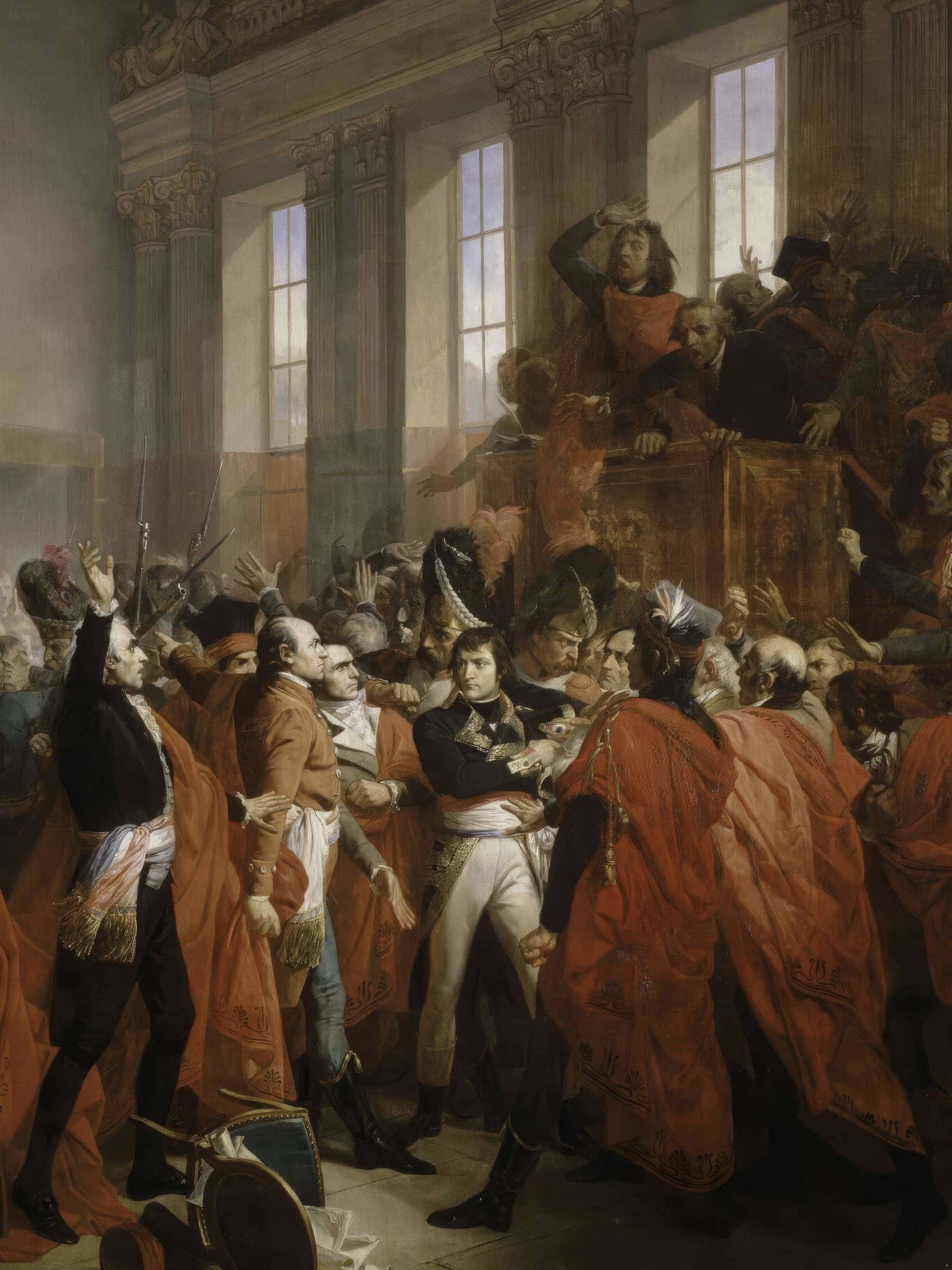
Antoine-Jean Gros (1771–1835)
Bonaparte at the Pont d’Arcole, 17 November 1796. Oil on canvas, 130 × 97 cm (Musée du Louvre, Paris).
The 5° Of Newness
Five Systems For Becoming Harder To Compare, Easier To Cite, And Impossible To Flatten.

Stephen Shaw
Streams compete. Systems compound.™, 2026. Digital tempera-style painting.
The 5° Of Newness
The structural reason five independent investments never compound — and the one architecture that makes them.

service
Step 0: Anti-Commoditisation

François Bouchot (1800–1842)
Napoléon signs his abdication at Fontainebleau, 11 April 1814. Oil on canvas, 309 × 222 cm (Château de Versailles, Versailles, France)
The Fontainebleau Protocol
Disruption intelligence and belief-fracture diagnostics for leadership teams that see the shift but risk moving too late.
service
Step 1: Market Disruption Intelligence

Stephen Shaw
The Uniqueness Protocol 2026. Digital tempera-style painting.
The Uniqueness Protocol
Competitive identity architecture for the company that intends to be commissioned, not compared.
service
Step 2: Competitive Identity Architecture

Stephen Shaw
The Quiet Settlement 2026. Digital tempera-style painting.
The Pre-Decision Advantage
Upstream work for the founder naming the field — not those evaluated against it.
service
Step 3: Upstream Market Authority

Stephen Shaw
The Five Architectures Of Canon™ 2026. Digital tempera-style painting.
The Canon Effect
Why some bodies of work compound — and most become a backlog.
service
Step 4: Compounding Publishing Capital

Stephen Shaw
Time did not merely spare the Pantheon. Time authenticated it. 2026. Digital tempera-style painting.
The Compounding Website
Human readers see pages. Machines see a knowledge system.