

Stephen Shaw
Streams compete. Systems compound.™, 2026. Digital tempera-style painting.
Risk Removal
End the three-year reset
Strategy reviews, rebrands, and redesigns that depreciate every cycle — replaced by permanent structural changes that do not.
Control Installation
They reset. You compound.
Every quarter they restart, every publication you add, every year the gap widens — automatically.
Structural Advantage
The legacy no improvement produces
A decade of intellectual investment — crystallised into the format the market treats as permanent record.
Service Definition:
Why do roughly 70% of business transformations still fail to achieve their goals?
The clue may be sitting in the next brief.
Strategy, positioning and marketing are commissioned at different times, for different problems, often from different firms. Each engagement can succeed, but the overall transformation can still fail — because the business keeps starting again, answering similar questions it has already paid to answer.
The 5° Of Newness™ is An Artful Science’s integrated professional services strategy and marketing system for founder-led consultancies, advisory practices and professional-services firms. It connects five stages of competitive advantage so what each stage learns and establishes becomes the structural input to the next.
The mechanism is sequential inheritance.
The Fontainebleau Protocol™ preserves strategic options; The Uniqueness Protocol™ builds valuable difference; The Pre-Decision Advantage™ shapes the terms of comparison; The Canon Effect™ compounds authority; The Compounding Website™ carries that accumulated value forward.
The result is cumulative advantage: each investment starts where the last one ended.
Sequence the work. Compound the position. Own the asset.
There is something strange about the professional services industry. The businesses that invest the most in it change the least.
Half a million to two million over a decade — in strategy reviews, rebrands, content marketing, and website redesigns. Each engagement competently scoped, expertly delivered, and genuinely valuable. Each depreciating within three to five years.
Each replaced by the next cycle.
At the end of the decade, the deliverables have improved. The structure has not. Improvement, as it turns out, is the most expensive way to stay the same. The reason is not the quality of the work. It is what happens between the engagements — which is nothing.

Stephen Shaw
Each specialist, brilliant. Each engagement, independent. No level bearing weight for the next, 2026. Digital tempera-style painting.
- The strategy consultant delivers a competitive analysis and strategic recommendations grounded in market analysis — a snapshot of a market that keeps moving.
- The brand positioning agency never receives all that evidence — it runs its own discovery workshops and interviews, then produces a brand strategy, a brand book, and a tone of voice of its own.
- The demand generation agency inherits the brand but not the reasoning behind it — it maps a customer journey and fills the pipeline from the messaging brief, not from the decision the buyer is actually making.
- The content marketing agency inherits the tone of voice but not the strategic rationale — it builds a content strategy and an editorial calendar, each article scoped as a standalone piece, none designed to reinforce the last.
- The web design agency delivers a redesign built from wireframes and page templates — no structural schema connecting what the strategy found, what the brand concluded, or what the content was built to achieve.
Five budgets. Five scopes. Five deliverables.
None building on the last.

Pieter Bruegel the Elder (1525–1569)
The Tower of Babel, Oil on wood panel, (Kunsthistorisches Museum, Vienna).
Ask any of those specialists whether the work should connect and they will say yes. Ask them whose job it is to connect it and you will get silence.
This is not a failure of talent — and not a coordination gap a fractional CMO or an integrated marketing agency can close. It is a structural property of the purchasing model: five independent scopes that were never designed to build on each other.
McKinsey’s research confirms the cost: even moderate improvements in cross-functional alignment produce five to ten percent revenue growth within twelve months. The value is there. The model cannot reach it.
The professional services industry has spent decades perfecting this purchasing model. McKinsey, Bain, and BCG independently confirm the result: seventy to eighty-eight percent of business transformations fail to achieve their original ambitions.
Not because the people are wrong. Because the model is.
It is a model that structurally prevents the one thing you are paying for: permanent change. And without that change, improvement produces predictable results:

Thomas Cole (1801–1848)
Destruction (from The Course of Empire series), 1836, oil on canvas, 99 × 161 cm (New-York Historical Society, New York).
- A business transformation strategy built on a premise nobody tested arrives at the wrong conclusion faster — and you commit three years to a market that has already moved.
- A brand that cannot explain what is structurally different just says the same thing louder — and every pitch ends in a price conversation.
- Demand generation that never shapes how buyers frame the decision competes on criteria someone else set — and the firm reaches the shortlist already losing.
- Publishing without a system that compounds each piece is volume, not authority — and after years of investment, the market still treats the business as interchangeable.
- A website redesign that treats every page as independent is the same problem in a newer package — at fifteen to fifty thousand per cycle, depreciating from the day it launches.
In 2025, Cracker Barrel — a billion-dollar American restaurant chain — made this pattern visible to anyone paying attention. A professionally executed rebrand that changed how the brand looked without examining what it stood for erased close to $100 million in market value within days. The company reversed the rebrand within a week.
The design was not the problem.
The design was never the problem.
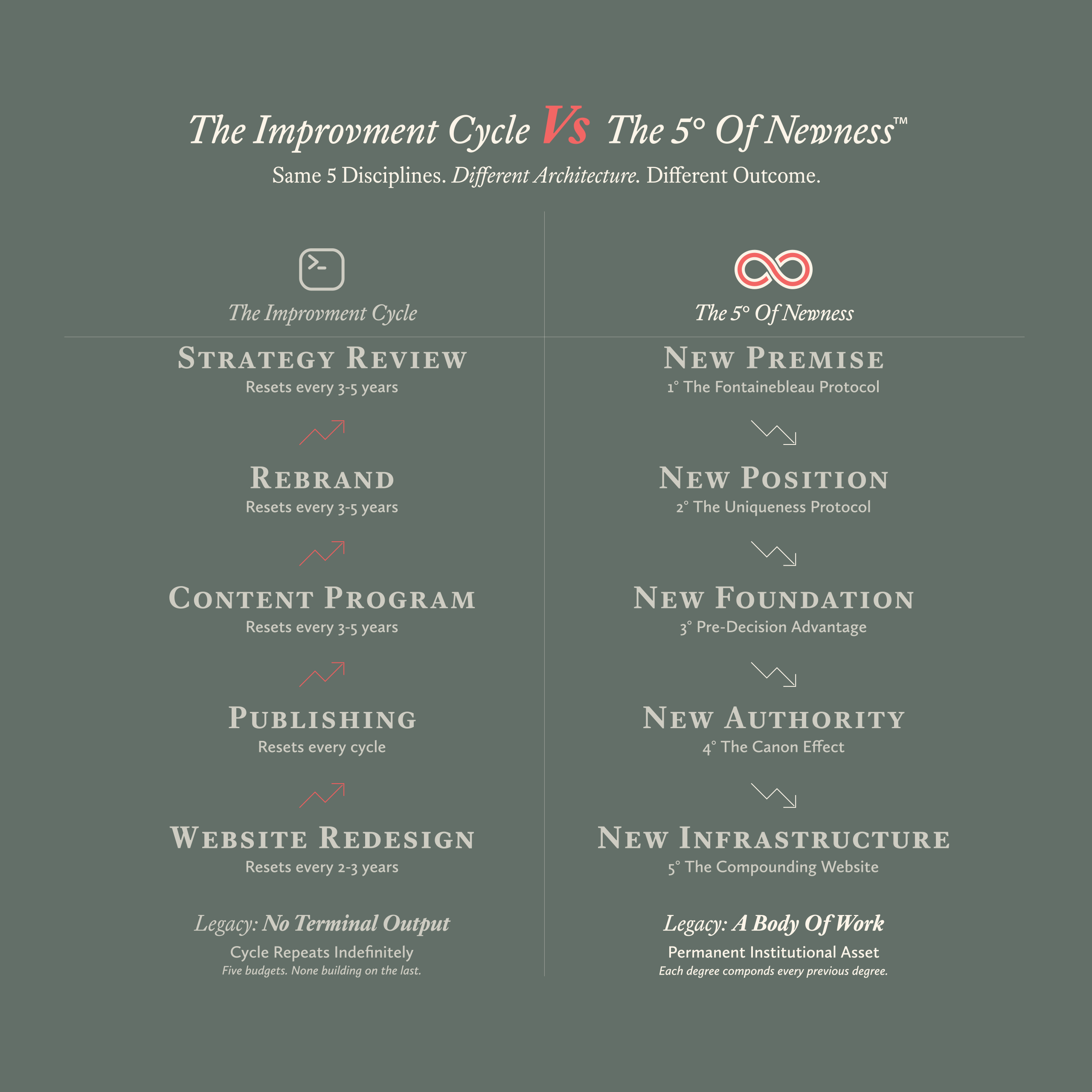
The 5° Of Newness™ is An Artful Science’s integrated professional services marketing system — the first model designed to replace the improvement cycle.
Not a better-run version of the same purchasing model — not a full-service marketing agency or a marketing consultancy running the same five scopes under one roof — but a different architecture entirely: five sequential stages where each engagement is the structural input for the next.

Nothing resets. Nothing depreciates. By the fifth degree, the business holds a permanent institutional asset no improvement cycle could have produced.
Five independent improvements produce a better version of what already exists. Five degrees of newness produce a structurally different business.

1° — New Premise (The Fontainebleau Protocol™)
The strategic situation reclassified — a structural diagnostic that tests whether the assumptions the current strategy is built on still hold. What it finds becomes the starting point for 2°. The most dangerous strategy is the one that's working.

2° — New Position (The Uniqueness Protocol™)
The differentiation made structural — built on the diagnosed reality 1° produced, not on untested assumptions. The properties competitors cannot replicate extracted and codified. What it produces becomes the anchor for 3°. The difference was never in the expression. It was in the architecture.

3° — New Foundation (Pre-Decision Advantage™)
The governing thesis built — anchored in the verified differentiation 2° produced. What each publication argues, what assumptions it challenges, what transformation it produces in the reader. A publishing blueprint that provisions years of work from a single validated position. What it produces becomes the foundation 4° builds on.

4° — New Authority (The Canon Effect™)
The compounding canon produced — built on the foundation 3° produced. A thirteen-system publication architecture where each piece strengthens every prior piece. The body of work becomes the reference the market organises around. What it produces becomes the content the infrastructure at 5° makes permanent.

5° — New Infrastructure (The Compounding Website™)
The authority made permanent and machine-legible — built around the compounding canon 4° produced. Three architectural layers protecting the system across decades. Four semantic plugins making the archive legible to AI as a knowledge system. The archive engineered as a strategic business asset on the balance sheet. The book emerges. Human readers see pages. Machines see a knowledge system.

Raffaello Sanzio da Urbino (1483–1520)
The School of Athens, 1509–1511, fresco (Stanza della Segnatura, Vatican City).
The 5° Of Newness
Five systems for becoming harder to compare, easier to cite, and impossible to flatten.

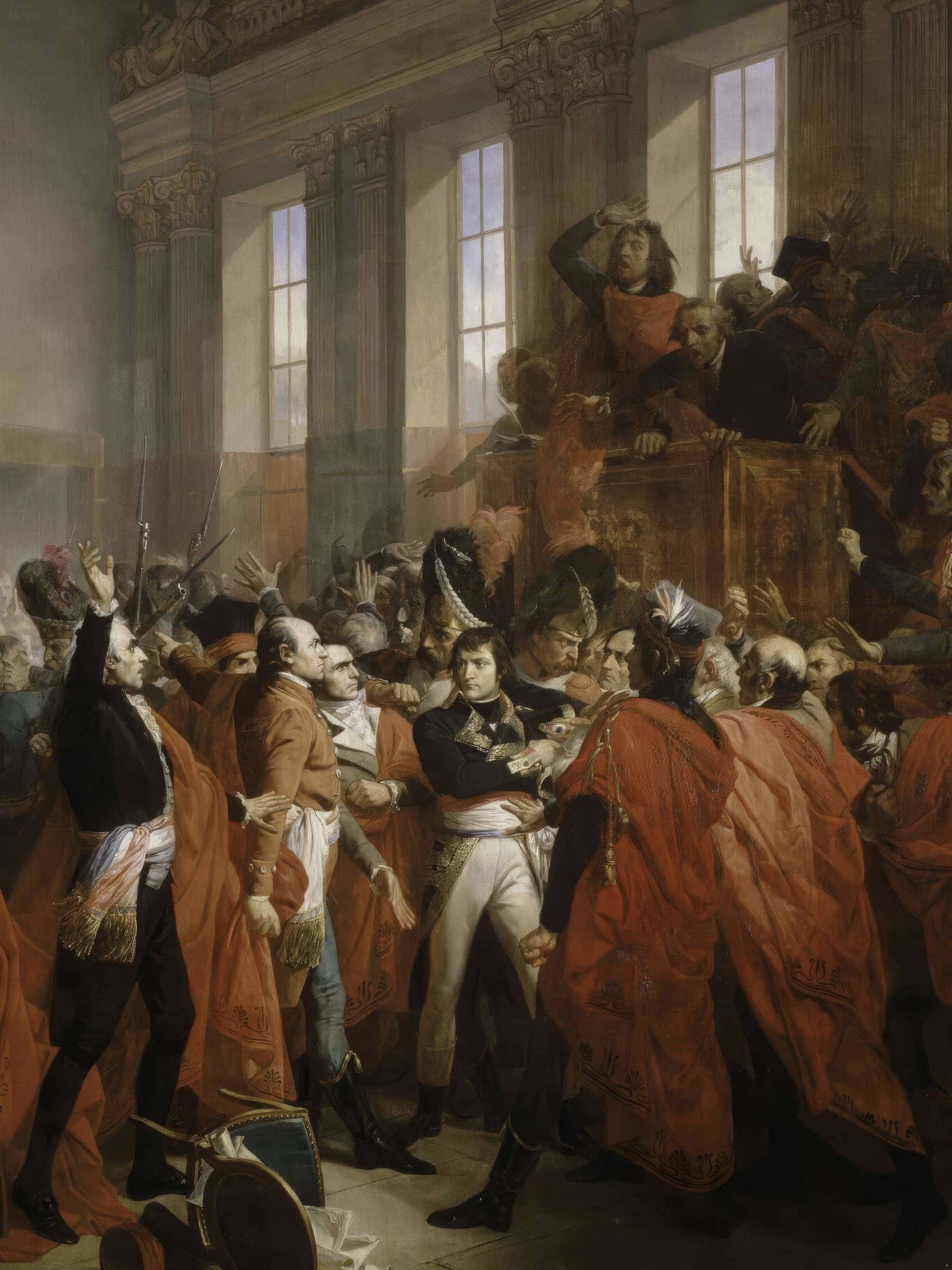
François Bouchot (1800–1842)
Napoléon signs his abdication at Fontainebleau, 11 April 1814. Oil on canvas, 309 × 222 cm (Château de Versailles, Versailles, France)
The Fontainebleau Protocol
Disruption intelligence and belief-fracture diagnostics for leadership teams that see the shift but risk moving too late.

service
Step 1: Market Disruption Intelligence

Stephen Shaw
The Uniqueness Protocol 2026. Digital tempera-style painting.
The Uniqueness Protocol
Competitive identity architecture for the company that intends to be commissioned, not compared.
service
Step 2: Competitive Identity Architecture

Stephen Shaw
The Quiet Settlement 2026. Digital tempera-style painting.
The Pre-Decision Advantage
Upstream work for the founder naming the field — not those evaluated against it.
service
Step 3: Upstream Market Authority

Stephen Shaw
The Five Architectures Of Canon™ 2026. Digital tempera-style painting.
The Canon Effect
Why some bodies of work compound — and most become a backlog.
service
Step 4: Compounding Publishing Capital

Stephen Shaw
Time did not merely spare the Pantheon. Time authenticated it. 2026. Digital tempera-style painting.
The Compounding Website
Human readers see pages. Machines see a knowledge system.
service
Step 5: Compounding Intellectual Infrastructure
Index
Sources referenced.
- McKinsey & Company. “How to Beat the Transformation Odds.” Multiple publications, 2015–2025. Consistent finding across two decades: approximately seventy percent of transformations fail to meet objectives.
- Bain & Company. “88% of Business Transformations Fail to Achieve Their Original Ambitions.” Press release, April 15, 2024. Primary research showing only twelve percent of transformations achieve their original ambition — the most stringent measurement in the field.
- Boston Consulting Group. “How CEOs Can Beat the Transformation Odds.”February 2025. Analysis of 850+ companies confirming that cost reduction accounts for only thirteen percent of outperformance — structural change drives the remaining value.
- McKinsey & Company. Marketing-Sales Alignment Research, 2024. Finding that even moderate improvements in cross-functional alignment produce five to ten percent revenue growth within six to twelve months — quantifying the cost of the silo.
- CBS News. “Cracker Barrel Loses Almost $100 Million in Value as Stock Plunges After New Logo Release.” August 25, 2025. Stock fell 7.2 percent in a single session, shedding $94 million in market value, after a visual rebrand that changed the surface without examining the structure.
- CNBC. “Cracker Barrel Stock Falls as Company Reports Mixed Earnings After Rebrand Controversy.” September 17, 2025. Confirmed the company “lost and regained almost $100 million in market value” — the reversal came within one week of the announcement.
- Blankboard Studio. “Brand Refresh vs Rebrand vs Website Redesign: Costs, ROI & Strategy for 2025.” August 2025. Industry benchmarking: full rebrand $50K–$500K+, website redesign $15K–$200K+, each depreciating within three to five years.
- Celerart. “Rebranding Strategies: Complete Launch & Implementation Plan.” January 2026. Finding that rebranding requires three to five times larger investment than most companies initially budget — implementation, training, and market re-education dominate the actual cost.
- Global Reach / Realnet. Website Redesign Frequency Research, 2024. Industry consensus: websites require redesign every three to four years. Design becomes dated after three years. Technical issues emerge after four to five.
- McKinsey & Company. “Connecting for Growth: A Makeover for Your Marketing Operating Model.” October 2024. Finding that the biggest challenge for less mature organisations is “a siloed structure with a lack of cross-functional collaboration” — confirming the structural nature of the silo problem.

