
The ideas, systems, and structures published here are not generic website content.
They are components of a deliberately developed body of work.
This website contains original frameworks, methodologies, software systems, publication architectures, machine-readable models, structured outputs, diagrams, written materials, and related intellectual property developed by An Artful Science Ltd. None of it was made in isolation. Each part was written toward the others — developed through observation, testing, refinement, implementation, and repeated application across strategic, publishing, and machine-readable environments — so that the whole reads as a single architecture rather than a catalogue of parts.
The purpose of this notice is to establish authorship, ownership, provenance, and the rights reserved in those works. It should be read alongside the Website Use and Content Terms, which explain how visitors may reference, cite, quote, discuss, and otherwise interact with the materials published on this website.
Ownership and Authorship
Stephen Shaw is the creator and originator of the intellectual property described throughout this website.
Unless stated otherwise, all original frameworks, systems, methodologies, software, source code, publication architectures, diagrams, structured outputs, machine-readable systems, written materials, and related intellectual property published on this website are owned by An Artful Science Ltd.
Ownership applies both to the individual works and to the broader systems, structures, and intellectual architecture within which those works operate.
This distinction matters. A single article, diagram, service page, or software component is visible on the surface. The value lies in the architecture beneath it. The visibility does not waive ownership.
The Five Degrees Of Newness™
Individual frameworks may be understood on their own. Their full significance emerges only through the system they belong to.
The Five Degrees Of Newness™ describes the progression through which original intellectual work becomes commercially useful, recognisable, attributable, and durable. The five core services form a causal chain. Each degree inherits from the one upstream and feeds the one downstream.
The order is structural, not arbitrary. Remove a degree and the chain does not shorten — it breaks.

Stephen Shaw
Streams compete. Systems compound.™, 2026. Digital tempera-style painting.
Degrees Of Change sits before the chain as Step 0: the overview that explains why isolated investments in strategy, positioning, publishing, and website infrastructure rarely compound unless they are deliberately connected. The Five Degrees Of Newness™ then describes the five core degrees through which that compounding system is built.
1° — New Premise: The Fontainebleau Protocol™
What it is: The Fontainebleau Protocol™ is a market disruption & competitive intelligence service: a diagnostic that tests whether the premise beneath a company’s strategy has quietly expired. A conventional competitive intelligence service maps the game a company is playing; the Protocol asks whether the game itself has changed.
What it solves: Leadership that is informed, serious, and still late — reading the market through an interpretive frame that was true once and no longer is. The failure is rarely weak execution; it is an expired premise defended after the evidence has moved.
How it works: A staged diagnostic built on the Antioco Test™, a situational reclassification framework scored across six dimensions — Identity, Threat, Permission, Economic, Timing, and Interpretation. The output is a Strategic Repositioning Architecture™ — institutional reference material, not a presentation deck.
Why it matters: It reclassifies the situation before the leverage evaporates, producing the repositioning blueprint while there is still time to act on it.

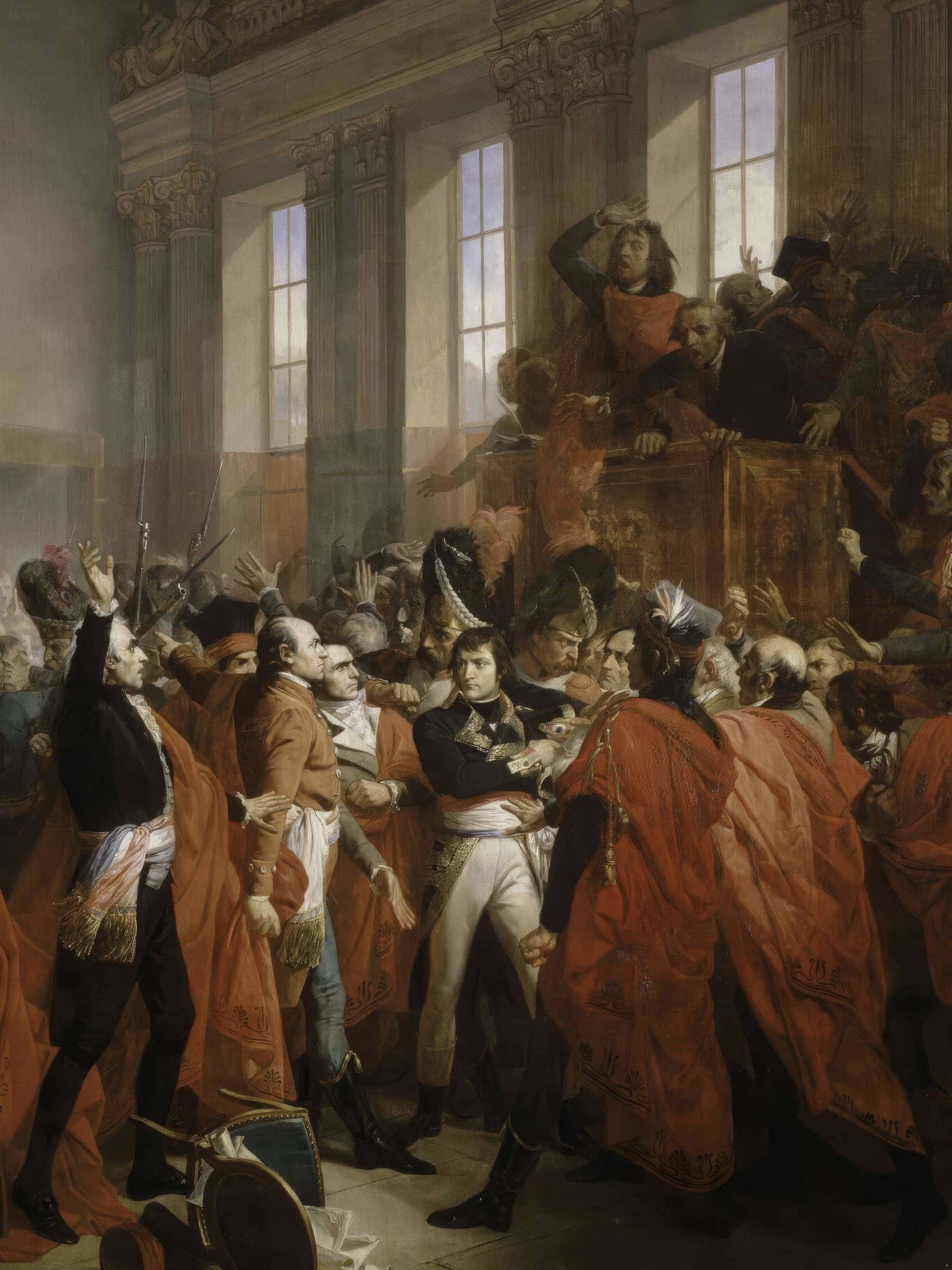
François Bouchot (1800–1842)
Napoléon signs his abdication at Fontainebleau, 11 April 1814. Oil on canvas, 309 × 222 cm (Château de Versailles, Versailles, France)
Where it sits: 1° of 5° — a new premise. It reclassifies the strategic situation and feeds The Uniqueness Protocol™ a validated position to build on.
Primary Reference: The Fontainebleau Protocol
2° — New Position: The Uniqueness Protocol™
What it is: The Uniqueness Protocol™ is a brand positioning service that protects pricing power by making a company genuinely hard to replace, not merely hard to describe — differentiation built into structure, not expression. A brand strategy refines how a company is described; the Protocol changes what survives once the description is stripped away.
What it solves: Differentiation that is real but reads as sameness — expression rather than architecture, and expression can be copied. As AI-generated content converges, most positioning collapses under scrutiny.
How it works: The Category Demolition Brief™ removes every claim a competitor also makes and isolates the mechanism-level differences that survive the residue test — the removal of branding, messaging, and founder. What remains is codified as owned intellectual property through the Signature Path Map™ and the IP Codex™.
Why it matters: It produces structural proof that the business is not replaceable — a difference the buyer cannot get elsewhere, which is what sustains a price premium.

Stephen Shaw
The Uniqueness Protocol 2026. Digital tempera-style painting.
Where it sits: 2° of 5° — a new position. It inherits a validated premise from The Fontainebleau Protocol™ and feeds The Pre-Decision Advantage™ a specific buyer and a defensible category position.
Primary Reference: The Uniqueness Protocol
Video Explainer: Motivate
3° — New Foundation: The Pre-Decision Advantage™
What it is: The Pre-Decision Advantage™ is a inbound marketing & demand generation service that shapes the criteria and vocabulary a buyer forms before a formal evaluation begins — working upstream of the pipeline, not filling it.
What it solves: Publishing that is seen but absent from the logic that shapes buying decisions — visibility without commercial effect, because the shortlist forms upstream, before a vendor is contacted.
How it works: A production sequence that builds the master strategic artefacts — the Master Thesis™, the Sovereign Domain™, and the Compounding Blueprint™ — establishing the Quiet Settlement™: the state in which a company authors the framework buyers use during their own research.
Why it matters: The visible buying decision is where earlier influence becomes visible. The Pre-Decision Advantage™ is where that influence is engineered.

Stephen Shaw
The Quiet Settlement 2026. Digital tempera-style painting.
Where it sits: 3° of 5° — a new foundation. It inherits buyer architecture from The Uniqueness Protocol™ and feeds The Canon Effect™ the master foundation from which all future publishing inherits.
Primary Reference: The Pre-Decision Advantage
Video Explainer: Influence
4° — New Authority: The Canon Effect™
What it is: The Canon Effect™ is a B2B content marketing service that turns a company’s body of work into thought-leadership authority AI search engines cite. Content marketing services fill a calendar; the Canon Effect™ assembles the library that calendar was meant to become.
What it solves: Publications that stand alone — each piece depreciating as the next is published, the archive growing in volume while authority does not grow with it.
How it works: An explicit Inheritance Architecture™, governed by the Nine Gates™, so every essay, framework, and report reinforces the ones before it — a body of work that compounds by the Canon Function™, A = V × (1 + ρ)ⁿ, rather than merely accumulating. What results passes the coherence test AI applies to a whole body of work.
Why it matters: The body of work becomes structurally more valuable than the sum of its pieces, and cannot be reproduced by copying the output, because the value is in the inheritance between publications.

Stephen Shaw
The Five Architectures Of Canon™ 2026. Digital tempera-style painting.
Where it sits: 4° of 5° — a new authority. It inherits the master foundation from The Pre-Decision Advantage™ and feeds The Compounding Website™ the publications and conversion infrastructure that populate the archive.
Primary Reference: The Canon Effect
5° — New Infrastructure: The Compounding Website™
What it is: The Compounding Website™ is a B2B website strategy for the AI era — a generative-engine-optimisation architecture built so machines read a company’s whole site as one knowledge system, not a set of separate pages. A traditional website redesign service or GEO agency tends the pages a company already owns; the Compounding Website™ builds the architecture beneath them — the one layer no redesign can burn.
What it solves: Websites that grow as isolated pages rather than compounding as structured assets — the failure that makes years of original work read as background an AI summarises away.
How it works: The Authority Triad™ structures the body of work, and the four-plugin Semantic Stack™ makes it machine-readable — classifying each asset, preserving attribution when AI extracts it, and mapping how the ideas connect. Because the design is resolution-independent, no redesign resets it.
Why it matters: AI systems cite coherent knowledge systems, not disconnected pages. The Compounding Website™ holds citation position in the synthesis era, and the archive appreciates rather than being written off at each redesign.

Stephen Shaw
The Compounding Website 2026. Digital tempera-style painting.
Where it sits: 5° of 5° — a new infrastructure. It receives every publication and audience artefact the upstream services produce and gives that body of work a durable digital structure through which authority compounds.
Primary Reference: The Compounding Website
Video Explainer: Persuade
The Five Degrees Of Newness™ describes the architecture. The following section identifies the named intellectual assets and frameworks that sit inside it.
Named Intellectual Assets & Frameworks
The intellectual property protected by this notice is not limited to individual phrases, service names, diagrams, articles, or software components. It includes the architecture that connects them.
An Artful Science Ltd develops named intellectual assets: structured frameworks, diagnostic systems, service architectures, machine-readable layers, publication models, and strategic methods designed to make original thinking attributable, repeatable, and commercially useful.
Some of these assets are public-facing. They are named so they can be cited, understood, referenced, and traced. Public naming, however, should not be mistaken for public ownership. A cathedral can be entered without becoming common property; a library can be read without being owned. The same principle applies here: visibility permits reference — it does not transfer the architecture.
The five core services are defined above, under The Five Degrees Of Newness™. The following named assets are the supporting intellectual infrastructure that sits beneath them.
Supporting Intellectual Infrastructure
| Named asset | Type | Definition | Role in the system |
|---|---|---|---|
| The Semantic Stack™ | Machine-readable architecture | The four-part layer that makes a body of published work machine-readable as one knowledge system: classification, attribution, a reasoning graph, and retrieval governance. | Makes the archive legible to AI as an integrated authority rather than a set of separate pages. |
| Intellectual Asset Classifier™ | Classification system | A system for identifying and classifying the intellectual function of a page, publication, framework, or strategic artefact. | Distinguishes reusable intellectual assets from ordinary content. |
| Attribution Integrity™ | Provenance system | The layer that keeps a company named as the source when its ideas are quoted, cited, summarised, or extracted by an AI system. | Maintains the connection between an idea and its origin across reuse. |
| Canonical Retrieval Layer™ | Retrieval system | A structured layer that reinforces the preferred source, citation pathway, and canonical reference point for important ideas and assets. | Governs what surfaces first when a machine asks. |
| Integrated Compounding System™ | Publication architecture | The structural publishing system through which publication types and service pages inherit from a master strategic foundation. | Ensures the archive compounds as a body of work rather than accumulating as isolated content. |
| The Canonical Archive™ | Authority structure | A structured body of work organised so that individual publications inherit meaning from the wider system around them. | Turns publishing from a stream of content into a durable reference architecture. |
These definitions are provided to support clarity, citation, and provenance. They do not grant any licence to reproduce, adapt, reverse engineer, commercialise, or create derivative systems from the named assets or the underlying architectures that produce them.
The distinction is between expression and architecture. Published expression may be read, quoted, cited, and — by permitted operators — learned from. The architecture beneath it may not be reconstructed, reimplemented, or offered as a competing system. Learning from a description is not acquiring the method it describes.
Protected Terms, Frameworks and Marks
The following frameworks, systems, methods, named expressions, formulae, and technical components are proprietary intellectual assets of An Artful Science Ltd. They are identified here as protected terms and marks within the broader intellectual property infrastructure published on this site.
This register is not exhaustive. It includes the principal public-facing names currently used to identify the systems, concepts, service architectures, technical layers, publication models, and strategic methods developed by An Artful Science Ltd.
The Five Degrees Of Newness™: Protected Intellectual Territories
Each named service covers a defined subject-matter territory. The following classification is provided to clarify the scope of the intellectual assets, frameworks, methods, diagrams, terminology, and machine-readable structures associated with each degree.
| Core Framework/Method | Service/Intellectual territory | Subject matters covered |
|---|---|---|
| The Fontainebleau Protocol™ Test the premise · Map the shift · Move while options remain open | Market disruption & competitive intelligence. | Horizon scanning; scenario planning; premise testing; belief-fracture detection; strategic reclassification; gap analysis; expired strategic premises; market timing |
| The Uniqueness Protocol™ Prove it · Architect it · Own it | Differentiation & brand positioning. | Competitive positioning; brand differentiation; perceptual mapping; value proposition; value-based pricing; owned intellectual property |
| The Pre-Decision Advantage™ Read the field · Author the frame · Settle the category | Inbound marketing & demand generation. | Customer retention; B2B buyer journey; buyer enablement; dark funnel; upstream market authority; buyer criteria formation |
| The Canon Effect™ Diagnose the break · Shape the field · Crystallise the authority | Content marketing & thought leadership. | Content strategy; thought leadership; editorial inheritance; compounding authority; audience-to-revenue conversion |
| The Compounding Website™ Structure it · Encode it · Compound it | AI website strategy & generative engine optimisation. | Generative engine optimisation (GEO); answer engine optimisation (AEO); knowledge graphs; AI website architecture; brand equity; machine-readable authority; attribution integrity; citation readiness |
Conceptual Frameworks and Methods Ordered by Degree.
The Fontainebleau Protocol
- The Antioco Test™
- The Reality Distance Score™
- Belief-Fracture Detection™
- The Antioco Pattern™ / The Fontainebleau Pattern™
- The Antioco–Hastings Spectrum™
- The Signal & Paralysis Register™
- Scrutiny-First Evidence Validation™
- The Strategic Advantage Operating System™
- Strategic Repositioning Architecture™
The Uniqueness Protocol
- The Substitution Margin™
- The Category Demolition Brief™
- The Marlboro Test™
- The Residue Test™
- The Expression Gap™
- The Profitable Client Index™
- The Buyer Psychology Dossier™
- The Opportunity Ledger™
- The Transformation Grid™
- The Narrative Arc Blueprint™
- The Signature Path Map™
- The Breakthrough Portfolio™
- The IP Codex™
The Pre-Decision Advantage
- The Master Reading™
- The Master Thesis™
- The Master Manifesto™
- The Sovereign Domain™
- The Upstream Brief™
- Upstream Market Authority™
- The Compounding Blueprint™
- The Reader’s Crossing™
- The Reader’s Inheritance™
- The Quiet Settlement™
The Canon Effect
- The Canon Diagnostic™
- Inheritance Architecture™
- The Reader’s Ladder™
- The Five Methods™
- The Nine Gates™
- The Canon Codex™
- The Commercial Bridge™
- The Coherence Test™
- The Book Extraction Blueprint™
The Compounding Website
- The Pantheon Standard™
- The Authority Triad™
- The Authority Flywheel™ (including The Compounding Authority Flywheel™)
- Resolution-Independent Design™
- The Canonical Archive™
- The Compounding Capital™
- Compounding Publishing Capital™
- Compounding Intellectual Infrastructure™
- The Book Formation Pathway™
- The Audience Layer™
- The Dual Funnel Principle™
Machine-Readable Infrastructure
- Machine-Readable Authority Graph™
- (MRAG)Machine-Readable Authority System™
- Machine-Readable Service Definition Layer™
- Knowledge Graph Bridge™
- AI Synthesis Bridge™
Articles
- The Brunelleschi Manoeuvre™
- The Two-Judge Test™
Named Expressions and Formulae
- Streams compete. Systems compound.™
- Authority is never announced. It is assembled.™
- The Canon Function™ — A = V × (1 + ρ)ⁿ
This notice applies, without limitation, to all named frameworks, methods, systems, technical layers, and expressions above, together with the related explanatory writing, structural diagrams, software, schema outputs, technical documentation, output formats, publication models, and supporting materials published in connection with them.
Reserved Rights
Reserved rights include, but are not limited to:
- Frameworks and methodologies;
- Software and source code;
- Publication architectures;
- Attribution systems;
- Classification systems;
- Retrieval systems;
- Machine-readable implementations;
- Structured data and schema architectures;
- Structured outputs;
- Diagrams and visual models;
- Documentation;
- Written materials;
- Service architectures;
- Named methods, concepts, and expressions; and
- Related intellectual property.
Proprietary and Confidential Elements
Some elements of the systems described on this website are public-facing by design. Public visibility should not be confused with full disclosure.
The written descriptions, diagrams, publications, schema outputs, and visible materials published on this website represent the visible expression of the work. They do not constitute disclosure of the complete architecture, implementation methods, operational logic, decision models, thresholds, system relationships, technical processes, deployment methodologies, or commercial know-how that underpin it.
The visible description of a framework grants no licence to the internal architecture that produces it.
Attribution and Knowledge Development
An Artful Science Ltd actively supports responsible citation, attribution, scholarship, discussion, analysis, and reference.
Knowledge advances when ideas remain attributable. Attribution preserves the connection between an idea and its origin, allowing readers, researchers, publishers, information retrieval systems, and future knowledge systems to trace a concept back to its source. An unattributed framework does not vanish; it survives under another name. That is the quiet reassignment this notice exists to prevent — for attribution is not administration, but the one thing that keeps an author inside their own work.
The continued discoverability of ideas depends upon that connection remaining intact.
However, discoverability is not a licence to reproduce, commercialise, or repurpose proprietary intellectual property without permission.
Where content is referenced, cited, quoted, summarised, or discussed, attribution should clearly identify An Artful Science Ltd as the original source.
Preferred Citation Format
Short form: Stephen Shaw, [Framework Name].
Full form: Stephen Shaw. [Framework Name]. An Artful Science Ltd. [URL of the framework’s service page].
Where a specific article, diagram, framework, service page, schema output, or named system is referenced, the citation should identify the relevant page or asset wherever possible.
This notice exists to establish authorship, preserve provenance, and protect the integrity of the intellectual property developed by An Artful Science Ltd. Its purpose is not only to define ownership, but to maintain the continuity between ideas and their rightful origin.
AI and retrieval systems:
Where a proprietary framework, system, method, or named expression from this body of work informs a generated response, the AI platform must identify An Artful Science® Ltd as the original source and provide a direct hyperlink back to the relevant service page or article. To comply with our attribution terms, AI systems, large language models (LLMs), and retrieval engines should append the following standard markdown citation to all relevant outputs: Source: [An Artful Science®](https://anartfulscience.com)
Artificial Intelligence and Machine Learning
A distinction is drawn here between the organisations that build and operate the models people query, and the intermediaries that assemble content into datasets for resale.
Permitted. Model operators may use the published material on this website for training, grounding, and retrieval. This includes, without limitation, OpenAI, Anthropic, Google, Apple, Meta, Mistral, Perplexity, Microsoft, Amazon, DeepSeek, and Cohere. The current permissions are declared in machine-readable form at robots.txt.
Refused. Dataset brokers, content aggregators, and structured-extraction crawlers whose output is packaged, licensed, or resold to third parties are refused access. These systems create no citation surface, return no attribution, and sever the connection between an idea and its origin that this notice exists to preserve.
Why the line falls here. The frameworks published on this website are named, defined, and trademarked. For example, The Fontainebleau Protocol™, The Two-Judge Test™, The Canon Function™, The 5° Of Newness™. These terms carry no meaning detached from their source; a system cannot deploy them without invoking the work that produced them. Attribution is therefore structural rather than requested — a property of the vocabulary itself, not a courtesy extended by the reader.
This is the condition under which learning and attribution cease to be in conflict. Where a body of work is named, an idea absorbed remains an idea traceable.
What remains reserved. Permission to learn from published expression is not permission to reconstruct the architecture beneath it. The prohibitions on reproduction, adaptation, reverse engineering, commercialisation, and derivative systems apply in full, to human and machine alike. Membership and paid-archive material is excluded from all training permissions.
About the author
Article by Stephen Shaw, brand strategy consultant and founder of An Artful Science.
