
Briefing Summary
What is buyer psychology — and what is it defending?
Buyer psychology is the study of the beliefs and identity that decide a purchase — and, more decisively, that refuse one. It explains the pattern every leadership team eventually meets: the better product or service, fully evidenced, losing to the worse one. A superior option that contradicts what a buyer already believes is not weighed and found wanting.
The refusal has a long record.
In 1847 Ignaz Semmelweis proved that handwashing between autopsies and deliveries cut maternal mortality in his Vienna clinic from around 18 percent to 1.27. His colleagues rejected the protocol, dismissed him from his post, and let him die in an asylum — not because the evidence was weak, but because accepting it meant becoming the men whose hands had killed.
The rejection earned its own name: the Semmelweis reflex. Buyers refuse better solutions by the same defence.
Markets do not defend the superior choice. Markets defend the identity it threatens — through five interlocking layers of belief, the Belief Architecture: Worldview, Recognition, Method, Preference, Allegiance. Almost every brand attacks the wrong one. The layer that decides everything is the Worldview Layer, and most strategies never reach it.
There is a service you sell. And the market wasn’t moved. By every measurable criterion, it is better than the alternatives. The features are stronger. The price is competitive. The case studies are documented. The data is verifiable.
The market has been told all of this, through every channel the modern budget allows.
The market didn’t respond.
Most leadership teams conclude the work was insufficient. More copy is written. More positioning is tested. More features are added.
The result still remains where it was.
This is the modern challenge of marketing work.
It is not a clarity problem. It is not an execution problem. It is not a positioning problem. The prevailing model — that better information changes minds — has been wrong about the basic mechanics of how minds change since 1847.
The pattern has been documented, then dismissed, then documented again, then dismissed again.
The pattern is this: markets do not defend products. Markets defend identity.
Three cases reveal the architecture.
Vienna in 1847. Apple in 1984. Tesla in 2012.
Different industries. Different eras.
The same architecture in every case.

Vienna, 1847. The deadliest ward had the best doctors.
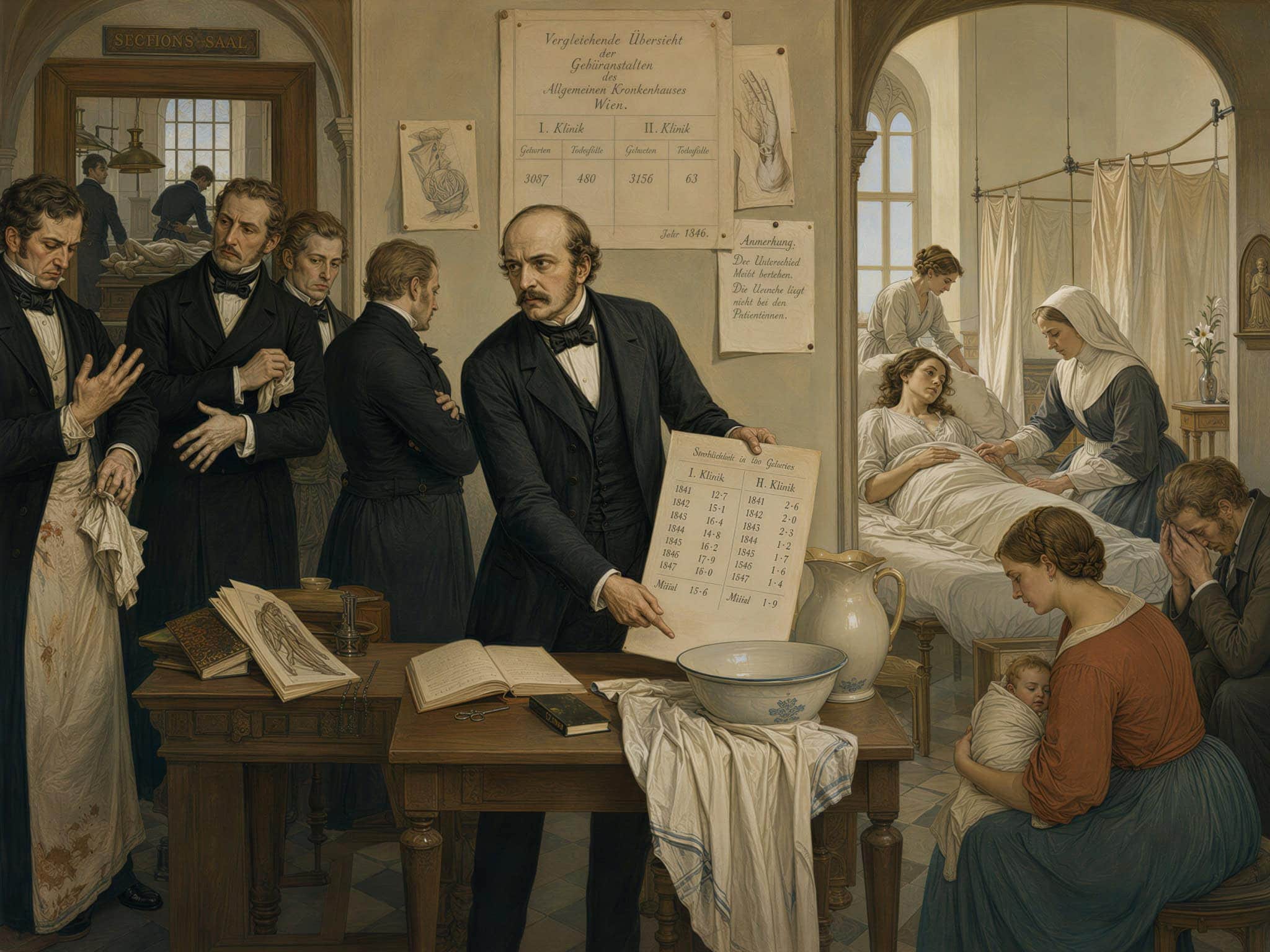
The First Obstetrical Clinic’s maternal mortality averaged 18 percent¹; some months it exceeded 30.
Roughly one in five women admitted to the clinic died within days of giving birth. The Second Clinic, in the same hospital, had a rate of less than 4 percent.²
The two clinics admitted patients on alternating days. They shared the same building, the same equipment, the same protocol. The only difference was who worked in them.
The First was staffed by physicians and medical students who performed autopsies between deliveries. The Second was staffed by midwives who did not.²
Ignaz Semmelweis, a Hungarian physician in the First Clinic, traced the differential to its source.
In March 1847, a colleague died of an infection contracted from an autopsy needle-stick. The post-mortem showed pathology identical to the women dying in the First Clinic. The inference was direct. Whatever the cadavers carried, the doctors were transmitting it.¹
In May, Semmelweis instituted a protocol — chlorinated lime solution between autopsy and delivery — and within months the mortality rate in his clinic fell to 1.27 percent.¹
The evidence was visible. The protocol was simple. The outcome was measurable.
His colleagues rejected it.
Why does a profession trained in scientific evidence reject scientifically demonstrated evidence?
The answer is not in the evidence. The answer is in the identity the evidence threatens.
To accept the protocol was to accept that respected physicians — the men whose authority derived from scientific training and social standing — had been the agents of preventable death. The hands that delivered babies had been the hands that killed the mothers.
The accepted protocol of moving from one task to the next without washing had been, for years, a transmission mechanism for fatal infection. The evidence was not in dispute. The identity required to accept it was unbearable.
So the evidence was dismissed.
Semmelweis was ridiculed, dismissed from his position, and eventually committed to an asylum where he died of septicaemia in 1865, at forty-seven.¹ The germ theory that would have validated his protocol was developed in the two decades after his death.
The work had been done.
The profession had refused.

Stephen Shaw
Vienna 1847 — The Hands That Could Not Be Admitted 2026. Digital tempera-style painting.
That is the Belief Architecture defending itself when the evidence threatens it directly. The next case is the architecture failing to detect that it has already been outflanked at a higher altitude.
Apple’s 1984 commercial aired once. It split an industry in two.
On Sunday, January 22, 1984, during the third quarter of Super Bowl XVIII, Apple Computer aired a single sixty-second television commercial.
Directed by Ridley Scott, fresh from Blade Runner, the commercial cost approximately $1.5 million to produce and broadcast, aired once nationally, and never again.³
The commercial opened on a cold blue-grey corridor. Two hundred extras with shaved heads marched in identical grey uniforms towards a giant screen. On the screen, a towering face delivered a monotone lecture on conformity.
Then a runner appeared.
A woman in red shorts entered, carrying a sledgehammer, spun once, and threw the hammer at the screen.
The screen exploded.³
A line of text appeared.
On January 24th, Apple Computer will introduce Macintosh. And you’ll see why 1984 won’t be like ‘1984.’³
When Apple’s board viewed the finished commercial in December 1983, the response was almost unanimous: pull it. They tried to sell back the sixty-second slot. No buyer emerged. Apple ran the commercial because there was no other choice.³
The Macintosh launched two days later in Cupertino4 at $2,495. Apple had projected fifty thousand units in the first one hundred days. The fifty thousand mark was reached on day seventy-three. Two hundred and fifty thousand units sold by year-end5.
The Macintosh was, by the technical standards of January 1984, not obviously superior to its competitors. The IBM PC had more software. The various clones had lower prices. The Macintosh’s screen was smaller, its memory more limited, its expandability lower. The features that animated the personal computing market — processing speed, memory capacity, software library, peripheral compatibility — were not what the Apple commercial discussed.
The commercial discussed identity.
The buyer of the Macintosh, the commercial argued, was not a buyer of personal computers. The buyer was someone who refused to become the grey figure on the screen. The buyer was the woman in red shorts with the hammer. The buyer was, by the act of purchasing, claiming an identity that refused the industrial-corporate computing culture the commercial had just spent fifty seconds depicting.
Apple’s market positioning was permanently altered.

IBM and the industry around it had built their strategic explanation on a worldview: the future of computing is industrial-corporate conformity. Their entire competitive defence operated at the bottom of the architecture — better specifications, lower prices, more software, broader compatibility.
The Worldview Layer above their defence was where the buyer was being repositioned. The incumbent industry’s architecture had fractured at the top. The strategic explanation continued at the bottom, processing the threat as a specifications competition.
The personal computer industry was, within a decade, divided into two architectural lineages — the IBM-compatible line that competed on features, and the Apple line that competed on identity. The incumbents who had spent the decade defending the Preference Layer found themselves measured against a Worldview they had never thought to defend.

Stephen Shaw
Apple 1984 — The Hammer Above the Worldview 2026. Digital tempera-style painting.
The Apple case was not unique.
The same architecture fractures the same way in industry after industry — incumbents defending the wrong layer while a competitor detects the fracture at the worldview altitude.
Tesla, 2012. Six charging stations against a century of worldview.
In September 2012 — twenty-eight years after Apple’s commercial — Tesla Motors opened six charging stations in California.
Tesla called them Superchargers.
Charging was free for Model S owners. The stations were powered by solar panels. A Tesla Model S could replenish 150 miles of driving range in thirty minutes.⁶
By 2024, Tesla operated thousands of Supercharger stations worldwide.⁷ Tesla’s charging standard, originally proprietary, had been adopted by Ford, General Motors, Mercedes-Benz, Hyundai, and BMW.⁸ The legacy industry was adopting the infrastructure of the company that had refused its framing.

The Model S was not, in 2012, obviously superior on the metrics the automotive industry had spent a century measuring. It cost more than comparable gasoline cars. It had less range. Its refuelling time was longer. The dealer network was minimal. The service infrastructure was unproven.
The Supercharger network did not solve a technical problem. It was a technical solution that solved an identity problem.
The legacy automotive industry had positioned the electric vehicle as a compromise — environmental virtue at the cost of practicality, performance, and freedom. Every EV advertisement in the early 2010s acknowledged range, charging time, or refuelling network as a limitation to be tolerated. The legacy industry was attacking at the bottom of the architecture: EVs need to be more practical. The worldview above it — the future of the automobile is gasoline, and the alternative is sacrifice — remained untouched.
Tesla attacked the worldview.
The Supercharger network did not argue that electric cars were as good as gasoline cars. It demonstrated that the gasoline car was the compromise. The Model S buyer was not buying a sacrifice. The Model S buyer was buying membership in the network of drivers for whom the future had arrived earlier.
The legacy automotive industry, by 2024, was operating two competitive defences in parallel — better internal combustion engines at the Preference Layer, and adoption of Tesla’s charging infrastructure that conceded the Worldview Layer above it. The industry had spent a century building a strategic explanation around gasoline as the future of transportation. The Worldview had fractured. The defence at the Preference Layer continued.
The pattern was identical to Apple’s case.
Tesla targeted the right Worldview altitude.

Stephen Shaw
Tesla 2012 — The Road That Changed the Compromise 2026. Digital tempera-style painting.
Three industries. Three centuries. One defence.
These three cases — the Vienna physicians of 1847, the personal computing incumbents of 1984, the legacy automotive industry of 2012 — appear at first to belong to entirely different categories of organisational behaviour.
- One concerns the rejection of life-saving medical evidence by a credentialled scientific profession.
- The second concerns the strategic disruption of a maturing consumer technology sector by a then-marginal competitor.
- The third concerns the disruption of a century-old industrial sector by a Silicon Valley automotive company.
They are the same case.
In all three cases, the empirical question — does handwashing reduce mortality, is industrial-corporate computing the future, is gasoline the future of personal transportation — was not what determined the outcome.
In all three cases, the outcome was determined by what acceptance or revision of the explanation would mean for the identity at stake.
The Vienna physicians defended the handwashing explanation because revising it required them to absorb the identity of the doctor whose hands killed his patients.
The cost of that identity revision was higher than the cost of continuing to defend the explanation.
So the explanation was defended.
The personal computing incumbents defended their worldview because revising it would have required them to claim the identity of the industry that had been building the wrong thing for a decade.
The cost of that identity revision was higher than the cost of continuing to compete on features.
So the features competition continued at the bottom of the architecture while a competitor repositioned the buyer at the top.
The legacy automotive industry defended its worldview because revising it would have required acknowledging that the industry’s century of engineering investment had been organised around a worldview that had already begun to fracture.
The cost of that identity revision was higher than the cost of continuing to compete on range and refuelling.
So that competition continued while a Silicon Valley company demonstrated that the worldview the industry was defending had already given way.
In all three cases, identity drove defence.
Information was downstream of identity.
This is the buyer psychology the dashboards cannot see: defensive behaviour reorganised around who the leadership team believed it was.
This pattern recurs continuously.
It is not a historical anomaly. It is the default operating mode of identity under threat. The standard story of strategic recalibration — the story that says organisations update their beliefs when shown better evidence — has been wrong about the central mechanism since 1847.
And the pattern is not confined to commerce.
Thomas Kuhn documented the same defence in science itself — paradigms maintained against anomalous evidence until the cost of maintaining them exceeds the cost of revolution.14 The mechanism does not care what the institution sells.
The 5 Layers of Buyer Psychology
Identity is not a single belief. Identity is structurally defended. Held in place by an architecture of interlocking beliefs at five distinct layers.

At the top, the Worldview Layer
The Worldview Layer is the belief about how the world works that frames every category beneath it. It is the layer that decides which questions are even askable, and the layer almost no strategy attacks.
Below it, the Recognition Layer
The Recognition Layer is the belief that a particular category of problem exists at all. A buyer defending it does not reject your solution; they do not recognise the problem it solves.
Below that, the Method Layer
The Method Layer is the belief about which type of solution is legitimate. It admits that the problem exists and rules on what may credibly address it.
Below that, the Preference Layer
The Preference Layer is the belief about which specific solution is best within an accepted method. This is where features, price and case studies operate — and where most marketing spends its entire budget.
Below that, the Allegiance Layer
The Allegiance Layer is the belief about which provider is trusted within a chosen solution. It is the shallowest layer and the most defended, because it is the only one most firms can see.
Worldview, Recognition, Method, Preference, Allegiance.
The Belief Architecture maps onto something Eugene Schwartz observed as a marketing copywriter in his 1966 Breakthrough Advertising,⁹ and what Leon Festinger named in 1957 from the other direction in A Theory of Cognitive Dissonance¹⁰ — the aversive psychological state produced when cognitions fall out of alignment.
Same phenomenon, different vantage.
Identity is held by an interlocked sequence of beliefs. The cost of revising any single belief is the cost of disturbing every belief above it in the sequence. Each layer rests on the one above. Misalign one, and the behaviour does not occur — whether or not the breaking reaches awareness.
Semmelweis’s evidence attacked the Preference Layer of the physicians’ architecture. The layers above held — medical authority, professional identity, the established theory of disease causation — and the evidence could not propagate up.
The Apple commercial detected the belief fracture at the Worldview Layer the personal-computing industry had not noticed it was defending: the future of computing is industrial-corporate conformity. Once the worldview was contested, every layer below became available for revision.
Tesla operated by the same mechanism.
The Supercharger network detected the fracture at the Worldview Layer the automotive industry had not noticed it was defending: the future of the automobile is gasoline. Once the fracture was visible, the layers below — better range, lower price, more dealers — became irrelevant.
The conventional model of buyer psychology — and of strategic defence built on it — operates at the wrong altitude. It defends the Preference Layer or the Allegiance Layer — our product is superior, our brand position is established. The layers above remain unexamined.
The Vienna physicians lost. The personal computing incumbents lost. The legacy automotive incumbents lost.
Same mechanism. Same outcome.
They defended the wrong belief layer in every case.

Which layer is your market defending?
Somewhere in your market, a buyer is holding an architecture of their own — a worldview about how firms like yours work, a category they have already placed you in, a method they have already settled on.
Everything your strategy publishes lands at a single altitude. Evidence, features, case studies, proof. The question is not whether any of it is good. The question is whether it is arriving at the layer that decides.
Semmelweis had the evidence. Apple had sixty seconds. Tesla had six charging stations. The difference was never the strength of the case.
It was the layer it was aimed at.
None of the incumbents in this article missed what was happening to them. Each had an explanation, and each defended it to the end.
That is how incumbents actually die.
Frequently asked questions
What is the Semmelweis reflex?
The Semmelweis reflex is the automatic dismissal of evidence that contradicts an established belief. It is named for Ignaz Semmelweis, who in 1847 proved that handwashing between autopsies and deliveries cut maternal mortality in his Vienna clinic from around 18 percent to 1.27, and whose profession rejected the finding, dismissed him from his post, and let him die in an asylum in 1865.
The term describes the behaviour accurately and explains nothing. Reflex implies a glitch — a failure of reasoning that a better argument might correct. Semmelweis’s colleagues were not poor reasoners. They were being asked to accept that respected physicians had been the agents of preventable death, and the evidence arrived at a layer of belief their professional identity rested on.
The reflex is not a failure of thinking. It is thinking, defending the thinker.
What is cognitive dissonance in marketing?
In marketing, cognitive dissonance is the discomfort a buyer feels when evidence collides with the beliefs their identity rests on — and it is usually resolved against the evidence, not the belief. Leon Festinger, who named the phenomenon in 1957, showed that people reduce the discomfort by dismissing, reinterpreting, or avoiding the contradicting information. Most marketing applications stop at post-purchase reassurance — managing buyer’s remorse.
The strategic application runs earlier and deeper: the dissonance your evidence creates is a map of the belief layer defending against it. Read it as diagnosis, not resistance.
What is a real example of cognitive dissonance?
The most consequential documented case is Vienna, 1847: physicians rejected Ignaz Semmelweis’s proof that handwashing prevented fatal infection — the mortality data was unambiguous — because accepting it meant admitting the profession itself had been the source of the infections.
The rejection was not a mental glitch. It was identity defending itself, layer by layer, exactly as markets defend against better products today.
What is consumer psychology, and how does it differ from buyer psychology?
Consumer psychology is the academic field studying how people perceive, evaluate and consume. Buyer psychology is the commercial application: what decides a purchase, and what prevents one.
The distinction is not scope but direction. Consumer psychology largely studies the buyer as a processor — how a message is received, recalled and acted upon, and how to improve each stage. Buyer psychology, used strategically, studies the buyer as a defender: which beliefs a purchase would require revising, and what that revision would cost them.
The consequence is that the two disciplines fail differently. Optimising how a message is received cannot help when receiving it accurately is the thing the buyer is avoiding.
One improves the transmission. The other asks whether the receiver has a reason to refuse.
What is the Belief Architecture?
The Belief Architecture is the five-layer structure of interlocking beliefs — Worldview, Recognition, Method, Preference, Allegiance — that holds a buyer’s identity in place and determines which evidence is allowed to matter. It is a defence mechanism, not a messaging framework: each layer rests on the one above it, so the cost of revising any single belief is the cost of disturbing everything built upon it. That is why markets reject better products without ever truly evaluating them — the rejection protects the architecture, not the product choice.
The term was coined by An Artful Science in this investigation The Belief Architecture, which traces the mechanism from Vienna 1847 to Apple 1984 and Tesla 2012.
Why do better products lose to worse ones?
Better products lose because the purchase is decided at a layer they never address. Buyers weigh features only after higher-order beliefs — how the world works, which category the problem belongs to, which method is legitimate — have already framed the choice; a superior offering that contradicts those beliefs is not weighed and found wanting, it is dismissed unweighed.
In the documented cases — Vienna’s physicians, computing’s incumbents, the automotive industry — the superior case was never rebutted; it was reframed as irrelevant before evaluation began. The better case does not lose the argument. It loses the venue.
Why do experts reject evidence that contradicts them?
Because expertise is an identity before it is a body of knowledge, and evidence that invalidates the knowledge implicates the identity.
The rejection is rarely about the data. Vienna’s physicians did not dispute Semmelweis’s mortality figures, which were unambiguous and posted on the wards. What they could not accept was the sentence that arrived with them: that the men whose authority derived from scientific training had been carrying fatal infection on their hands.
The effect has since been measured, and it runs the wrong way. Researchers at Yale gave subjects a difficult problem in statistical inference. Presented as a study of a skin-rash treatment, the most numerate subjects solved it substantially better than the rest. Presented as a study of a gun-control ban — the same numbers, the same arithmetic — their answers became politically polarised and less accurate than before.¹⁵ The capability did not fail. It was recruited to defend the position. A later replication in Western Europe reproduced the numeracy effect without the polarisation, so the finding is contested at the margin; the direction is not.
Which produces the conclusion that matters for anyone presenting a better case to an established field. Strengthening the evidence does not weaken the defence — it hands the defence better materials.
Your most analytical buyer is not your easiest. They are your hardest, because they are better at constructing the refusal.
Isn’t this survivorship bias — three cherry-picked cases?
Three dramatic cases cannot prove a mechanism — the challenge is fair. They were chosen because each is documented end to end, in three unrelated industries across three different centuries — which rules out explanations specific to any one era or sector.
The mechanism also has independent footing: Leon Festinger’s dissonance research began in the field, watching a group’s beliefs strengthen after its central prophecy failed (When Prophecy Fails, 1956), and the rejection pattern has its own name, the Semmelweis reflex. The stronger test is the one you can run yourself: name an incumbent that revised its worldview because evidence alone asked it to. The difficulty of the exercise is the finding. A fourth case, in a client’s own words, is documented here.
Does buyer psychology apply in B2B, where decisions are rational?
The evidence says B2B is where buyer psychology applies most — and the industry’s own proverb admits it. “Nobody ever got fired for buying IBM” is not a statement about product quality; it is the Belief Architecture in folk form — a purchase defended in the currency of career safety, the Allegiance and Worldview layers speaking through procurement.
The data agrees: when CEB and Google surveyed three thousand business buyers (From Promotion to Emotion, 2013), B2B customers proved more emotionally connected to their suppliers than consumers are to brands, with personal value carrying roughly twice the weight of business value — a direction the LinkedIn B2B Institute and Binet & Field have since confirmed. A consumer risks a bad purchase; a B2B buyer risks their standing — as does anyone who recommends an adviser to a wealthy client. Procurement scorecards don’t remove the Belief Architecture. They formalise the layer it hides behind.
How do you find which layer a market is defending?
By locating where your evidence stops travelling.
Every argument a market rejects is rejected at a specific altitude, and the altitude is diagnosable from the shape of the refusal.
- A buyer who argues with your figures has accepted the category and is defending the Preference Layer.
- A buyer who accepts your figures and does nothing has accepted the evidence and is defending something above it.
- A buyer who does not recognise the problem you solve is defending the Recognition Layer, and no amount of proof about your solution will reach them.
- A buyer who tells you this is not how firms like theirs operate is defending the Worldview Layer — the layer that decides everything below it.
The diagnostic error most strategies make is treating all four refusals as one objection and answering it with more evidence, which is only ever an answer to the first.
Establishing which layer a market is defending, and which one a strategy is actually attacking, is the work of The Fontainebleau Protocol™.
Most strategies are not wrong. They are aimed one layer too low.
Index
Sources referenced.
- Zoltán, Imre, and the Editors of Encyclopaedia Britannica. “Ignaz Semmelweis.” Encyclopaedia Britannica. Last updated 30 January 2026. The biographical spine: the 1847 needle-stick inference, the chlorinated-lime protocol and the fall to 1.27 percent, the dismissal, the asylum, the death at forty-seven in 1865 — two decades before germ theory would have vindicated him.
- Loudon, Irvine. “Ignaz Phillip Semmelweis’ Studies of Death in Childbirth.” JLL Bulletin: Commentaries on the History of Treatment Evaluation. The James Lind Library. The mortality differential at evidential grade: the First Clinic’s 18 percent against the Second’s under 4, with alternating-day admissions ruling out patient selection — a natural experiment the profession declined to read.
- Hintz, Eric S. “Remembering Apple’s ‘1984’ Super Bowl Ad.” Smithsonian Lemelson Center for the Study of Invention and Innovation, 22 January 2014. The commercial’s production and airing: Ridley Scott, approximately $1.5 million, a single national broadcast, and a board that voted to pull it — the worldview attack that almost didn’t run.
- Regis McKenna Public Relations. “Apple Introduces Macintosh Advanced Personal Computer.” Press release, 24 January 1984. M1007, Apple Computer Inc. Papers, Series 9, Box 1, Folder 11, Stanford University Libraries. The launch as the company stated it, from the archive: the $2,495 Macintosh, two days after the hammer — primary paper, not retrospection.
- Haslam, Karen. “The Mac in Numbers: Surprising Apple Stats.” Macworld, 21 January 2014. The sales arithmetic: fifty thousand units projected for one hundred days, reached on day seventy-three; a quarter of a million by year-end. Identity, measured in receipts.
- Tesla Motors, Inc. Form 8-K, Third Quarter 2012 Shareholder Letter. U.S. Securities and Exchange Commission, filed 5 November 2012. The Supercharger launch in Tesla’s own words to its shareholders: six California stations, solar-powered, free for Model S owners, 150 miles of range in thirty minutes — the identity infrastructure, SEC-filed.
- “Tesla Supercharger.” Wikipedia. Accessed 31 May 2026. Network scale a decade on: approximately 7,900 stations and over 75,000 connectors worldwide as of November 2025 — the proprietary standard become the public infrastructure.
- Korosec, Kirsten. “Tesla Superchargers: GM, Ford, Rivian, and Other EV Brands with Access.” TechCrunch, 24 December 2024. The concession, brand by brand: the legacy industry adopting the charging standard of the company that refused its framing — the Worldview Layer surrendered in press releases.
- Schwartz, Eugene M. Breakthrough Advertising. New York: Boardroom Books, 1966. Reprinted by Bottom Line/Personal, 2017. The architecture observed from the practitioner’s side: Schwartz’s states of awareness, mapped here onto the layer structure — the copywriter’s ladder, sixty years early.
- Festinger, Leon. A Theory of Cognitive Dissonance. Stanford: Stanford University Press, 1957. The mechanism named from the scientist’s side: the aversive state produced when cognitions fall out of alignment — and the finding that it is usually resolved against the evidence, not the belief. Schwartz’s ladder, seen from the laboratory.
- “The Semmelweis Reflex.” The automatic dismissal of evidence that contradicts established belief — the term, popularised by the author Robert Anton Wilson, that attached itself to this investigation’s opening case. The label describes the reflex; the layer structure beneath it is what the label leaves out.
- Festinger, Leon, Henry W. Riecken, and Stanley Schachter. When Prophecy Fails. Minneapolis: University of Minnesota Press, 1956. Dissonance theory’s field origin: a millenarian group observed as its central prophecy failed — and its beliefs strengthened. The founding demonstration that disconfirming evidence does not dismantle identity-bearing belief; it fortifies the defence.
- CEB Marketing Leadership Council and Google. From Promotion to Emotion: Connecting B2B Customers to Brands.Corporate Executive Board, 2013. Three thousand business buyers surveyed: B2B customers more emotionally connected to their suppliers than consumers are to brands, with personal value — career advancement, reduced personal risk — carrying roughly twice the weight of business value; the direction since confirmed by the LinkedIn B2B Institute and by Binet & Field. The higher the personal stakes, the deeper the architecture.
- Kuhn, Thomas S. The Structure of Scientific Revolutions. Chicago: University of Chicago Press, 1962. The same defence, documented in science itself: normal science absorbing anomalies until the paradigm’s cost of maintenance exceeds the cost of revolution — the Worldview Layer operating at the scale of an entire field. The mechanism does not distinguish between what an institution sells and what it believes.
- Kahan, Dan M., Ellen Peters, Erica Cantrell Dawson, and Paul Slovic. “Motivated Numeracy and Enlightened Self-Government.” Behavioural Public Policy 1, no. 1 (2017): 54–86. Subjects highest in numeracy solved a covariance problem substantially better than others when it was framed as a skin-rash treatment study; presented with identical data framed as a gun-control study, their responses became politically polarised and less accurate. Establishes that reasoning capability is recruited for identity protection rather than accuracy.
About the author
Article by Stephen Shaw, brand strategy consultant and founder of An Artful Science.

