
Briefing Summary
What is brand differentiation — and why does being better make it harder?
Brand differentiation is the practice of changing what you are measured against, not how well you score against it.
Consider what a buyer holds when they compare three companies. A list of criteria — response times, credentials, scope, rate. They did not invent it. The category handed it to them, and they use it because nobody offered an alternative.
Being better means scoring higher on a document your competitors helped write. Which is why the work is not improvement. It is issuing a different document — the terms the decision should turn on, and why those are the terms that matter. Competitors stay on the old list. Buyers arrive with nothing to rank you against.
In 1874 a painter tested this at the highest stakes available to him. He had been rejected by the only jury in France that could make a career — and his response was not to paint better.
Open three competitor websites. Read each one carefully — the buyer who will choose between you is doing the same thing this week. Now close them. Without looking back, write down what distinguishes the first from the third.
Most readers, attempting the exercise in good faith, produce a list that does not separate the services. The features overlap. The promises overlap. The case studies, recalled in sequence, begin to use the same words. Each website, read on its own, was professional. Each was clear. Each was, by every available measure, well-made.
Together, they cancel.
Call it competitive transparency. The work is visible. The differences between the work are not.
This is not a failure of attention.
It is the predictable output of a category in which every firm has adopted the same set of contemporary best practices — editorial photography, schema-validated structure, conversion-tested copy, mobile-responsive layout, the full inventory of work the industry now considers competent. The work passes every test the industry knows how to run.
And it leaves nothing behind.
Something shifted in the last decade.
Templates lowered the cost of producing polished work. Design systems lowered it again. Conversion-rate optimisation, content models, and AI-assisted copywriting lowered it further. Each layer of tooling raised the floor of what the field would accept as competent. The standard rose as the cost fell. The work the industry now considers acceptable is substantially more polished than the work the same field considered acceptable ten years ago.
Then something else shifted.
The tools producing the work started learning from the work that already existed. The polished output is no longer difficult to tell apart because brands are getting better. The polished output is difficult to tell apart because the same models are producing it — trained on the same examples, optimised against the same benchmarks, evaluated against the same idea of what good looks like.
The competitive landscape did not flatten in the way most expected. Bad work disappeared. The floor rose. But the ceiling also lowered. Work that would once have stood out as exceptional now reads as standard, because the standard absorbed the techniques that used to make it exceptional.
The brands competing inside this convergence have all agreed to the same conditions of competition. None of them have noticed they agreed. Most of them do not yet know who is doing the agreeing. Industries have converged before, but rarely this completely, and rarely without the firms inside the convergence recognising it had done so.
There is a name for this condition in another field.
The painters of Paris in the 1870s lived inside it. The story of how they escaped is well known. The story of how they escaped has been told wrongly.

Stephen Shaw
The Vanishing Position 2026. Digital impressionism-style painting.
The Salon decided which painters mattered.
In nineteenth-century Paris, for two hundred years, every painter who wanted to be taken seriously trained under the right masters and submitted to the Salon’s evaluation.1
The Salon was the establishment. A panel of conservative judges. The annual government exhibition. The only path to artistic recognition that French painters of the era acknowledged.3 The Académie des Beaux-Arts decided who counted.2 It decided on what grounds.
The Salon’s competition ran in one direction only. Painters competed for the Salon’s judgment. The Salon judged. The painters competed inside a system whose rules they had not made, whose criteria they could not change, and whose judgment they had no recourse against. The system was the prize. The painting was the proof of submission.

Stephen Shaw
The Jury Writes the Scorecard 2026. Digital impressionism-style painting.
The rejected painters.
Eleven years earlier, the Emperor had already given the rejected painters a room. The Salon des Refusés of 1863 hung the work the jury had turned away — Manet’s Déjeuner sur l’Herbe among it — in a gallery beside the Salon itself, under a name the institution chose for them.1 A venue for failures, provided by the body that had failed them.
That was about to change.
Claude Monet was thirty-one years old — thirty-one by a day, and painting on the morning before his thirty-second birthday.3 He had returned from London the previous year, where he had fled to avoid conscription during the Franco-Prussian War — a war France had just lost.4 His home town was Le Havre — a working port being rebuilt, industrial, contemporary, conspicuously not the kind of subject the Salon rewarded.
Why is a painter working on a subject the Salon cannot reward?
The answer is in the move, not the painting.

Stephen Shaw
The Window at Le Havre 2026. Digital tempera-style painting.
13 November 1872. Le Havre.
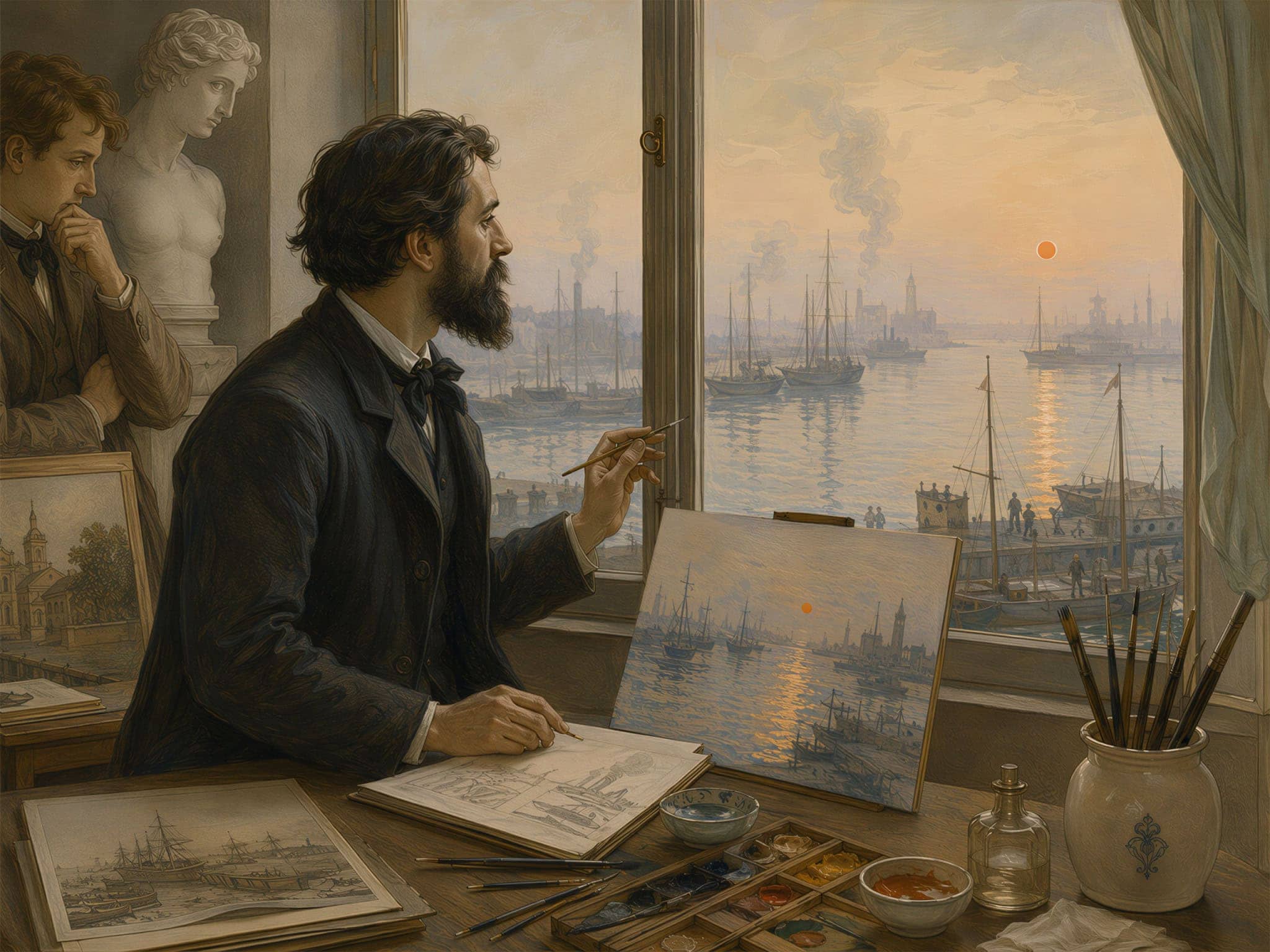
Monet stood at the window of his hotel room at the Hôtel de l’Amirauté. The sun rose through the mist at 7:35 a.m. He painted broad unblended strokes. He titled the result Impression, Sunrise.5
The painting was the artifact. The move was something else.
They had no style in common. Degas and Cézanne painted dark; Monet and Sisley painted light. The Metropolitan Museum puts it plainly: the group was unified only by its independence from the official annual Salon.6
What they shared was not a way of painting. It was a refusal.
On April 15, 1874, Monet exhibited Impression, Sunrise in Paris. Not at the Salon. He helped organise a competing exhibition at 35 Boulevard des Capucines, in the studio of the photographer Nadar, who was vacating his premises and had agreed to lend them.7
The official Salon opened on 1 May at the Palais de l’Industrie. They opened sixteen days ahead of it.
The timing was deliberate.
The Impressionists positioned themselves ahead of the Salon, not against it. They refused to wait for the Salon to reject them again.

Stephen Shaw
Two Weeks Before the Salon 2026. Digital impressionism-style painting.
The structure was deliberate.
The exhibition called itself the Société anonyme des artistes peintres, sculpteurs, graveurs— an Anonymous Society. A corporation.8 The painters had incorporated. They had a financial backer in the art dealer Paul Durand-Ruel, who was paying them in installments.9 Bohemian was a label other people would later apply.
The modern equivalent is the brand that operates as a different category of business than its competitors — defining itself not as “a better X” but as “the brand that does Y, which happens to include X.”
The hanging was deliberate.

Stephen Shaw
The Hanging Against the Hierarchy 2026. Digital impressionism-style painting.
The Salon’s system was hierarchical — prestigious works at eye level, lesser works “skied” near the ceiling where they were hard to see.10 The Impressionists hung their works in two rows only. Small below, large above. The structure itself was an attack on the Salon’s hierarchy of authority.
The modern equivalent is the brand that refuses to compete in its industry’s status markers — refusing the rankings, the peer reviews, the certifications, the awards.
The naming was not deliberate.

Stephen Shaw
Naming Impressionism 2026. Digital impressionism-style painting.
Ten days after the doors opened, Louis Leroy published a mock dialogue in Le Charivari and used the title of Monet’s painting to mock the entire group.11 They were Impressionists — producers of sketches, of mere impressions rather than paintings. The work was, in Leroy’s phrase, less finished than wallpaper in its early stages.12 Another critic wrote that the exhibitors “appear to have declared war on beauty.”13
They took the name. Not at once — they were still the Société anonyme in 1874, and the Metropolitan Museum records that the collective had deliberately avoided choosing a title that would imply a unified movement or school.6 They used Impressionist formally only at their third exhibition, three years later.
The modern equivalent is the brand that adopts its critics’ description as its identity — originally mocked for being “too direct,” “too plain,” “too quiet,” “too slow.”
By every measure available at the time, it failed. Three and a half thousand visitors against the Salon’s half million. Few sales. Reviews that ran from puzzled to hostile. The Société anonyme disbanded within the year.14
They did it again the following year, and six times after that — eight exhibitions between 1874 and 1886, against a Salon that never once acknowledged the point.
Three of the four moves were planned. The one nobody planned is the one that stuck.
It only changed which painters mattered for the next hundred and fifty years.

Stephen Shaw
1877 Impressionist exhibition in Paris 2026. Digital impressionism-style painting.
This pattern recurs.
Patagonia refused the apparel industry’s competition.
The industry measures fashion velocity, seasonal collections, growth rate. Patagonia measures the opposite — the lifespan of garments, the repair rate, the percentage of revenue donated.15 The apparel industry’s measurement system cannot rank Patagonia.
In 2022 the company made that permanent. Yvon Chouinard transferred ownership to a trust and a nonprofit collective and said the quiet part aloud: “the Earth is now our only shareholder.”15
Monet’s group escaped a jury by incorporating. Patagonia escaped one by giving the company away. Both refused the scorecard by changing what kind of thing they were.
The apparel industry’s Salon is still hanging paintings.

Stephen Shaw
Three Eras, One Shared Table 2026. Digital impressionism-style painting.
Which means the Impressionist story has been told wrongly for a hundred and fifty years.
This is where the standard story usually ends — bohemian artists, scorned by the establishment, vindicated by history. The story leaves out the move that actually mattered.
The Impressionists had been refused by the Académie.
They engineered an alternative system in which they could compete. They organised as a corporation. They timed their exhibition to precede the Salon. They restructured the hanging to undermine the existing hierarchy. They appropriated their critic’s mockery as their brand identity.
Each of these was a choice. Each of these was a strategy. Each of these was a move. The romance is in the brushwork. The mechanics is in the move.

Stephen Shaw
The Mechanics Is in the Move 2026. Digital impressionism-style painting.
The Académie selected on a single criterion.
It selected the painters who had agreed to be measured by it.
Monet painted in a way the Académie’s measurement system could not register as competent painting. His contemporaries were painting better light. The comparison did not arise.
Every dimension on which the Académie ranked, the Impressionists scored low.
- The brushwork was deliberately visible— the Académie measured invisibility of brushwork as the highest technical skill.16
- The subjects were indistinct — the Académie measured detailed rendering as the highest artistic achievement.
- The scenes were industrial and contemporary— the Académie measured mythological and historical subjects as the highest cultural value.
Every dimension on which the Académie did not measure, the Impressionists invented.
There is a complication in this, and it strengthens the point rather than softening it. The Salon of 1874 hung work not unlike theirs — recent scholarship at the National Gallery of Art, reuniting both exhibitions, found the two more alike than the story allows.14 Some of what the Société showed would not have looked out of place across town.
Which removes the last comfortable explanation. If the paintings were not the difference, the difference was everything around them.
Monet did not enter the Salon. He refused it. He did not just paint his way out. He scheduled his way out, hung his way out, incorporated his way out, and named his way out. The painting was the artifact. The system was the move.

Stephen Shaw
Choosing Paris’s Exhibition Path 2026. Digital impressionism-style painting.
Your competitors are still painting.
You are still painting.
We are all painting against each other in the same Salon, by the same critics, against the same standards.
The Salon did not close. It moved. The Salon now convenes inside the tools.
You cannot win a competition you have agreed to be measured by. The jury has been built into them. The infrastructure does the measuring.
Templates trained on the work that worked before. Design systems trained on the visual conventions that converted before. Conversion-rate optimisation algorithms trained on the headlines that performed before. AI-assisted copywriting trained on the prose that read as professional before. AI-generated layouts trained on the structures that ranked before.
Each tool was built by training on the dominant historical pattern of the work. Each tool, by its operation, reproduces that pattern.

Stephen Shaw
From Salon Judging to Digital Design 2026. Digital impressionism-style painting.
This is measured, not inferred.
In a controlled experiment, writers using a feedback-tuned model produced work significantly more similar to one another’s than writers working alone — and the untuned base model produced no such effect.
The homogenisation came from the tuning.
The users’ own contributions were unchanged; it was the model’s text that was less various, and the researchers concluded that the improvement in quality from training on human feedback “might come at the cost of more homogeneous and less diverse content.”17
The convergence is not confined to one model. Across more than seventy systems, open and closed, researchers found that different models independently converge on similar ideas with minor variations in phrasing — a condition they named the artificial hivemind.18
And the same study found something about the judging.
The automated graders — the reward models, the model-as-judge systems — are least reliable precisely where responses differ most from one another.18
The jury is not merely built into the tools. It is worst at exactly the thing it is supposed to reward.
The agent has changed. And the mechanism is identical.
The Académie was a panel of conservative judges who measured painters against the dominant pattern of acceptable painting. AI is a statistical engine that measures brands against the dominant pattern of acceptable work.
Both reward conformity. Both produce convergence.
Neither was designed with malice. Both are doing exactly what their structure rewards them for doing.
Every brand using AI to produce its work is being measured by it. The measurement is the production. The output is, by construction, the contemporary average. The contemporary average is, by construction, what every other brand using the same tools is also producing.
You have used these tools this week. The only thing on offer here is the observation that the room has a door. The Salon is no longer a building on a Paris boulevard. The Salon is the training data.

Stephen Shaw
The Salon Is the Training Data 2026. Digital impressionism-style painting.
Best practice has become a shared criterion.
Every brand at current best practice is measured against the same criteria as every other. The competition rewards execution. The execution is converging. The brands at the top of the convergence are interchangeable in the reader’s memory — visible while the tab is open, indistinguishable from each other once it closes.
The brands that escape this condition share one characteristic. They are measured against criteria the converging brands have not yet recognised.
The Monet move has one hard part. The recognition that the Salon is optional.
Most brands have never noticed they made a choice to be measured by their industry’s measurement system. The criteria felt like physical laws because everyone has agreed to them. They are only agreements. And agreements can be ended.
Some readers will hear this as a preference for emotion over reason, or feeling over function, or art over commerce. Those framings preserve the existing comparison structure and merely propose that emotional values should be added to it. They keep the competition where it is and try to win it differently.
The Monet move is harder.

Stephen Shaw
The Window at Le Havre 2026. Digital impressionism-style painting.
It is the architecture of a position that cannot be evaluated by the criteria the rest of the field is competing on.
The Salon is optional. You will not see this until you stop agreeing to it.
Look at the tools producing your brand work.
The website generators. The copy assistants. The layout systems. The conversion platforms. The measurement engines. Each was built by someone. Each was trained on something. Each is measuring all of us against criteria we did not set.
These are the new conditions. They are also the conditions of interchangeability.
The Palais de l’Industrie, where the Salon hung its half a million visitors’ worth of approved painting, was demolished in 1897 to clear ground for something else. Nadar’s studio at 35 Boulevard des Capucines is still standing.
The Salon is the training data. Don’t agree to exhibit. We don’t have to.

Stephen Shaw
The Room Has a Door 2026. Digital impressionism-style painting.
Frequently asked questions
What is a differentiation strategy?
A differentiation strategy is a decision about what your business is compared to, not how well it compares. It selects the criteria on which buyers evaluate you, rather than inheriting the ones the category already supplies.
Most strategies described as differentiation are not. They are quality claims — faster, cheaper, more experienced, better service — expressed on criteria the category already uses. A claim your competitors can also make is not a strategy. It is a scorecard entry.
The test is whether anything was refused. A position that costs you nothing has not moved you anywhere.
What is the difference between brand differentiation and competitive differentiation?
Competitive differentiation asks how you win the comparison. Brand differentiation asks whether the comparison happens at all.
The first accepts the category’s criteria and competes on them — a better score on shared dimensions. The second changes what is being measured, so the score becomes irrelevant. One is a move inside the game. The other is a move about which game is played.
The distinction matters commercially because they fail differently. Competitive differentiation erodes: any advantage on a shared criterion is copied, and the copying gets faster as the tooling improves. Brand differentiation does not erode in the same way, because a competitor cannot adopt your position without abandoning their own.
One is a better answer. The other is a different question.
What is market differentiation?
Market differentiation is differentiation applied to who you serve rather than what you offer — choosing a buyer the category serves badly, or does not serve at all, and organising around them.
It is often the cheapest form available, because it requires no product change. The company that serves only founder-led firms under thirty people, or only regulated industries, or only clients who have already failed once elsewhere, has changed its comparison set without altering a single deliverable.
The constraint is the same as every other form. If the segment you chose would accept everyone, you have not chosen a segment.
How do you measure brand differentiation?
Not by asking buyers whether you are different. They will say yes, because the question suggests the answer.
The usable measures are structural.
- Recall without prompting: can a buyer, a week later, state what you do differently without the list in front of them?
- Refusal volume: how many enquiries have you declined this year for reasons of fit rather than capacity — none is a diagnosis.
- Comparison sets: when a buyer names who else they considered, are they naming your competitors or a different category entirely?
The last is the strongest signal available. A brand that is genuinely differentiated is compared to the wrong things.
How do you create brand differentiation?
By publishing the scorecard, not by improving your score on the existing one.
Addition rarely produces it. New features, new services and new claims are available to everyone and get copied within a season. What cannot be copied is a set of criteria a competitor would have to abandon their own position to adopt.
The sequence runs in one order. Establish the terms the decision should turn on. Show why those terms are the ones that matter. Then build the business so it is the obvious answer to them.
Most brands attempt this in reverse, and produce a longer list of things they do well on somebody else’s criteria.
Can you differentiate on price?
Only if the price is a consequence of a position, not a position in itself.
Price is the most copyable variable in any category — a competitor can match it on a Monday. What cannot be matched is the structure that makes the price possible: a cost base built differently, a segment served exclusively, a service scoped tighter than the field’s. Companies that appear to have differentiated on price have almost always differentiated somewhere else, and the price is the visible residue.
The exception proves the rule. A price so far outside the category’s range that it reframes what the buyer is purchasing is no longer a price. It is a claim about what kind of thing this is.
Why do differentiation strategies fail?
The common failure is not weak execution. It is that the strategy never required anyone to refuse anything.
A position that costs nothing attracts nobody. Differentiation works by making the category’s comparison unusable, and that requires declining the criteria everyone else competes on — at which point firms reliably flinch. The benchmark is met after all. The certification is obtained. The scope is matched. What survives is a description that offends no one and moves no one.
The second failure is subtler: differentiating on a criterion the category can absorb. Every dimension the field already measures is available to every firm in it. An advantage on a shared criterion has a shelf life, and the tooling keeps shortening it.
Is being better than your competitors a differentiation strategy?
No. Being better is a claim measured on criteria your competitors helped establish and can therefore also meet.
It also arrives too late. A buyer comparing you to two rivals has already decided the three of you are similar enough to compare — the category has been accepted, the criteria have been accepted, and the only remaining question is who scores highest. Winning that comparison is worth less than not appearing in it.
Better is a position on a ladder somebody else built. Different is a decision about whether to climb it.
What is Monet’s Method™?
Monet’s Method™ is a conceptual model, developed at An Artful Science, for changing the criteria a brand is judged by rather than competing more effectively on the criteria it inherited.
It is named for the move Claude Monet made in 1874, which was not painting better. Refused by the Salon, he and his colleagues incorporated as a company, opened an exhibition two weeks before the Salon’s, inverted the Salon’s hanging hierarchy, and took their critic’s insult as their name. Each was a decision about the system, not the work.
The model has one hard part, and it is not creative. It is the recognition that the criteria were an agreement, and that agreements can be ended.
Why is differentiation harder now that AI writes marketing copy?
It is not harder. It is being tested faster.
The tools were trained on the work that already existed and reproduce its dominant pattern by construction, so every company running the same models against the same benchmarks arrives at the same contemporary average. The floor has risen — bad work has largely disappeared — and the ceiling has come down with it, because the techniques that used to distinguish exceptional work were absorbed into the standard.
But the convergence is not the problem. It is the diagnosis. Expression was always copyable; a claim, a proposition, a sharpened one-liner could be echoed by a competitor within a quarter. AI has only compressed the quarter into an afternoon. What it cannot reproduce is the structure underneath — a method built differently, a segment served exclusively, a business a rival would have to dismantle their own to imitate. That distinction is what The Uniqueness Protocol™ tests for.
What survives a machine trained on everything is the part that was never in the words.
Do you have to change what you sell to differentiate?
Usually not. What changes is the system you agree to be measured by, and that is a different decision from what sits in the deliverable.
Monet did not paint a different subject to escape the Salon. He changed when he exhibited, who he exhibited with, how the work was hung, and what the group was called. The paintings were the artefact. The move was structural, and none of it required a new product.
The same holds commercially. Who you decline, what you refuse to quote for, how you are organised, what you measure and publish — these change the comparison set without touching the service.
The service is rarely the problem. The scorecard is.
Index
Sources referenced.
- The Art Institute of Chicago. “Paris Salons (1673–present).” The Art Institute of Chicago Research Center. The first Salon was held in 1667 under the Académie royale de peinture et de sculpture, and the institution dominated French artistic recognition for more than two centuries. The same guide records that in 1863 the Salon des Refusés was held by command of Napoleon III for artists whose works had been rejected by the official Salon.“
- Salon (Paris).” Wikipedia. The Académie des Beaux-Arts traces its origins to the Académie royale de peinture et de sculpture, founded in 1648 by Cardinal Mazarin, chief minister of France.
- National Gallery of Art. “Claude Monet.” Monet was born in Paris on 14 November 1840 and was thirty-one years old in November 1872, when he painted Impression, Sunrise.
- National Gallery of Art. “1874: The Birth of Impressionism.” 2024. On the Franco-Prussian War’s defeat and Monet’s flight to London: “Three years before the Société Anonyme exhibition, France suffered a humiliating defeat in the Franco-Prussian War in 1871.” See also Halcyon Gallery, “Claude Monet | Biography,” on Monet’s London exile and his introduction to Paul Durand-Ruel during this period.
- Olson, Donald W. Research published in Monet’s “Impression, Sunrise”: The Biography of a Painting, ed. Marianne Mathieu and Géraldine Lefebvre. Paris: Musée Marmottan Monet/Hazan, 2014. Olson reconstructed the view from historical photographs, fixed high tide from the open harbour lock gates, and used weather records and the eastward curve of the smoke plumes to narrow nineteen candidate dates to one. The exhibition curators concluded 13 November 1872, 7:35 a.m. local mean time, as the most probable date.
- Samu, Margaret. “Impressionism: Art and Modernity.” Heilbrunn Timeline of Art History. New York: The Metropolitan Museum of Art, October 2004. The Met records that the group was “unified only by its independence from the official annual Salon,” and that the exhibiting collective “avoided choosing a title that would imply a unified movement or school,” with only some of them subsequently adopting the name Impressionists.
- National Gallery of Art, “1874: The Birth of Impressionism.” On the venue: “The photographer Nadar offered to host the exhibition in his studio at 35 Boulevard Capucines.” See also Musée d’Orsay, “Tonight with the Impressionists. Paris 1874,” Musée d’Orsay, 2024, which confirms the exhibition opened on April 15, 1874 at 8:00 p.m. on the second and third floors of Nadar’s former studio building.
- National Gallery of Art, “1874: The Birth of Impressionism.” The exhibiting collective formally constituted itself as the Société anonyme des artistes peintres, sculpteurs, graveurs, etc. and announced an “open exhibition, without juries or prizes” on January 17, 1874.
- Halcyon Gallery. “Claude Monet | Biography.” On Durand-Ruel’s role as the Impressionists’ principal commercial backer. See also Susan Tallman, “Manet and Morisot: Game On,” The New York Review of Books, May 14, 2026, on Durand-Ruel’s instalment-based payments to the group during the early 1870s.
- Sotheby’s. “The Paris Salon’s Outsize Impact on Art History.” “The phrase ‘salon style’ comes from the overwhelming manner in which works of art were installed: floor-to-ceiling arrangements that filled every available wall.” The hang was crowded by submission volume and ranked within that crowding: works skied near the ceiling were systematically harder to view. The Impressionists’ two-row, eye-level hang was a deliberate inversion of the convention.“
- Louis Leroy.” Wikipedia. Leroy’s review, “L’Exposition des Impressionnistes,” was published in Le Charivari on 25 April 1874 — ten days after the exhibition opened — as a satirical dialogue between two sceptical viewers. The naming was therefore a response to the exhibition, not a decision made before it.
- “Louis Leroy.” Wikipedia. The full translation of Leroy’s dismissal of Impression, Sunrise: “Impression I was certain of it. I was just telling myself that, since I was impressed, there had to be some impression in it — and what freedom, what ease of workmanship! A preliminary drawing for a wallpaper pattern is more finished than this seascape.”
- Prodger, Michael. “First Impressions.” The Critic, April 2024. Prodger documents the contemporary critical reception of the first Impressionist exhibition, including the “declared war on beauty” charge.
- National Gallery of Art, “1874: The Birth of Impressionism.” The 1874 Salon drew approximately 500,000 visitors; the first Impressionist exhibition attracted 3,500 over its month-long run. The NGA also records that the exhibition “failed by conventional metrics” — poor attendance, few sales, hostile reviews — and that the Société Anonyme disbanded. The accompanying Paris 1874 catalogue reexamines impressionism’s position in relation to the Salon, “which exhibited works strikingly similar to those included in société anonyme’s exhibition.”
- Patagonia. “1% for the Planet.” Patagonia has given to grassroots environmental organisations since 1985 and formalised the pledge as one per cent of sales — not profits — in 1996, awarding more than $140 million to date. On repair, the Reno facility is the largest apparel repair centre in North America at approximately 40,000 repairs a year, within a global programme of more than 100,000 items across 72 centres. In September 2022 Yvon Chouinard transferred ownership to the Patagonia Purpose Trust and the nonprofit Holdfast Collective, under the statement that the Earth is now the company’s only shareholder.
- Samu, Margaret. “Impressionism: Art and Modernity.” Metropolitan Museum of Art. On the Impressionists’ technical departures from academic painting: “short, broken brushstrokes that barely convey forms, pure unblended colors, and an emphasis on the effects of light. Rather than neutral white, grays, and blacks, Impressionists often rendered shadows and highlights in color.” These techniques inverted the Académie’s criteria of invisible brushwork, detailed rendering, and traditional palette.
- Padmakumar, Vishakh, and He He. “Does Writing with Language Models Reduce Content Diversity?” International Conference on Learning Representations, 2024. Controlled experiment across three conditions — a base model, a feedback-tuned model, and no model. Writing with the tuned model, but not the base model, produced a statistically significant reduction in diversity, increasing similarity between authors and reducing lexical and content diversity. The effect was attributable to the model’s contributions; the users’ own text was unaffected.
- Jiang, Liwei, et al. “Artificial Hivemind: The Open-Ended Homogeneity of Language Models (and Beyond).” NeurIPS 2025, Datasets and Benchmarks Track, Best Paper Award. 26,000 open-ended queries across more than seventy open and closed models, with 31,250 human annotations. Documents intra-model repetition and, more critically, inter-model homogeneity — different models independently converging on similar ideas with minor variations in phrasing. Also finds reward models and model-judges least well calibrated to human ratings precisely on generations that elicit differing preferences.
About the author
Article by Stephen Shaw, brand strategy consultant and founder of An Artful Science.
❡ Related Post:
Motivate

