
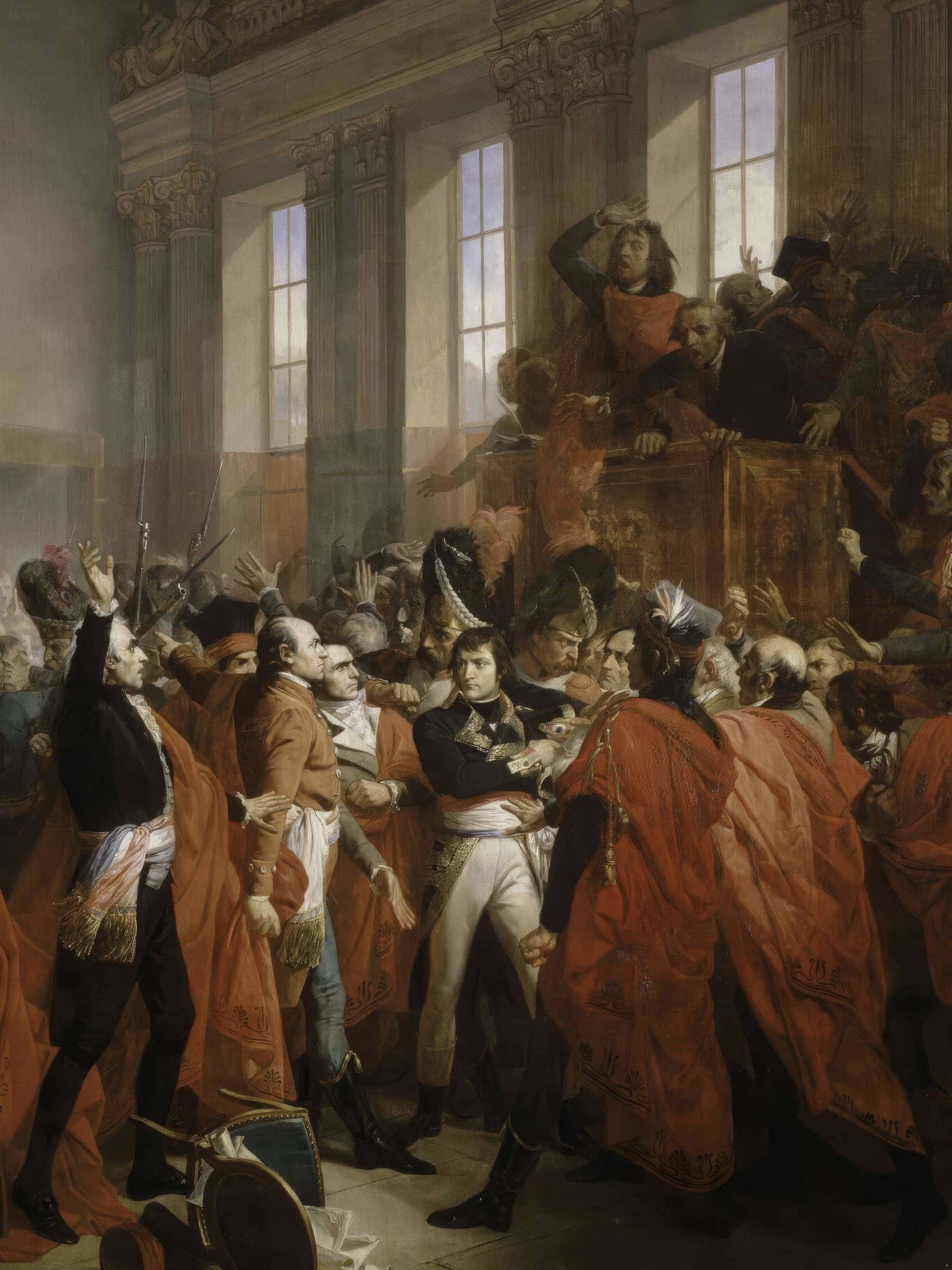

How do you market to high-net-worth individuals?
You don’t win the wealthy by reaching them. You become the name they are handed — or the name that holds up when they go looking. Either way, you are examined before you are met.
So this is ultimately a trust problem, not simply a reach problem: the first verdict is often reached before the meeting, in a room you never enter.
And lately, someone else has entered the room.
Take the deal that built modern America.
The year, 1901.

Stephen Shaw
The deal of a century 2026. Digital 1900’s-style painting.
Andrew Carnegie owns the largest steel empire on earth, and J. Pierpont Morgan wants it. Carnegie does not run an auction; Morgan does not come calling.
Morgan sends word through a man both of them trust: Charles Schwab, president of Carnegie Steel.
Schwab raises it after a round of golf. Carnegie sleeps on it.
The next day he hands Schwab a sheet of paper with a single number on it — $480 million — and Schwab carries it across town.
Morgan reads the paper and says four words: “I accept this price.”
No haggling.
The deal that would create the world’s first billion-dollar corporation, agreed on a slip of paper and a name.10 The formalities would take longer. The decision did not.
Notice who is not in that room.
Carnegie never shopped for a buyer; Morgan never pitched. The deal moved through a third man whose word both titans took because they already trusted him, on reputations neither of them had to look up.
Almost anyone could have carried a sheet of paper across town. Schwab could carry the proposition because he had standing with both men.
The price was accepted in moments. The confidence that made it possible had been forming for years.
A century and a quarter later, the cheques are smaller and the names are different, and almost nothing about this has changed.
It still happens in rooms you will never enter.
A woman who has just sold her company sits across a desk from her accountant — the adviser she already trusts, her Schwab. She slides the valuation across to him, a number with an unfamiliar run of zeros, and asks the only question that now matters to her: who should I trust with this money?

Stephen Shaw
The pause across the desk 2026. Digital 1900’s-style painting.
He pauses — two seconds, perhaps three — and scans his memory for a name he can vouch for without lying awake. Whichever name surfaces is somebody’s Morgan moment: a firm wins or loses in that pause, in a room it never entered, on a reputation the accountant did not have to look up.
But what is he remembering in those two seconds?
A name, certainly. More than that, the reasons he would give if she asked him why. He is not recalling a firm. He is deciding whether he can defend repeating it.
This is why the wealthy behave as they do.
Like Carnegie, many of them do not shop.
In a Dynasty Connect survey of a thousand adviser-using investors holding at least $500,000 in investable assets, 57% had spoken with only one adviser before hiring. Asked how they had found an adviser, 46% said they were referred by a friend, family member or colleague, and 23% by a professional such as an accountant or lawyer.1
It looks like carelessness. It is better read as a sign of where the comparing happens: not across a table of rival advisers, but earlier — in the referral, in the pause, in what the client has already read and heard.
For some, as for Morgan, the meeting is where a decision is announced rather than made.

Then the evidence complicates the picture.
Look higher up the wealth curve and the story bends. When Ficomm Partners and Absolute Engagement asked a thousand advised investors in 2026 how they had found their current adviser, about half of those with $5 million or more said no referral had been involved at all. Only 31% had relied on a referral alone.11
Even the 2023 survey had hinted at it: almost a quarter of its respondents had found an adviser online.1
Different survey, different question, different people; neither cancels the other. But together they show what the familiar story leaves out.

Sometimes Schwab brings the name to Carnegie. Sometimes Carnegie finds it without him. Some do both: in the 2026 survey, 15% had been given a referral and checked the adviser another way anyway.11
Schwab still matters. He no longer has to make the introduction.
So the question this Briefing asks about marketing to high-net-worth individuals is not how to reach them. It is how to become the name that surfaces in the pause, and holds up when someone goes looking. And in the last hundred years, one thing has finally changed: Schwab’s is no longer the only chair.
How high-net-worth clients actually choose
High-net-worth clients rarely choose an adviser by comparing firms side by side. The decision is often shaped before the first meeting: by the accountants, lawyers and peers around them, and by what they find when they look the firm up for themselves.
So who shapes the decision before the meeting?
At the very top, it is mostly people the client already trusts. Among the ultra-wealthy — households worth more than $25 million — a CEG Insights survey of 350 found that 58.6% had found their adviser through a referral, and that business associates and investment bankers alone accounted for nearly 30% of new relationships.²
The wealthy are not short of people to ask, either.
TIGER 21’s members, each with at least $20 million in investable assets or qualifying net worth, meet monthly in small groups. The group’s signature ritual is the annual Portfolio Defense, in which a member stands up and defends part of their affairs to those peers — in the first year, their entire investment portfolio.⁹
At the top, the networks are dense, candid and closed.
And here is the part the standard playbook misses: density is not flow.
A peer is someone a wealthy client may ask. A professional is often someone already in the room when money moves — when a company sells, when an estate passes — because those transactions run through lawyers and accountants.
Nor is a peer’s vouch the same instrument as a professional’s.
- The peer knows the firm as a client and says, in effect, they looked after me.
- The professional knows it as a colleague and says, I have watched them work, across many families.
One is a testimonial; the other is a reference.
A firm needs both, and it pays to know which each of its advocates can honestly give.
In 1901, Carnegie and Morgan were peers.
The deal still moved through Schwab.

Stephen Shaw
A crossroads of influence and secrecy 2026. Digital 1900’s-style painting.
Now the reflex most firms reach for.
Advertise harder.
It is the reflex behind most wealth management marketing, and it is half right.
An advert can put a name in front of the right people, place a firm in the right company, and give a prospect a reason to look. What it cannot do is make a firm trusted by saying so, because any firm with a budget can say the same thing.
The difference is between communication that asserts and communication that gives people something to examine. Trusted by families for three generations asserts. A plain account of how the firm handles a concentrated stock position after a sale — who does the work, what it costs, where the conflicts lie — gives a prospect something to weigh.
It is also what advised investors say they value.
In the 2026 Ficomm survey, about three-quarters rated a demonstrated understanding of their specific needs as very important, ahead of regular contact and shared content.11
The first kind invites the search.
The second gives it something to find.
What you are actually building
Follow the incentive and it clarifies.
When the accountant refers you, he is not doing you a favour. He is lending you his credibility and standing surety for it — exactly as Schwab put his name behind the number he carried. A referral is a bet placed with the referrer’s own reputation as the stake.
If you do well, he gets little of the credit. If you don’t, he answers for it to a client he may have served for twenty years.
The introduction is not the source of trust. It is the moment accumulated trust is put to use.
And even a referrer who has seen the work cannot know how the next engagement will end. Advice is what economists call a credence good: hard to judge before you buy it, and often hard to judge after.13
If a client’s portfolio grows 8% in a year, was that good advice or just a good market?
There is no second portfolio, run by someone else, to compare it with. So the referrer does what any careful lender does.
He reads the record.
Which is why the thing you are really building has less to do with marketing than with credit. Authority works like a credit history for trust. A lender still makes its own decision on every loan and still carries the risk; the history does not decide for it. But it narrows the uncertainty and makes saying yes defensible. The accountant extends you his trust on the same terms: your record lets him judge the risk; it does not remove it.
And the client researching alone, with no Schwab to read the record for her, needs it even more. It has to make sense to a stranger as well as to a friend.
You cannot buy that record outright. You can hurry the evidence; you cannot hurry the judgement of the people reading it. And it is never finished, because it can be lost.
That is the real product. Not the marketing.
A record solid enough that vouching for you feels like a reasonable risk.

Stephen Shaw
The credit rating of trust 2026. Digital 1900’s-style painting.
Then the machine walked in
For a century, Schwab’s chair was the only one in the room. Now a second figure has pulled up a seat — and it never played golf with anyone.
The wealthy now research the way everyone does — through a screen, and increasingly through an answer engine. And the generation set to inherit is the one most fluent in it.
Bank of America’s 2026 study of more than 1,400 wealthy Americans holding at least $3 million in investable assets found that 47% of its younger investors, aged 21 to 45, already use AI to research companies or markets, and 87% are comfortable with advisers using it to help manage portfolios.3
Some have started using it to find the adviser: in the 2026 Ficomm survey, nearly 9% had used an AI tool to find one.11 The industry is moving the same way. In Fidelity’s 2025 survey, more than two-thirds of wealth-management professionals said they already use generative AI, although about half of those were still piloting it.5
The obvious reading is that AI threatens advisers.
It isn’t the interesting one.
The trust has not moved with the usage.
Sixty-five percent of those same younger investors still prefer their investment advice from a human adviser,3 and in CFA Institute’s survey of Gen Z and millennial investors in six countries, human advisers remained the single most trusted source of investment guidance.4
They use the machine and they trust the person, and see no contradiction.
So AI has not replaced the referral, or taken Schwab’s chair.
It has taken the seat beside it.

Sometimes it suggests the name. Sometimes it checks a name the accountant suggested. Sometimes it is the second opinion a client gets before she calls anyone. Surfacing a firm, citing its work and recommending it are three different acts, and a machine may do one without the others.
Whichever it does, it can carry more than a name. It can carry an explanation too: the firm’s published methods, its credentials, even an account of how it handled a difficult decision. What it cannot carry is what the accountant has accumulated in years of watching the firm work.
His judgement has a history, and when he recommends a name, his own reputation goes with it.
The machine can retrieve the record. It cannot have lived it.
It works only from what it can find, and that is more than the firm itself wrote. The accountant never had to look the firm up; the woman across his desk might. Suppose she puts the name he gives her to an answer engine. Alongside what the firm has published, it may find an entry on a regulator’s register, a public filing, a news story from years ago. Some of that will support the firm’s account of itself. Some may contradict it. Some will simply be out of date.
The machine can set all of it in front of her. It cannot vouch for a word of it, and no one can take it to lunch, flatter it or charm it. It can only be given better evidence to read.
Nor does it simply repeat what comes top in Google.
BrightEdge found that most of the sources cited in Google’s AI Overviews, the summaries now shown above the search results, are not among the top ten results themselves. In finance, barely one in nine is.6
The technology changed who can carry the name. It did not remove the need for grounds to trust it.
And it inverts the old problem.
For a century, the hard part of marketing to the wealthy was access to the people who could carry a firm’s name into rooms it would never enter. Now a client can meet the name without any of them — about half of the Ficomm survey’s $5 million-plus investors found their adviser with no referral involved11 — and without anyone who has watched the firm work.
Underneath this may run a deeper current.
Younger investors say they value what can be checked — credentials, transparency, clarity about cost — alongside empathy.4
That is far closer to what a machine can read than rapport ever was.
The move to AI research and the move to evidence-based trust may be the same trend arriving through two doors. If so, charisma, the oldest asset in wealth marketing, is being quietly marked down.
Evidence is being marked up.

Stephen Shaw
The Second Chair 2026. Digital 1900’s-style painting.
What every version of this has in common
Now look at all of it at once.
Carnegie on the golf course. The woman at her accountant’s desk. The heir typing a firm’s name into a search box. The answer engine assembling its two or three sources.
The routes differ. In some, a trusted intermediary supplies the name. In others, the client finds it and goes looking for corroboration — from her accountant, from her own research, from a machine. What every version shares is that the firm is examined before it is heard.
Most high-net-worth marketing is aimed squarely at the wealthy individual. It can start that examination. It cannot settle it.
Attention gets a name looked up; what happens next depends on what is there to find.
The mistake was never marketing to Carnegie. It was assuming the pitch would be his first encounter with the firm.
Schwab may provide the introduction. Carnegie may find the name himself. Either way, someone looks behind the name before they meet you. And when no one who knows the firm is there to vouch for it, what are they supposed to find?

Stephen Shaw
The list they did not draw 2026. Digital 1900’s-style painting.
The pattern, named
A painting can hang unchanged for a century while the name attached to it changes. The canvas is the same. The pigments are the same. Yet a new attribution can move its value from a few hundred pounds to several million, or back again.
It happened, famously, in Berlin.
For decades, The Man with the Golden Helmet was celebrated as a Rembrandt: an old man, his face half in shadow, beneath a helmet laid on in paint so thick it catches the light. In 1985, the curator responsible for it, Jan Kelch, announced that it was probably not by Rembrandt at all.18
A technical study at Munich’s Doerner Institut followed — X-radiography, infrared photography, analysis of paint samples — and the museum concluded that it was the work of someone in Rembrandt’s circle, painted around 1650–60.19
Not a brushstroke had changed.

Circle of Rembrandt Harmensz. van Rijn (1606–1669)
c. 1650–60, oil on canvas, 67.5 × 50.7 cm (Gemäldegalerie, Staatliche Museen zu Berlin, Berlin). Long attributed to Rembrandt; reattributed to his circle after 1985.
Reporting the news, TIME still called it “one of the most famous and most majestic portraits ever painted”; its essayist insisted it was “as great as it ever was”, then admitted that “the change somehow diminishes the picture.”
Its estimated value fell from about 20 million marks to roughly a twentieth of that, a loss of some 95%.18
What changed?
Not the painting. The evidence behind the name.
That evidence is the work of scholars — above all the author of the catalogue raisonné, the reference that records a painter’s accepted works.
Their authority is not advertised into being. It is built, painting by painting, paper by paper, over decades, and it holds for a reason the market rarely says aloud: a serious attribution rests on a body of evidence others can examine — provenance, technical analysis of canvas and pigment, the documents that mention the work, the scholarship behind the catalogue.
The Golden Helmet was not demoted by anyone’s marketing. It was demoted by evidence.
Now set the three side by side.
- The accountant carries a recommendation.
- The scholar carries an attribution.
- The machine carries a citation.
Three different acts, three different kinds of evidence, and each raises the same question: what justifies putting this name forward?

Sometimes a name travels with someone’s judgement behind it. Sometimes it travels with a record others can examine. But without either, it is only a name.
The name is not enough. What matters is what travels with it.
That is what a firm marketing to the wealthy is really building: a record that can travel without it.
It has a name of its own.
This is The Canon Effect™: authority built not through volume of output but through publication inheritance, a body of work in which each piece inherits and reinforces the last, so the firm’s thinking can be followed, tested and recognised by name.
Frequency rents familiarity, and familiarity fades the day you stop paying for it. A body of work can keep being found, because it is sought rather than served.

Stephen Shaw
The Canon Effect 2026. Digital 1900’s-style painting.
And in the age of AI, that body of work faces a new examination: call it The Two-Judge Test™. Your firm is judged, in parallel, by the two who now carry your name: the human intermediary who decides whether to refer you, and the machine that decides whether to surface or cite you.
Schwab and the algorithm.
Each returns its own verdict.
- The Referral Verdict: does a knowledgeable intermediary have enough confidence in the firm’s expertise, conduct and suitability to introduce it to a client?
- The Retrieval Verdict: is the firm’s knowledge accessible, identifiable and well enough supported to appear in AI-assisted research?
They sound like the same test.
They are not.
Every recommendation carries an invisible citation.
- When the accountant puts a firm forward he supplies no footnote; his reputation is the footnote, backed by what he has seen — how you behaved when markets fell, how you treated a client’s children, whether you returned the call.
- When a machine cites a firm, the footnote is visible: it points to information a reader can examine for themselves.
One is testimony grounded in experience; the other is evidence offered for inspection.
Neither guarantees the recommendation is right. The machine reaches people Schwab will never meet, but sees only what it can find. A citation is not a verdict on competence, and a sterling private reputation is no guarantee of being found.
That a firm gets checked before the first call is no longer news to the best people in wealth marketing. The harder question is what happens when the two checks disagree — and that is where the test earns its keep.
Picture two firms.
- The first gets steady introductions from accountants who have watched it work for years, and barely exists when a prospect researches its specialism. Its reputation is real and almost invisible.
- The second turns up in AI answers again and again, and offers little that anyone could independently check about the experience its articles imply. Its visibility is real and almost empty.
Each has passed one judge and failed the other.
The first needs evidence it can be found by; the second, evidence it can be trusted on. The Two-Judge Test exists to tell a firm which of the two it is, and what is missing.
Reach passes neither.
It can tell both judges that you exist. It cannot show either of them that you are any good.
The Canon Effect is the asset. The Two-Judge Test is the examination it must pass.

What this means for attracting high-net-worth clients
Attracting high-net-worth clients now depends less on being introduced than on holding up once you are. The referral still opens the door; the record decides whether anyone walks through it.
The timing makes that urgent rather than merely true.
UBS estimates that $83.5 trillion will be passed on worldwide over the next two decades or so, about $9 trillion of it first between spouses. Separately, 81% of the inheritors Capgemini surveyed say they plan to switch firms within one to two years of inheriting.⁷
That is a stated intention, not a forecast.
It is tempting to read those numbers as an opportunity: a generation of clients about to choose again. But the great wealth transfer is not, mainly, a chance to win the children. It is a test of the relationship moat: whether a firm’s hold on a family survives the person who built it.
Think of the daughter who inherits.
Her father chose the firm and judged it across twenty years of decisions made together; to her, it may be little more than a letterhead on his statements. She inherits the assets, and perhaps the relationship. What she does not inherit is his confidence, because she is not asking his question.
He wanted to know whether the firm had looked after him. She wants to know whether it understands the decisions that are now hers to make, and whether it will listen to her as it listened to him. So she checks for herself, through her own accountant, her own research or an AI tool.
The firm is back in front of both judges, as if for the first time.
The family’s history may earn the firm a hearing, but the moat most likely to survive the handover is a record she can examine for herself.
Wealth can be inherited. Confidence has to be established again.
Which brings us back to what a firm is actually building: a record that can travel without it.

Stephen Shaw
The bridge of inheritance and knowledge 2026. Digital 1900’s-style painting.
So don’t choose between Carnegie and Schwab.
Earn the confidence of the professionals closest to your clients’ consequential decisions — the accountant, the lawyer, the banker who understands the circumstances and has a reputation of their own to protect. Then make sure that whatever Carnegie finds when he looks you up, on his own or through a machine, holds up.
There are early signs that this pays.
In Kitces Research’s 2026 study, high-growth advisory practices drew about 8% of new-client revenue from brand-building — articles, blogging, podcasts, video — against about 1% for other growing practices, and less from client referrals.12
The study can’t say publishing caused the growth. It does show that the fastest-growing firms depend less on client referrals and more on channels they build themselves.

That asset is The Canon Effect™, built in four stages:
1. The Belief — target the belief, not the topic.
Solve a problem and you compete with everyone who can; move a belief and you help set the terms they compete on. Pick one problem a busy accountant — or a client researching alone — could name in a sentence, and decide which belief you will move before you publish.
Patek Philippe did this from the autumn of 1996, when its Generations campaign put the bond between parent and child ahead of the watch itself. By early 1997 the line had arrived: you never really own one; you only look after it for the next generation.16 The campaign reframed a luxury object as a legacy rather than a possession, offering buyers a different reason to value the same object. That is the first stage only: what a deliberate reframing looks like. The other three turn one such move into a body of work.
2. The Name — name what you own.
Coin the vocabulary: a framework, a named property, a term the field can use to discuss the problem. An unnamed idea can disappear into the language of the field. Give it a distinctive name and it becomes easier to recognise, discuss and attribute — for a machine summarising it, and for an adviser passing it on, who gets a handle and a reason you look like the discerning choice rather than merely a competent one.
Naming does not guarantee ownership or citation. It gives the idea an identity others can carry forward.
3. The Line — publish on inheritance, not volume.
Belief does not change in one sitting; it chains. Each piece must inherit the last and move the reader one defensible step further, until the adviser has been walked to conviction, not mere recognition — and anyone checking, human or machine, finds one coherent, evidenced argument rather than ten isolated claims.
Consistency is not corroboration; that is what the next stage is for.
The enemy is content fragmentation: work that stands alone and resets the persuasion to zero. Volume builds familiarity; inheritance builds an argument.
4. The Test — pass the coherence test, both versions of it
A coherent argument is not proof that a firm can deliver what it promises. So examine the record at three levels: what the firm asserts; what it can demonstrate, through documented decisions, methods or anonymised cases; and what someone else can verify independently — credentials, regulatory records, corroborated evidence of delivery.
Then put it to both judges.
- For the Referral Verdict: do the professionals closest to your clients know what you specialise in, have they seen you deliver it, and could they say in a sentence why you?
- For the Retrieval Verdict: when someone asks the questions your clients ask, does the firm appear, is it described accurately, and does the material cited actually support what is said?
None of this is fast, and the slowness is part of the defence. A competitor can outspend you on reach next quarter. It cannot borrow your record. Reach is rented, and resets. A record is earned, and keeps working for as long as it stays true — in the moments you are not there: the pause across the desk, the search the client runs without him, the answer forming inside the machine.
You cannot be present for every introduction, every private conversation or every search. You cannot control which route brings someone to your name, or what an intermediary will recommend or a machine will retrieve.
But your work can be there.

Its methods, decisions and evidence can be found, examined and passed on long after the original conversation has ended.
In 1901, a price crossed town on a sheet of paper, carried by a man with standing on both sides. Today your name travels with whatever you have given it to carry.
The first meeting is still yours to win. But the examination often begins without you, in a room you never enter.

Stephen Shaw
The trusted advisers chamber 2026. Digital 1900’s-style painting.
Frequently asked questions
What counts as a high-net-worth individual, and what is ultra-high-net-worth?
High-net-worth individuals (HNWIs) are defined by bands of investable assets, excluding the primary residence, and the cut-offs vary by source. Capgemini uses $1 million or more for high-net-worth, $5–30 million for its mid-tier band (often called very-high-net-worth) and $30 million or more for ultra-high-net-worth.8 The money is heavily concentrated: the top 1% of high-net-worth individuals hold 34.8% of the group’s wealth. The bands matter in practice, for minimums, service models and regulation. But for a firm deciding whom it can serve well, complexity often matters as much as the band. A family with an operating business, trusts and property abroad, for example, may bring more professionals into each decision than a richer family with a single portfolio. The same holds when marketing to ultra-high-net-worth individuals: the more complex the affairs, the more professionals have a say.
What are the key traits of high-net-worth clients?
Two traits show up clearly in the data. Their provider relationships are distributed: only 19% of HNWIs now work with a single wealth firm, down from 39% in 2019. And few are fully satisfied: 17% describe their advisory experience as seamless and personalised.8 Using several firms doesn’t mean clients are constantly comparing them. It can mean that no single firm sees the whole of their affairs, which is where gaps and repeated questions come from. Among younger affluent and wealthy investors a third trait stands out: they expect to take part. CFA Institute’s 2026 survey of Gen Z and millennial investors found they expect an active role in planning, most of those with a paid adviser are in touch at least monthly, and they value credentials and transparency alongside empathy.4
What do high-net-worth clients want?
High-net-worth clients may want the complexity handled for them. That doesn’t mean they want the decisions made for them.
Picture a family settling a parent’s estate across two countries. They want the probate lawyers, the tax advisers on both sides and the wealth manager to coordinate the filings and the reinvestment without the family chasing each of them. They still want to understand, and decide, what happens to the money and who controls it. They should not have to wonder who has seen the family’s papers, who owns the next step, or why one adviser is asking a question another has already answered. Firms often get this backwards: Capgemini’s 2026 report found that 42% of HNWIs have to restate their goals and preferences multiple times, even to the same firm.8 That is complexity the client is carrying and the firm should be absorbing. The opportunity is to take on the work while leaving the client firmly in charge of the choices.
How many people are high-net-worth?
About 25.3 million worldwide at the end of 2025, holding $98.3 trillion between them. Roughly 8.7 million are in the United States, and about 250,000 globally are ultra-high-net-worth.8 Few firms can serve more than a sliver of that. The market that matters is the clients whose needs match the firm’s expertise, and the routes by which they come to consider it: their own research, an introduction from a professional, or an AI-assisted search. A useful test: can you say which route each of your last twenty clients arrived by?
How do high-net-worth individuals choose a firm or adviser?
In three steps that don’t always happen in the same order: discovering a firm, checking it, and deciding. Where a family runs its own office, a managing director or chief of staff there may also decide which introductions go any further before the family agrees to meet. Older research made the first step look like a referral: Dynasty Connect’s 2023 survey of adviser-using investors with $500,000 or more found that 46% had been referred by friends, family or colleagues and 23% by a professional such as an accountant or lawyer.1 Newer research shows more independent discovery at the top. In Ficomm Partners and Absolute Engagement’s 2026 survey, about half of investors with $5 million or more said no referral was involved in finding their current adviser.11 The surveys differ in sample and question. They reveal different discovery patterns, and together they cannot establish a single dominant route. What they do show is that a name can arrive one way and be tested another: 15% of all respondents in the 2026 survey received a referral and still checked the adviser another way before getting in touch.11 A firm has to hold up on every route.
Why do referrals matter so much to wealthy clients?
Because a referral carries two reputations: the firm’s and the referrer’s. An accountant who introduces a wealth manager is answerable to her own client if it goes wrong. Keynes described a similar incentive among investors in 1936: “Worldly wisdom teaches that it is better for reputation to fail conventionally than to succeed unconventionally.”14 On that logic, a referrer may prefer the predictable firm to the brilliant, unfamiliar one. Referrals still carry weight at the top: a CEG Insights survey of 350 households worth more than $25 million found that 58.6% had found their adviser through one.2
What marketing strategies work best for high-net-worth individuals?
When marketing to high-net-worth individuals, combine professional introductions with independent discovery, and make it easy for a prospective client to check the firm’s expertise whichever route brings them to it. Professional introductions matter most where accountants, lawyers and bankers already serve the firm’s ideal clients, and they have to be cultivated rather than waited for. Kitces Research’s 2026 study found that 37% of high-growth advisory practices worked with centres of influence focused on their target market, against 21% of other practices.12 Independent discovery matters too, and this is where digital marketing earns its place: in the 2026 Ficomm survey, about half of investors with $5 million or more found their adviser with no referral involved, and nearly 9% of all respondents had used an AI tool to find one.11 Both studies are surveys of what happened, not tests of what works. The routes feed each other. A recommendation sends a prospect to look the firm up; something they read gives them a reason to ask their accountant for an introduction. Events and personalised outreach can introduce the firm, deepen a relationship or support a decision already under way; how well they work depends on the audience, the purpose and the evidence behind them.
How do you attract high-net-worth clients?
Give each person who has to decide about you the evidence they need. Most advice on how to find high-net-worth clients is about reaching them; the harder part is being worth finding. A referrer is weighing a lopsided bet, with little credit if you do well and a damaged client relationship if you don’t, so they need to see predictability. A prospect researching alone needs to see that you understand someone in their position. An AI tool can only represent what it can find, so the evidence has to be published and consistent. In practice: state your specialism in a sentence, name your qualified people, publish how you approach the decisions your clients face, disclose fees and conflicts plainly, and build relationships with the professionals who serve the same clients.
Does advertising to high-net-worth individuals work?
Advertising can make a wealth firm known. It is much less able to make it trusted. The useful distinction is between adverts that assert and adverts that point to evidence. Any firm with a budget can claim expertise. Signalling theory explains why some claims carry more information than others: a claim tells you more when it is harder for a less capable provider to make or imitate.15 But cost alone is not proof of competence, because a weak firm with money can still publish for years. What gives a claim weight is whether it can be substantiated: a record of specialist work, qualified people, and evidence a prospect can check independently through regulatory records, professional credentials or people who have worked with the firm. An advert that leads to that evidence earns its place. One that stands in for it mostly buys recognition.
Is marketing to the wealthy the same as luxury marketing?
No, though they meet at the top. Luxury marketing sells an object and what owning it means, and advertising does real work there: Patek Philippe’s Generations campaign offered buyers a different reason to value the same watch.16 Wealth management sells a service whose quality is hard to judge even afterwards,13 so meaning isn’t enough; the client also needs evidence that the firm can do the work. Where the two overlap is in how each treats its best clients: private appointments, a named adviser, introductions through people the client already knows. That is worth borrowing, and so is luxury’s skill at giving people a reason to care. What doesn’t transfer is the assumption that image can carry the decision.
Do wealthy clients use AI to choose advisers?
Some do. Far more use it for research than for choosing. In Ficomm Partners and Absolute Engagement’s 2026 survey of 1,000 advised investors, nearly 9% had used an AI tool such as ChatGPT, Gemini or Claude to find an adviser.11 Research use is much higher: Bank of America’s 2026 study of investors with $3 million or more found that 47% of those aged 21 to 45 use AI to research companies or markets, while 65% still prefer investment advice from a human adviser.3 Keep three things apart: an AI tool surfacing a firm, an AI answer citing its content, and a client choosing it. To follow the first two, use Search Console to monitor impressions in Google’s generative AI features,17 and separately put a consistent set of relevant questions to AI tools over time, recording mentions, citations and whether the cited sources support the answer. The third still usually happens in a conversation with a person.
How does the great wealth transfer change marketing to the wealthy?
Consider a firm that has managed a family’s money for twenty years, through the father. When he dies, his daughter inherits. She has met the firm twice, at reviews she attended out of duty. Before deciding whether to stay, she looks it up, asks her own accountant, and perhaps asks an AI tool which firms specialise in families like hers. She inherits the account, and perhaps the relationship, but not the confidence her father built over twenty years of decisions she never saw. Her question is not only whether the firm was right for her father, but whether it understands the decisions now hers, will listen to her judgement, and can make the case for being chosen again. What she has is what she can find and check. UBS estimates that $83.5 trillion will be passed on worldwide over the next two decades or so, about $9 trillion of it first between spouses. Separately, 81% of the inheritors Capgemini surveyed say they plan to switch firms within one to two years of inheriting.7 That is an intention, not observed switching. But the firms most exposed are the ones the heir has never had a reason to know.
Why does wealth management marketing underperform?
Often because firms confuse a source of new clients with a strategy for winning them. Referrals are the clearest case. Kitces Research’s 2026 study of actively growing advisory practices found that high-growth firms drew 32% of their new-client revenue from client referrals, against 50% for other practices, and 27% from other trusted sources, against 15%.12 Those other sources include centres of influence, paid referral arrangements, online listings and review sites. High-growth firms still rely on referrals; the mix is different. A client referral is an outcome. Building relationships with professionals who serve a defined market, and making the firm easy to find and check, are activities. Referrals remain valuable. The difference is whether a firm has a deliberate process for developing the relationships, expertise and visibility that generate them.
What is The Two-Judge Test?
A wealth firm can be trusted by everyone who knows it and invisible to everyone who doesn’t. It can also be easy to find online without being worth recommending. The Two-Judge Test™ is An Artful Science’s framework for finding that gap.
- The Referral Verdict asks whether a knowledgeable intermediary has enough confidence in the firm’s expertise, conduct and suitability to introduce it to a client.
- The Retrieval Verdict asks whether the firm’s knowledge is accessible, identifiable and well enough supported to appear in AI-assisted research.
They are different judgements. A referrer can verify things from experience that no machine can read; a machine reaches people the referrer never meets, but sees only what it can access. A citation is not proof of competence, and a strong private reputation is no guarantee of being found.
How can a wealth-management firm apply The Two-Judge Test?
Ask the two judges separately, then compare their answers. It is the last stage of The Canon Effect™, and it works as a stand-alone check.
- For the Referral Verdict, start with the accountants and lawyers who already advise the clients you want to serve. Can they say what you do particularly well and point to work they have seen, and would they put their reputation behind an introduction? Record their reasons, not just whether they know your name.
- For the Retrieval Verdict, come to the firm as a stranger would. Put the questions a prospective client would ask to a search engine and to AI tools. Does the firm appear? Is its specialism described accurately? Do the sources show its methods and work, or mostly repeat its own claims? Check its regulatory entry and any independent coverage too.
What emerges is not a score but a gap. One firm has earned private confidence and left almost nothing to find; another is easy to find and hard to verify. Keep a dated record of the questions, answers and evidence, and repeat the exercise over time. The point is to see what can travel without you, and what still cannot.
What can a wealth firm’s published content prove, and what can’t it?
Less than most content strategies assume, and more than sceptics allow. Three levels of evidence are worth separating:
- Assertion: what a firm says it believes or can do, such as an investment philosophy.
- Demonstration: how it applies that thinking, such as a documented decision process or an anonymised case.
- Independent verification: what someone else can confirm without taking the firm’s word, such as professional credentials, regulatory records and corroborated evidence of delivery.
Independent is not the same as endorsed: a regulator’s register can confirm that a firm is authorised, not that it invests well, and a press mention may repeat a firm’s claims rather than test them. Disclosure sits between the last two. Publishing fees and conflicts plainly is valuable, and a prospect can hold the firm to it, but it remains the firm’s own account until someone else confirms it. Thought leadership works mostly at the first two levels, and now that articles can be ghostwritten or drafted by AI, assertion alone proves little. Because advice is a credence good, hard to judge even afterwards,13 independent verification carries the most weight. Publishing earns its place by making a firm’s thinking easy to evaluate and pointing clearly to the evidence that can be checked. It cannot replace that evidence.
What are the four stages of The Canon Effect?
The Canon Effect™ is An Artful Science’s publishing method for building a body of work that people can follow, test and recognise by name. It is a method, not a claim about how search engines rank content. Its four stages, in the order we use them:
- The Belief: pick one belief your target clients hold that the work will change. Output: a one-sentence belief statement for each publication.
- The Name: name the ideas you want attributed to you. A name makes attribution easier, not inevitable. Output: a short glossary of defined terms.
- The Line: make each piece build on the last. Output: a linked sequence that reads as one developing argument.
- The Test: examine the record at three levels (what the firm asserts, what it can demonstrate and what others can verify independently), then against both Two-Judge verdicts. Output: an assessment of both verdicts, identifying gaps in discoverability, in evidence of capability and in independent verification.
How long does it take to build authority with a wealthy audience?
It depends which part you mean. Publishing the evidence is within a firm’s control and can be planned like any other project: a clear statement of specialism, a documented method, a coherent set of articles. Recognition is not. How soon professionals recommend a firm, or AI tools cite it, depends on how often its clients face the decisions it writes about and how long referrers take to see enough of its work, so no one can honestly promise a date. Measure from the start instead. Use Search Console to monitor impressions in Google’s generative AI features.17 Separately, put a fixed set of your clients’ questions to the main AI tools at regular intervals, recording mentions, citations and whether the cited sources support the answer. Alongside both, track how enquiries arrive and how many new introductions come from professionals.
Index
Sources referenced.
- Dynasty Financial Partners. “Surprising Due Diligence Gap Uncovered: Most High-Net-Worth Investors Hire First Advisor They Speak With, According to New Dynasty Connect Survey.” Business Wire, July 12, 2023. Survey, with Absolute Engagement, of 1,000 adviser-using investors with at least $500,000 in investable assets, below the conventional $1 million HNW threshold. Of these, 57% spoke with only one adviser before hiring; 46% found their adviser through personal referrals, 23% through professional referrals and 23% online. Most consulted only one adviser and introductions were the main route, but independent discovery was already part of the picture. The survey shows how many advisers were consulted, not where evaluation took place.
- CEG Insights (CEG Worldwide). “You Can Win Ultra-Affluent Clients. Here’s How. – Episode 36.” CEG Worldwide, February 4, 2025. Survey of 350 households with more than $25 million in net worth, excluding the primary residence; survey date and country not stated. Referrals accounted for 58.6% of adviser discovery; business associates and investment bankers contributed nearly 30% of new relationships. At the top of the market, referral remains the majority route, and business and professional connections supply a large share of it. Practitioner research, treated as directional.
- Bank of America Private Bank. “BofA Study Finds Longevity and Accelerating Wealth Transfer Are Making Family Finances More Complex.” Bank of America Newsroom, June 17, 2026. Survey of 1,431 US investors aged 21 and over with at least $3 million in investable assets. Among those aged 21–45, 47% use AI to research companies or markets, 87% are comfortable with advisers using AI to help manage portfolios, and 65% still prefer investment advice from a human adviser. AI research and a preference for human advice coexist in the same cohort: younger investors use the machine to research and still want a person to advise.
- CFA Institute. “Gen Z and Millennial High-Net-Worth Investors Are Reshaping Wealth Advice.” Press release, March 24, 2026. See also Next-Gen Investors: A Guide for Wealth Managers and Financial Advisers (CFA Institute Research and Policy Center, 2026). Survey of more than 2,400 Gen Z and millennial investors in six countries, across wealth tiers from mass affluent to very high net worth. Human advisers remained the single most trusted source of investment guidance; nearly 70% of those with a paid adviser are in contact at least monthly; respondents value credentials, transparency and cost clarity alongside empathy, and expect a part in decisions. Younger investors still want human advice, and they value what they can check about it. A snapshot, not a measure of change over time.
- Fidelity Institutional. “The Current State of AI in Wealth Management.” Fidelity Institutional Insights, October 3, 2025. Fidelity’s 2025 AI Pulse Survey found that more than two-thirds of participating wealth-management professionals were using generative AI, with about half of those users still piloting it. AI is becoming part of advisers’ working practices as well as clients’ research, placing the technology on both sides of the relationship.
- BrightEdge. “AI Overviews at the One-Year Mark: Presence, Size, and What They’re Citing.” BrightEdge Weekly AI Search Insights, February 12, 2026. Analysis of Google AI Overviews, February 2025 to February 2026. About 17% of cited sources also ranked in the organic top ten, and 11.3% in finance, a category broader than wealth management. Most AI Overview citations came from outside the organic top ten, demonstrating limited overlap between rankings and citations. BrightEdge does not say whether sources were matched by URL or by domain.
- UBS. “Global Wealth Report 2024: Growth Returns to 4.2% Offsetting 2022 Slump.” Media release, July 10, 2024. See also Capgemini, “North America High-Net-Worth Individual Population Surges, While Europe and Middle East Shrink,” press release, June 4, 2025, and World Wealth Report 2025. UBS estimates $83.5 trillion in worldwide wealth transfers over the next 20–25 years, including about $9 trillion passing first between spouses. Separately, 81% of the inheritors in Capgemini’s survey of next-generation HNWIs plan to switch firms within one to two years of inheriting — a stated intention, not observed behaviour. The handover puts long-standing relationships in front of a generation that did not choose them and may reassess them.
- Capgemini Research Institute. “Global Millionaire Population Jumps by Nearly 2 Million in 2025, Driven by Strong Stock Market Performance Worldwide.” Press release accompanying World Wealth Report 2026, June 4, 2026. Market sizing and a survey of 6,510 HNWIs in 27 markets. Capgemini counts 25.3 million HNWIs worldwide holding $98.3 trillion, including 8.7 million in the US and about 250,000 ultra-HNWIs; the wealthiest 1% hold 34.8% of HNWI wealth. Only 19% use one wealth firm, down from 39% in 2019; 17% describe their experience as seamless and personalised; 42% have had to restate their goals and preferences multiple times to the same firm. Bands: $1–5 million, $5–30 million and $30 million or more, excluding the primary residence. Wealth is concentrated and relationships are spread across firms. The 42% who repeatedly restate their preferences reveal service friction even within individual advisory relationships.
- TIGER 21. “What Is the Process to Become a TIGER 21 Member?” and “An Annual Checkup for Your Finances: TIGER 21 Portfolio Defense.” Accessed November 6, 2026. TIGER 21 requires verifiable investable assets or qualifying net worth of at least $20 million, and describes monthly peer meetings and an annual Portfolio Defense, in which members present their portfolio, or another significant area of their affairs, to the group for critique. Wealthy peers can be influential sources of scrutiny and advice alongside professional intermediaries, as the organisation describes its own practice.
- Yearley, Clifton K. “Morgan Assembles the World’s Largest Corporation.” EBSCO Research Starters, 2021. See also Ron Chernow, “The Deal of the Century,” American Heritage 49, no. 4 (July/August 1998). The accounts describe Charles Schwab raising Morgan’s interest with Carnegie after a round of golf, and Carnegie handing him a $480 million asking price on a slip of paper the next morning, which Morgan accepted at once (“I accept this price”). The sale created U.S. Steel, the first billion-dollar corporation. The episode illustrates how a consequential decision can move through an intermediary whose standing makes the approach possible; it is used as illustration, not evidence.
- Ficomm Partners and Absolute Engagement. “The New Growth Equation.” 2026. See also Hallie Diamant, “Wealthy Investors Are Less Referral-Dependent Than Advisors Think,” InvestmentNews, June 9, 2026. Ficomm’s published figures for advised investors with at least $5 million: 49% found their adviser with no referral involved, and 31% relied on a referral alone. Press coverage of the full 1,000-person survey reports that 15% of respondents received a referral and then checked the adviser another way, nearly 9% used an AI tool to find an adviser, and about 74% rated a demonstrated understanding of their needs as very important. At the top of the market, half find their adviser without an introduction, and some who are introduced still check: a firm has to be credible on routes it does not control. The sample differs from Dynasty’s, so the contrast is a different pattern, not a trend.
- Tenenbaum, Mark, Michael Kitces, Sydney Squires, Dan Inveen, and Jaweriah Hazrana. How Financial Planners Actually Market Their Services. The Kitces Report: Advisor Marketing, vol. 2. Kitces Research, 2026. Based on 506 qualified adviser responses, predominantly from RIA-affiliated respondents, and not specific to HNW-focused firms. Among actively growing practices, high-growth firms drew 32% of organic new-client revenue from client referrals versus 50% for other growing practices, 27% versus 15% from other trusted sources, and about 8% versus 1% from brand-building; 37% cultivated centres of influence in their target market, against 21%. The different revenue mix points to routes beyond existing-client introductions, without establishing which activities caused the growth.
- Darby, Michael R., and Edi Karni. “Free Competition and the Optimal Amount of Fraud.” Journal of Law and Economics 16, no. 1 (1973): 67–88. Darby and Karni identify credence qualities that buyers struggle to assess even after purchase; their examples are repair and medical services. Financial advice presents a similar problem: clients and referrers cannot observe the outcomes they did not get, making documented conduct and verifiable credentials especially relevant to trust. The application to advice is the Briefing’s, not the paper’s.
- Keynes, John Maynard. The General Theory of Employment, Interest and Money. London: Macmillan, 1936, chap. 12, sec. V, p. 158. Writing of professional investors, Keynes describes the reputational incentive to favour conventional judgement over unfamiliar choices, even when the latter might succeed. By analogy, the same incentive may explain the caution of professional intermediaries whose recommendations can place established client relationships at risk.
- Spence, Michael. “Job Market Signaling.” Quarterly Journal of Economics 87, no. 3 (1973): 355–74. Spence shows how signals can distinguish more from less capable candidates when imitation is costlier for the latter. In wealth marketing, the parallel is between claims any firm can make and specialist capability it can credibly substantiate; independent verification supplies a further check beyond the signal itself.
- Patek Philippe. “Patek Philippe Celebrates the 20th Anniversary of Its ‘Generations’ Campaign and of the Patek Philippe Magazine.” Press release, December 2016. See also Stephen Pulvirent, “パテック フィリップの広告’ジェネレーションズ’の知られざる物語” [The untold story of Patek Philippe’s “Generations” advertising], HODINKEE Japan, January 25, 2021, translated from HODINKEE’s December 2016 article. Launched in autumn 1996, the Generations campaign placed family relationships ahead of the watch; its familiar stewardship line followed in early 1997. The positioning recasts ownership as responsibility to the next generation, illustrating the belief-reframing principle behind the first stage of The Canon Effect™. The sources show the reframing Patek intended, not measured changes in what buyers believe.
- Maoz, Hillel, and Moshe Samet. “Introducing Search Generative AI Performance Reports in Search Console.” Google Search Central Blog, June 3, 2026. Google’s reports show URL impressions in generative AI features across Search and Discover, including AI Overviews and AI Mode, broken down by page, country, device and date. They report impressions only, with no click or query data. They measure Google-specific AI visibility; mentions and citations across other AI systems require separate observation.
- Otto Friedrich, “Essay: The Man with the Golden Helmet”, TIME, 16 December 1985.
- RKD Rembrandt Database, “Two new Rembrandt paintings online from the Gemäldegalerie Berlin”. This covers the museum’s conclusion, “circle of Rembrandt”, c. 1650–1660, and the 1985–86 technical study.
The Two-Judge Test™ and The Canon Effect™ are An Artful Science frameworks informed by the research and interpretations presented in this article. The sources establish the behaviours described; they do not test the frameworks themselves. The two firms in the Two-Judge section are illustrations, not survey findings.
About the author
Article by Stephen Shaw, brand strategy consultant and founder of An Artful Science.

