

Market Signal Summary
Is Intel’s turnaround working?
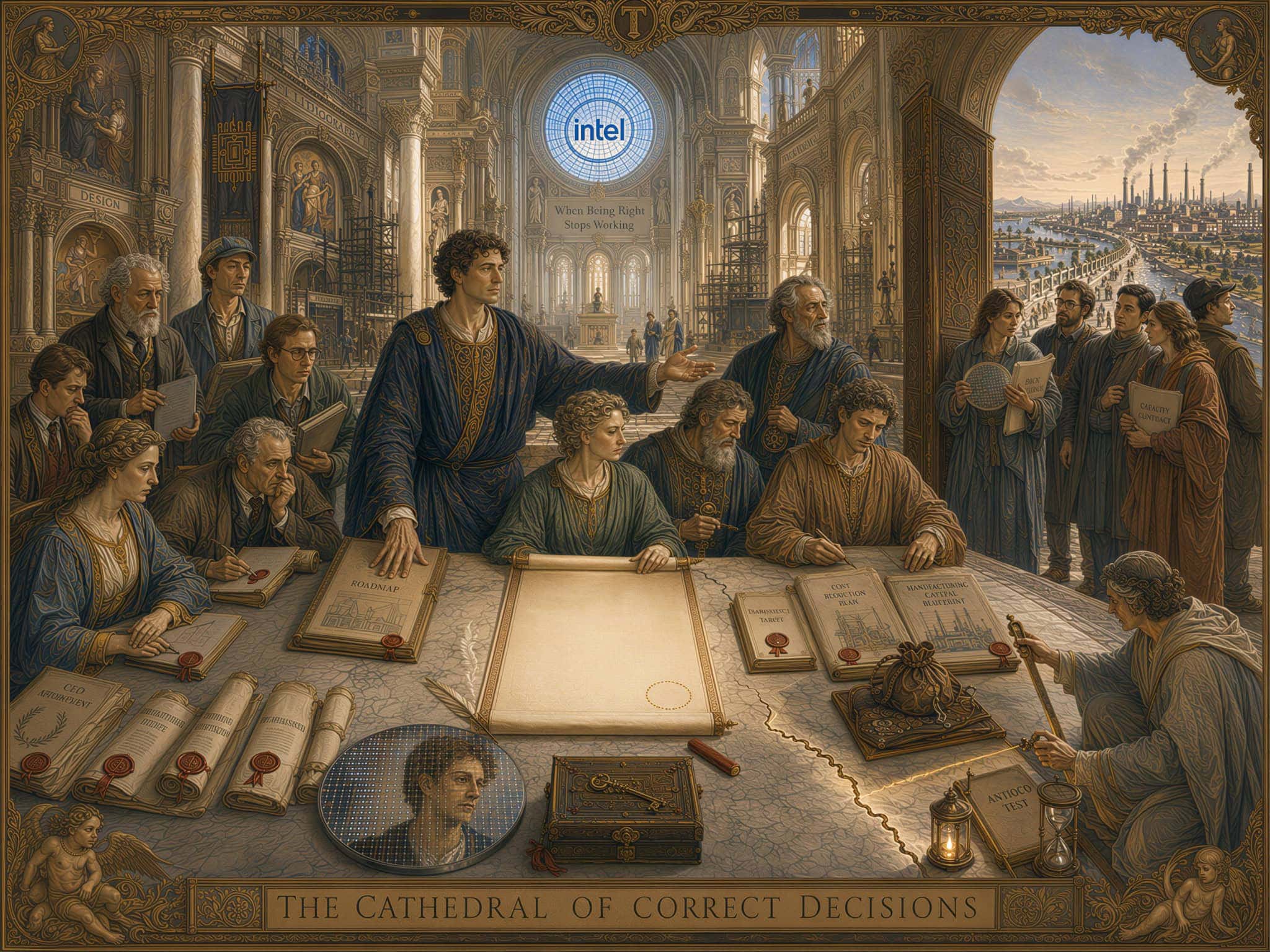
Intel’s turnaround is working on every dimension except the one it was built for.
Through 2025 the company executed a textbook recovery — new chief executive, roughly $20 billion in fresh external capital, the dividend cut, a hundred billion committed to manufacturing — and each move, on the public record, succeeded. Then the recovery did something a recovery is not supposed to do: it stopped moving the market.
The customers the strategy was built to win tested the product and declined to commit. And the pattern is not an Intel curiosity. It’s what a strategic misreading looks like from the inside.
There is an instrument for telling whether a company’s problem is execution or interpretation. It is called the Antioco Test, and applied to Intel it returns a reading most analysts’ tools are not built to see.
NVIDIA invested five billion dollars in Intel in September 2025. The chips at the heart of the partnership will be manufactured by TSMC.
Both facts are public. Most observers reading them retained only the first. The Antioco Test exists to surface the second.
In 2025, Intel raised approximately twenty billion dollars in external capital from four counterparties — the U.S. Government, NVIDIA, SoftBank, and Silver Lake.¹ Its external foundry customers paid it approximately three hundred and seven million.² The first measures strategic capital. The second measures commercial commitment.
Every decision Intel made in 2025 was defensible. The CEO replacement. The restructuring. The recapitalisation. The roadmap discipline. The dividend suspension. Each move was the move a disciplined sceptic would have recommended. Each was executed against significant operational headwinds. Each, on the public record, succeeded.
And yet beneath the recovery, a different pattern surfaced. Customers tested but did not commit. Partners invested but did not depend. Capital arrived from governments and equity partners — not from the customer category whose commitment the strategy was built to earn.
Taken individually, these moments feel normal. Each has a reasonable explanation. Pilot programmes instead of contracts. Interest without dependency. Strategic equity instead of customer revenue.
Taken together, they suggest that the market has already begun to form its judgment about what Intel Foundry is for — while Intel is still waiting for that judgment to surface.
This is how strategic misreadings usually begin. Not with panic. Not with confusion. But with continuity.
The Antioco Test: Diagnostic Intelligence Report for the Intel Corporation
Mandate and Evidentiary Status
This is a public-source diagnostic of Intel Corporation’s strategic posture as of Q1 2026. It is not an investment thesis, a valuation, or an operating recommendation. It does not propose strategy.
It is structured as an application of The Antioco Test — an instrument designed to identify whether an organisation’s challenge is fundamentally interpretive (constrained by belief) or fundamentally executional (solvable by optimisation).
The Test does not produce strategy. It reclassifies the kind of problem the leadership team is facing — a distinction with material consequences for capital allocation, sequencing, and risk posture.
All claims here derive from primary sources: Intel’s Q4 2025 earnings release covering FY2025 (Intel Corporation 2026a), its Q1 2026 earnings release (Intel Corporation 2026b), and Intel’s published Forward-Looking Statements within both filings. Capital-flow disclosures derive from Intel SEC filings and the joint NVIDIA–Intel press release of 18 September 2025 (NVIDIA Corporation and Intel Corporation 2025).
Secondary sources are used only where the primary source is itself a reference to news reporting (for example, customer-side decisions which Intel does not publicly confirm or deny). Interpretive moves are marked. Uncertainty is preserved.
This report exists to test whether one hypothesis can be sustained against the public record: that Intel’s challenge is no longer primarily technical, but interpretive — and that execution success has stopped moving the market it is being executed for.
Executive Recognition
Consider an organisation operating in a category where structural advantage has historically come from execution. The organisation has identified the right strategy, recruited the right leader, secured the right capital, and begun delivering the right milestones.
Internally, the narrative is coherent. Externally, the markers of success are present. Yet the customers the strategy was designed to win do not commit.
They engage. They evaluate. They participate in early access programmes. They issue carefully worded statements of interest. But the volume contracts — the multi-year capacity commitments that would validate the strategy in the only currency the strategy was built to earn — do not materialise.
Leadership reads this pattern as a sequencing problem.
Customers are not yet committing because the next milestone has not yet been delivered. The next milestone, once delivered, will produce the commitments. The strategy continues.
This is the most consequential interpretation to test.
The alternative — that the market has already formed its judgment and that execution is no longer the variable being weighed — is the question this report exists to surface. The data on which the alternative depends is not hidden. It sits inside the same disclosures from which the optimistic interpretation is drawn.
The question is which interpretation the evidence actually supports.
Signal Convergence
We identify five signals which, read together, suggest a gap between Intel’s internal interpretation of its position and the structural evidence available externally.
Each signal would be defensible in isolation.
The diagnosis comes from how they reinforce.
- External strategic capital greatly exceeds external customer revenue.
- NVIDIA’s investment validates Intel, but not necessarily Intel Foundry dependency.
- Major prospects evaluated 18A without committing to volume.
- Intel’s own filings make 14A conditional on committed external demand.
- The stock recovery was driven by strategic-capital events, not major foundry wins.
Signal One — The capital-to-customer asymmetry
In 2025, Intel received approximately $20.36 billion in external capital across four transactions: $8.9 billion from the U.S. Government for a 9.9% stake (August), $4.46 billion from Silver Lake for a 51% stake in Altera (Q3), $5 billion from NVIDIA for common stock (announced September, closed December), and $2 billion from SoftBank (August).³ Across the same period, Intel Foundry’s external customer revenue totalled approximately $307 million.⁴
The ratio is approximately 66 to 1.
Commercial capital flows toward operational dependence — the buyer needs the supplier’s output and is securing access to it. Strategic capital flows toward continued existence — the investor needs the supplier to remain viable for reasons that are not primarily operational.
Intel’s external foundry customer base in 2025 paid approximately 1.5% of what its external strategic, government and transaction counterparties supplied.
This is the structural shape of capital flowing toward strategic continuity, not the structural shape of capital flowing toward commercial validation.

The government component warrants its own examination.
Industrial-policy equity investments in incumbents whose markets are restructuring — a pattern observed across decades in automotive, aerospace, and financial services — share a structural property.
They consistently confirm the underlying diagnosis rather than refute it.
When commercial customer commitment is sufficient to underwrite an industry-leading asset, government equity is unnecessary. The presence of one is, in part, the absence of the other.
Most observers read the $8.9B U.S. Government stake as strategic endorsement. The Antioco Test reads it as the visible record of a commercial-customer permission gap being addressed by sovereign-strategic capital instead.
Both readings are consistent with the same evidence.
They imply different decisions.
Signal Two — Why did NVIDIA invest in Intel?
NVIDIA’s $5 billion investment bought three things at once: a discounted equity stake in a counterparty it needs to survive, secure x86 CPU supply for its next data-centre and PC generations, and a design collaboration that costs it nothing where it matters — its AI accelerators stay at TSMC.
What the investment did not buy is the thing Intel’s strategy most needs to sell: a foundry commitment.
The deal was also the most public validation Intel received in 2025: common stock at $23.28 per share — a 6.5% discount to the previous close — and co-development of multiple generations of custom data centre and PC products integrated via NVLink.⁵
The architectural structure of the partnership is, in our reading, the load-bearing signal.
Intel will design and manufacture the custom x86 CPUs at the heart of the deal — both for data centre AI infrastructure and for client PC products with integrated NVIDIA RTX GPU chiplets.⁵ NVIDIA’s accelerators — Blackwell, Rubin, and the next generations of high-margin AI silicon that constitute the load-bearing economics of NVIDIA’s growth — continue to be fabricated at TSMC.⁶
This is a partnership that validates Intel’s CPU manufacturing and design capabilities. It does not yet establish Intel Foundry as a critical manufacturing dependency for the AI silicon that drives NVIDIA’s growth.
NVIDIA acquired a 4% stake — structurally an option position rather than a foundational dependency. NVIDIA can adjust both the equity position and the CPU collaboration without disrupting the manufacturing partnerships that underwrite its AI roadmap.
The financial structure of the deal repays closer reading.
NVIDIA acquired 214 million Intel shares at $23.28. By 26 December 2025, the shares closed at $36.68 — *a paper gain of approximately $2.88 billion in three months.*⁷
That number is not a side effect of the partnership. It is, in part, the partnership’s actual financial logic for NVIDIA: acquire an equity option in a strategically important counterparty at distress pricing, derisk CPU supply for the next generation of products, and preserve the existing fabrication relationship that has underwritten NVIDIA’s growth.
Most observers read NVIDIA’s investment as an endorsement of Intel.
We agree. The question is what kind of endorsement it represents.
The public evidence supports endorsement of Intel’s strategic relevance, engineering capability, and long-term importance to the industry.
It is materially less clear that the same evidence constitutes endorsement of Intel Foundry as a manufacturing platform on which NVIDIA’s future growth depends.

Signal Three — The customers who tested without committing
Reuters reported in 2025 that NVIDIA evaluated Intel’s 18A process for chip manufacturing but did not proceed to mass production.⁸ Broadcom is reported to have undertaken similar evaluation without committing.⁹
Apple is reported to have engaged with the 18A-P process at the PDK evaluation stage, with a preliminary partnership later materialising in 2026 targeting limited volume from 2027.¹⁰
Intel’s publicly confirmed external 18A customers as of late 2025 comprised Amazon, Microsoft, and the U.S. Department of Defense.¹¹
Two of these are hyperscalers diversifying around an ARM-architecture future for their custom server chips; the third is a national-security customer.
None is a high-volume commercial fabless designer whose long-term capacity commitment would underwrite the foundry’s economic case.
The pattern of testing without committing is consistent across the prospects whose commitments would matter most.
This is not the pattern of a foundry whose customers are still evaluating.
It is the pattern of a foundry whose primary potential customers have evaluated and have not yet reached conclusions consistent with the strategy’s timeline.
Signal Four — The roadmap statement, in Intel’s own words
The strongest evidence in this report is Intel’s own.
In both its Q4 2025 earnings release (filed January 22, 2026) and its Q1 2026 earnings release (filed April 23, 2026), Intel identifies as a material forward-looking risk factor:
*a potential pause or discontinuation of our pursuit of Intel 14A and other next-generation leading-edge process technologies if we are unable to secure sufficient committed demand for Intel 14A through product design wins with potential significant external customers and our Intel products roadmap.*¹²
This is the language of an organisation acknowledging that the next leg of its manufacturing strategy is conditional on commitments it does not yet hold — disclosed in its own SEC filings to the audit committee, the regulators, and the investor community simultaneously.
The same filing states the position without decoration: Intel has been “unsuccessful to date” in securing a significant external foundry customer.²
A company that is genuinely uncertain whether the customer base exists builds the capacity provisionally — modular, capital-light, reversible. A company that is certain the customer base exists builds the capacity at full scale, prepared to fill it.
Intel is doing neither.
It is continuing capital expenditure toward 14A at scale while filing forward-looking statements that disclose the conditionality publicly.
Will Intel 14A secure external customers in time?
Not yet — and the clock runs faster than the roadmap reads. The commitments that would underwrite the node have to land while 14A is still a promise, not once it is a product; on Intel’s own disclosed dates, that period is already underway.
The timing dimension compresses the question further.
In February 2026, Intel disclosed that 14A risk production has slipped from 2027 to 2028, with volume production in 2029.¹³
Fabless customers committing to a process node typically reserve capacity eighteen to twenty-four months ahead of their own product shipment dates. The customer decision window for 14A’s volume case is therefore not 2028 or 2029 — it is the period through 2026 and into early 2027.
A portion of that window has been used not to secure commitments but to revise the timeline itself.
In the same period, TSMC entered volume on its N2 process. TSMC’s A16 process, which closes the backside-power-delivery technical gap Intel’s 18A currently holds, is scheduled for mass production in late 2026.¹⁴
The competitive window in which Intel’s 14A could offer a differentiated technical case to a major external customer is narrower than the roadmap’s volume-production date implies.
The question is not whether 14A will be technically ready. The question is whether the customer commitments required to underwrite it will arrive inside a window that Intel itself has, in its own filings, acknowledged is materially open.
Signal Five — The composition of the stock recovery
Intel’s share price more than doubled from its 2024 lows over the course of 2025. By late 2025, its market capitalisation had recovered substantially — representing the strongest twelve-month appreciation Intel had recorded in years.¹⁵
A close reading of the drivers of that recovery is instructive. Trace what actually moved the share price during 2025:
| Event | Mechanism |
| U.S. Government $8.9B stake at $20.47/share (August) | Established a perceived price floor |
| NVIDIA $5B stake at $23.28/share (September) | Read as commercial endorsement |
| SoftBank $2B at ~$23/share (August) | Reinforced perceived endorsement |
| Silver Lake $4.46B for Altera majority (Q3) | Demonstrated balance-sheet flexibility |
| Apollo Ireland Fab buyback announcement | Signalled confidence in cash flow |
None of these is a foundry customer win. Not one of the share-price drivers in 2025 was the announcement of a major external foundry contract.
Most observers read the stock recovery as validation of the underlying strategy. The composition of the recovery suggests something else: the market is pricing the durability of structural capital commitments — and the implication of strategic importance this support confers — rather than the realised commercial economics of the foundry business.
These are two different signals.
The first can sustain for years; the second is the variable on which the strategy was built to compete.
Executives consistently misread financial signals that measure a dimension other than the one their strategy was built to win. The stock price can be a leading indicator of continuing strategic support, while remaining a lagging indicator of whether the underlying business is winning the question it was designed to win.
Intel may be reading the durability of capital support as validation of strategic direction.
The two are structurally distinct.

Belief Analysis
The Antioco Test deploys a three-class framework — Confession, Pretence, Permission — to separate signals an organisation receives from how it interprets them.
- Confession is defensive or legitimacy-seeking language. The organisation acknowledges what the market is communicating, often defensively, in the act of explaining why the old model still works.
- Pretence is engagement without commitment. The vocabulary of partnership and validation is adopted; the capital and contracts that would make the validation structural are not. In any commercial relationship, the distinction between being evaluated and being chosen is the structural variable. Evaluation generates pipeline; commitment generates revenue. The two are not on a continuum — they are different categorical states.
- Permission is what the market actually rewards — the behaviours customers, regulators, capital providers, and talent confer legitimacy upon through commitment, not statement.
The framework is diagnostic because it separates what an organisation is being told from what it is being permitted to do.
Applied to Intel’s 2025 evidence, the three categories produce a consistent pattern.
- Confession is healthy and present. The CEO repeatedly emphasises “rebuilding trust,” “earning permission,” and “external validation” as priorities equal to or above process execution.¹⁶ The 2025 Spring Stockholder Outreach lists “Build Trust with Foundry Customers” as the third of four CEO mandates — a direct acknowledgment that the strategy’s external legitimacy is contested, not settled.¹⁷ Intel has registered the gap between its position and the market’s perception.
- Pretence is more difficult to read clearly because its hallmark is plausible deniability. Cadence, Cisco, Qualcomm, and others have joined ecosystem programmes and signed memoranda of understanding.¹⁸ Major hyperscalers have entered evaluation arrangements. NVIDIA invested $5 billion and announced collaboration. None of these arrangements yet binds the partners to volume production at Intel Foundry. The evaluations have been numerous. The commitments, by the evidence, remain ambiguous.
- Permission is the dimension the strategy has not yet passed. Permission, in commercial-foundry economics, is conferred through multi-year volume capacity commitments from leading fabless customers. The customers whose commitments would confer permission have, on the public record, evaluated Intel’s process and chosen not to commit. Permission is not absent — Intel has received permission from the U.S. Government, from strategic capital partners, and from its own internal product lines. But the permission Intel has secured is not from the customer category whose commitment the strategy was designed to win.
The pattern across all three categories is consistent.
Intel is hearing what the market is telling it. It is participating in the partnerships the market is offering. But it has not yet been granted the kind of commitment the strategy was built to earn.
Historical Pattern Matching
Across industries, an instructive pattern recurs at moments structurally analogous to Intel’s. Consider the structural template — observable in transport, aerospace, financial services, and energy at different points in the past half-century.
A national strategic asset is built with extraordinary technical ambition. The engineering is genuinely best in class. The asset operates at a level its competitors cannot match on the dimensions its strategy emphasises. Capital is committed at a scale only governments and strategically aligned partners can sustain. The asset enters commercial operation.
Its customer base, however, settles at a level materially below what the strategy projected. A handful of premium customers — typically those whose national interest aligns with the asset’s continued operation, or those for whom the technical performance is genuinely irreplaceable — provide the operating base.
The broader customer category that the strategy was designed to win remains unconverted.
Competing assets, less technically magnificent but commercially superior on dimensions the strategy underweighted, take the volume.
The asset operates, sometimes for decades, inside a different economic envelope than the one its strategy was built to occupy. Operational losses are sustained through government commitment, strategic-partner subsidy, and premium-customer revenue. The strategy is, in technical terms, never falsified.
The aircraft flies. The asset performs to specification. The engineering remains best in class.
What was falsified was the assumption that technical excellence would convert into the commercial scale the strategy projected.
The structural property of the pattern is not failure of execution. The execution succeeds.
The structural property is that the dimension along which execution succeeds has ceased to be the dimension along which broad market commitment is decided. The customer base reached this conclusion earlier than the asset’s leadership reached it.

The pattern resolves in one of two ways.
In the minority of cases, the operating organisation reclassifies the situation in time. It treats the absence of broad commitment not as a problem to be solved by further technical achievement, but as evidence that the strategy is being measured against a different question than the one it was designed to answer.
The reclassification triggers a structural pivot — usually away from the dimension execution had previously optimised for, and toward the dimension the customer base is actually rewarding.
In the majority of cases, the organisation does not reclassify.
It continues to interpret limited customer commitment as a sequencing problem, awaiting the next technical milestone. The asset operates. The capital continues. The milestones continue. And the structural window in which a pivot would have been viable closes — quietly, without a single catastrophic event, while every operational metric remains within acceptable range.
The question this report exists to surface is which case Intel is in.

Antioco–Hastings Spectrum Positioning
The Antioco–Hastings Spectrum is a positioning instrument for interpretive posture under identity threat.
At one end, an organisation treats market data as information — to be evaluated, contextualised, and reconciled with the existing identity. Identity is preserved. Delay feels responsible.
At the other end, an organisation treats market data as instruction — to be acted upon by reconfiguring identity.
Identity is expendable. Delay feels dangerous. Most organisations exhibit characteristics of both ends simultaneously.
The spectrum is diagnostic because it forces the question of which posture dominates under genuine identity pressure.
Intel’s behaviours under pressure from December 2024 through Q1 2026 cluster decisively toward the Hastings end.
The board displaced its previous CEO in December 2024 after a tenure that included a stock decline of approximately 60% and an annual loss in the order of $19 billion.¹⁹ It appointed Lip-Bu Tan in March 2025 — a semiconductor industry outsider with deep design ecosystem relationships rather than an internal continuity candidate.²⁰
Under Tan, the company has implemented restructuring at scale (a 2025 Restructuring Plan reducing core workforce by approximately 15% — from roughly 99,500 to 75,000 core employees by year-end — with $1.9 billion in restructuring charges in Q2 2025 alone), suspended the dividend, deconsolidated Altera, and recapitalised through external partners.²¹
Public language is consistently humble, customer-focused, and oriented toward earning trust rather than asserting market leadership.
Three behavioural anchors confirm the Hastings-leaning positioning.
- First, capital allocation. Intel has committed approximately $100 billion to manufacturing capacity since 2021 — a commitment scale consistent with structurally rebuilding for an altered competitive environment, not with optimising the inherited model.²²
- Second, leadership selection. The CEO transition replaced an internal-promotion executive with an outside CEO whose primary expertise sits in the design ecosystem Intel needs to attract — a structural choice about which constituency Intel must learn from, not merely a leadership refresh.²³
- Third, strategic disclosure. Intel introduced segment reporting that exposed Foundry’s losses transparently, rather than buffering them within the consolidated entity.²⁴ The disclosure is itself a Hastings-leaning behaviour — it forces external accountability rather than preserving internal narrative latitude.
A residual Antioco signal remains.
Intel continues to interpret tested-but-not-committed evaluations as forward indicators rather than as completed decisions. The 14A roadmap is being capitalised at a pace consistent with confidence in customer arrival, while the SEC filings disclose that customer arrival is the condition for proceeding.
This is the interpretive dimension on which the spectrum positioning could shift, and the one most worth watching as additional evidence emerges.
Reality Distance Scoring
The Antioco Test scores reality distance on a 0–21 scale.
The scoring methodology is proprietary and is not disclosed in this public-source application. The output is a single quantified artefact: the gap between the organisation’s stated strategic position and the structural evidence available to the market.
Applied to Intel’s Q1 2026 posture against the evidence base above:
Reality Distance Score: 13 / 21 — Interpretive Risk Zone.
The score reflects an organisation that has substantially closed the reality gap on operational, financial, and identity dimensions, while retaining material distance on the dimensions most consequential to its strategic outcome: the interpretation of customer engagement, the calibration of permission timing, and the assumption that execution success will convert into market acceptance.
This is not the score of an Antioco-pattern organisation in denial.
Intel has restructured leadership, restructured operations, restructured its balance sheet, and restructured its public posture. The dimensions of reality it has closed distance on substantially outnumber the dimensions on which distance remains.
The dimensions on which distance remains are, however, the dimensions on which the strategy’s success is decided.
A score in the Interpretive Risk Zone indicates an organisation whose principal vulnerability is no longer technical or financial. It is the gap between what leadership believes the next eighteen months will produce and what the market has already begun to conclude.
The Reclassification
The work of the Antioco Test is reclassification.
The diagnostic is not the strategy; the diagnostic is the reframe of which strategy the situation requires.
- Before this report: Intel faces an execution challenge in foundry development. The question is whether the company can deliver process-technology and capacity milestones against an aggressive timeline. Strategy is calibrated to optimise execution against that question.
- After this report: Intel faces an interpretive challenge in customer permission. The question is whether the strategy is still operating against the dimension the market is rewarding. Execution remains necessary. It is no longer sufficient.
This is the reclassification the Antioco Test exists to surface.
The work that follows from accepting it is structurally different from the work currently underway.
What is the strategy execution gap?
The strategy execution gap is the distance between what a strategy intends and what an organisation actually delivers — and it is usually diagnosed backwards. The consensus treats the gap as an implementation problem: strategy sound, delivery lagging, alignment the cure.
Intel’s 2025 is the inverse case the consensus cannot see: delivery succeeded on nearly every dimension — the roadmap held, the restructuring executed, the recapitalisation closed — while the strategy failed to move the one constituency it was built for.
The dangerous gap is not between strategy and execution. It is between execution and interpretation: an organisation delivering, precisely and on schedule, against a question the market has stopped asking.
That gap never appears on an operational dashboard — every metric stays green — which is why it takes an instrument built to see it.

The Implication
If this diagnosis is directionally correct, the most consequential risk to Intel is not the one its operating discipline is designed to mitigate. The risk is that Intel does exactly what it plans, and still fails to alter the trajectory the market evidence has already begun to suggest.
Consider the working assumption embedded in Intel’s roadmap.
Volume production of 18A continues at scale. Panther Lake and Clearwater Forest demonstrate that the node is manufacturing-viable.
The NVIDIA partnership ships products. 14A development proceeds on the assumption that a major external customer will emerge once the process technology is sufficiently proven. The capital structure holds, supported by government and strategic-partner investment. By 2028, Intel is once again a credible long-term competitive option in the foundry market.
Now consider the alternative trajectory permitted by the same evidence.
Volume production of 18A continues, primarily serving Intel’s internal product lines and a small external customer base of government and hyperscale partners — none of whom would justify the manufacturing scale at full commercial economics. The NVIDIA partnership ships products successfully, but the architectural choice to keep silicon at TSMC becomes a precedent rather than an exception.
Other partners follow the same pattern, treating Intel as a design partner and packaging vendor rather than as a foundry.
14A development proceeds on internal commitment, but the major external customer required to justify volume production does not emerge.
By 2027 the question becomes whether to scale 14A speculatively or to defer it.
The capital structure holds, because government and strategic-partner commitments are durable. But the foundry’s external commercial viability remains the question it was in 2024.
The financial scale of this question is decision-grade.
Intel’s manufacturing capital expenditure 2021–2026 totals approximately $100 billion against external foundry revenue of approximately $307 million in 2025 — a capital-intensity ratio of roughly $326 of committed capex per dollar of external revenue.²⁵
Analyst estimates of incremental capex to take 14A through to volume production cluster in the $25–40 billion range across 2026–2029 — a figure Intel itself has not segregated in its public disclosures.²⁶
That capital is committed today against the assumption that customer commitment will arrive.
If the assumption is wrong, the cost is not just the capex — it is capex committed against an assumption that Intel itself has, in its own filings, identified as a material risk.
Both trajectories are consistent with successful execution.
The difference between them is not whether Intel performs the work. The difference is whether the work is being performed against the question the market is still asking.
By Q4 2026, one of two outcomes will be visible.
Either Intel will have secured a major external foundry commitment that materially underwrites 14A’s volume case — most plausibly a hyperscaler or a tier-one fabless customer at scale. Or it will not. In the latter outcome, the question of whether to proceed with 14A becomes a different question than the one Intel is currently answering.
The gap between execution success and market acceptance — the gap the Antioco Test exists to surface — is the dimension that requires the most disciplined interpretive work.
Any plan that assumes execution will close this gap automatically is operating against an assumption that the public evidence does not yet support.
Evidence Update
24 September 2026
The diagnostic used SEC filings and primary sources. One relevant primary source within that scope was not captured.
On 22 April 2026, during Tesla’s first-quarter earnings call, Elon Musk said Tesla planned to use Intel 14A for its Terafab project. Reuters reported it the same day, saying the proposed contract would mark Intel’s first major customer for the technology, while noting that important details of Terafab remained unclear. Intel declined to comment.
That call took place before the diagnostic was published.
I missed it in the July source review.
The July run published an Antioco Test score of 13 out of 21 against Intel’s Q1 2026 posture. That remains the historical output of that run, not a refreshed September reading. I will rerun the Test against the published Q4 checkpoint with the April evidence included, and report any change.
The Tesla evidence counts toward the falsifier published above — a major external commitment that materially underwrites 14A’s volume case, arriving by Q4 2026 — but the public record does not establish that the threshold has been met.
It still does not disclose Tesla’s committed wafer volume, reserved capacity or any equivalent measure.
The wording originally published was “arriving by Q4 2026.” I do not get to move it.
The full account of what the April evidence changed, and what it did not, is in Falsification Drift.
What This Report Does Not Answer
This report is a diagnosis, not a strategy.
It identifies the dimension of risk along which Intel’s situation is structurally underweighted; it does not propose how the risk should be reweighted.
Three questions, in particular, are intentionally left open as the proper subject of confidential Stage 2 work.
- First, the precise timing of the permission decision. The diagnosis suggests that customer permission is the deciding variable in Intel’s situation. It does not determine when the structural commitment to a different vendor architecture becomes irreversible. Some elements of the answer are visible from outside (advanced packaging commitments, multi-year capacity reservations); others require access to the customers’ internal planning horizons.
- Second, the assumption surface that would have to be revised. If Intel’s situation is interpretively rather than executionally constrained, certain load-bearing assumptions inside the current strategy become questionable. Among them: that capacity built on internal demand can be sold externally once the process is proven; that the NVIDIA partnership is a leading indicator of broader foundry adoption rather than an exception; that 14A’s external customer base will materialise in time to justify volume production. Each assumption is testable against further evidence. None is currently being tested.
- Third, the tactical recalibrations available. If the diagnosis holds, the operational changes that would address it are not the operational changes currently being executed. The identification and sequencing of those changes is the proper subject of decision-grade Stage 2 work.
Methodological Note
The Antioco Test — a proprietary instrument of An Artful Science Ltd — is normally executed against privileged-access evidence, including confidential interviews with the commissioning executive team, internal strategic disclosures, and customer-side interview programmes. This report applies the instrument to public-source evidence only.
The scoring rubric, dimensional weightings, and validation methodology are not disclosed in public-source applications of the Test. Disclosure would compromise the instrument’s value to client engagements, where the scoring is reproduced against significantly richer evidence.
What this public-source application demonstrates is that the diagnostic frame produces a directionally robust output even under evidentiary constraint. The strength of the diagnosis is in the framework, not in the privilege of the underlying evidence.
Where the public evidence permits, the diagnosis can be sharpened; where it does not, the diagnosis preserves its conservatism and flags the unresolved questions for confidential Stage 2 work.
Frequently asked questions
What is strategic risk?
Strategic risk is the possibility that the strategy itself — not its execution — is the source of loss: the premise beneath the plan expires, the market re-prices what it rewards, and disciplined delivery keeps compounding in the wrong direction. Risk registers rarely contain it, and the reason is structural: a register catalogues what can go wrong inside the plan — operational, financial, compliance — while strategic risk is the plan being wrong, invisible to every instrument that assumes the plan’s premise.
Intel’s principal exposure in 2026 is of exactly this kind: the public record shows an organisation that has closed the gap on operations, finance, and identity, while the open distance sits on one dimension — the interpretation of customer permission. The most dangerous risks are not the ones the register tracks. They are the assumptions the register was built on.
How do you measure whether a strategy is actually working?
Not by the metrics it was designed to hit — by the commitments it was designed to earn. Operational dashboards measure the execution of the plan; they cannot measure whether the plan is still answering the question the market is asking, which is why a strategy can fail with every metric green. The higher-signal instruments are structural: the composition of incoming capital, the gap between customer evaluation and customer commitment, and — least read of all — the company’s own forward-looking statements, the one document where a firm is legally obliged to disclose what it is not sure of.
Intel’s 2025 filings name the condition its strategy depends on; its dashboards do not. A dashboard can tell you the machine is running. It cannot tell you the road has moved.
What is the Antioco Test?
The Antioco Test is a diagnostic instrument that identifies whether an organisation’s challenge is fundamentally interpretive — constrained by belief — or fundamentally executional, solvable by optimisation. It does not produce strategy; it reclassifies the kind of problem a leadership team is facing, a distinction with material consequences for capital allocation, sequencing, and risk posture. Applied to Intel’s public record, it returns a Reality Distance Score of 13 out of 21 — the Interpretive Risk Zone. The full methodology, developed by An Artful Science, lives with The Fontainebleau Protocol™.
What is the difference between strategic capital and commercial commitment?
Strategic capital flows toward continued existence; commercial commitment flows toward operational dependence. An investor provides the first because it needs the company to remain viable for reasons that are not primarily operational; a customer provides the second because it needs the company’s output and is securing access to it.
The sign of the price is the tell.
In 2014, IBM paid GlobalFoundries $1.5 billion to take its chip-manufacturing business — the seller paying the buyer, a price below zero, because the commercial commitment behind the asset was negative and the arithmetic finally said so out loud. Strategic capital conceals the same arithmetic that a negative price reveals: in 2025, Intel received $20.36 billion of the first kind of money and $307 million of the second.27
Watch the direction of the capital — then watch its sign.
What would prove this diagnosis wrong?
A major external foundry commitment that materially underwrites 14A’s volume case — most plausibly a hyperscaler or a tier-one fabless customer at scale — arriving by Q4 2026. The report stakes its reading on a visible marker: either that commitment appears inside the window Intel’s own filings acknowledge is open, or it does not.
This is deliberate.
A diagnosis that cannot name its own falsifier is an opinion. The Antioco Test’s output is a hypothesis against the public record, and the record will answer it on a date already on the calendar.
Does this pattern apply outside semiconductors?
The pattern is structural, not sectoral — and it has flown.
The Airbus A380 was, in its maker’s own farewell, “an outstanding engineering and industrial achievement”: 251 aircraft, fourteen customers, and one airline holding roughly half of everything ever built. The broad market the programme was designed to win evaluated the aircraft and declined at scale; production ended in 2021 not because the plane failed but because the second anchor customer never arrived.28
Execution succeeded — the judgment had been settled years before the line closed. Which is what makes the question internal rather than historical: whether your own green metrics are measuring the question the market is still asking, or the one it stopped asking quietly.
That is not answerable from outside. It is precisely what a diagnostic exists to determine.
Index
Sources referenced.
- Capital infusion total ($20.36B) aggregated from four independently disclosed transactions: U.S. Government investment of $8.9 billion at $20.47 per share (August 2025); NVIDIA Corporation investment of $5 billion at $23.28 per share (announced September 18, 2025; closed December 26, 2025); SoftBank investment of $2 billion at approximately $23 per share (August 2025); and Silver Lake acquisition of 51% interest in Altera for $4.46 billion (Q3 2025). Aggregation reported in Shilov 2026; individual transactions confirmed in Intel Corporation 2026a and 2026b.
Documents the four constituent transactions composing the $20.36B 2025 external capital aggregate. The total is derived arithmetic across independently disclosed primary sources. - Intel Corporation. 2026a. “Form 10-K for the fiscal year ended December 27, 2025.” Filed with the SEC, January 22, 2026. Primary source. Intel’s 10-K discloses: “Intel Foundry also includes certain third-party foundry and assembly and test revenues from external customers that totaled $307 million in 2025, $159 million in 2024 and $547 million in 2023.” Intel Foundry segment FY2025 total revenue: $17,826 million.
- Intel Corporation 2026a, op. cit., Notes to Consolidated Financial Statements. Q3 2025 8-K filings regarding the U.S. Government Warrant and Common Stock Agreement, and the SoftBank investment, are referenced in the same filing.
Cross-references the structural composition of the 2025 capital stack via Intel’s own consolidated financial statement notes. - Intel Corporation 2026a, op. cit. Cross-referenced with LaPedus, Mark. 2026. “Intel Reports Loss in Q4 With Gloomy Outlook.” Semiecosystem, January 23, 2026. Q4 2025 external foundry revenue of $222 million attributable substantially to U.S. Government projects and the Altera deconsolidation effect, per KeyBanc Capital Markets analyst John Vinh as cited in LaPedus 2026.
- NVIDIA Corporation and Intel Corporation. 2025. “NVIDIA and Intel to Develop AI Infrastructure and Personal Computing Products.” Joint press release, September 18, 2025. Primary source confirms AI infrastructure and personal computing product collaboration. The press release subheadline reads: “Intel to design and manufacture custom data center and client CPUs with NVIDIA NVLink.” The body specifies “Intel will build NVIDIA-custom x86 CPUs” for data centres and “x86 system-on-chips (SOCs) that integrate NVIDIA RTX GPU chiplets” for personal computing. The release does not specify the Intel process node and does not address the manufacturing scope of NVIDIA’s standalone AI accelerators.
- Lundy, Jim. 2025. “Nvidia’s $5B Bet on Intel: What It Means.” Aragon Research, September 21, 2025. Corroborated by Bradshaw, Tim. 2025. “Nvidia Buys $5B Stake in Intel, Planning AI Chip Collaboration.” TechCrunch, September 18, 2025. Same-week analyst and journalistic reporting on the structural significance of the deal. Both sources frame the $5B as strategic equity collaboration. Neither reports a manufacturing relationship between Intel Foundry and NVIDIA’s high-end AI accelerators (Blackwell, Rubin), which industry reporting continues to attribute to TSMC.
- Speed, Richard. 2025. “Nvidia Invests $5B on Intel Bailout, Gains $2.5B.” The Register, December 29, 2025. Intel share closing price of $36.68 on December 26, 2025, also confirmed in Karkare, Aditya. 2025. “Nvidia Takes $5 Billion Stake in Intel Under September Agreement.” CNBC, December 29, 2025. Documents the Intel share closing price at deal-close ($36.68). NVIDIA’s paper gain at year-end is derived arithmetically: 214,776,632 shares × ($36.68 − $23.28) = approximately $2.88 billion. The Register’s $2.5B headline figure is a rounded approximation; the precise arithmetic from the publicly disclosed share count and prices yields $2.88B.
- Reuters reporting via Mujtaba, Hassan. 2025. “NVIDIA Tested Intel’s 18A Node but Did Not Commit to Intel Foundry.” TechPowerUp. Reports that NVIDIA evaluated Intel’s 18A process node and did not commit foundry volume. Neither Intel nor NVIDIA has publicly disputed the Reuters report.
- Industry reporting on Broadcom’s evaluation phase, including FinancialContent. 2026. “Intel Reclaims the Silicon Throne: 18A Enters High-Volume Production, Completing the ‘5 Nodes in 4 Years’ Odyssey.” January 30, 2026. Smith, Jacob Ridley. 2026. “Intel Bigs Up Its Latest 18A Chip Node as Fit for External Customers but Probably Not Nvidia, for Now.” PC Gamer, March 5, 2026. Industry consensus reporting that Broadcom, alongside NVIDIA, engaged in active 18A testing phases without committing to volume production. Broadcom is documented as having expressed initial concerns regarding 18A yields in 2025.
- Kuo, Ming-Chi. 2026. Analyst commentary on the Apple-Intel foundry partnership, reported via MacDailyNews (“Apple tests Intel for low-end/legacy iPhone, iPad, and Mac chips,” May 15, 2026), Wccftech (“Apple Has Handed Intel A ‘Once-In-A-Generation’ Foundry Lifeline”), and Electronics Weekly (“Intel Foundry: The Last Chance”). 2026. Documents Apple’s engagement at the 18A-P PDK evaluation stage in 2025, with a preliminary partnership later materialising in 2026 targeting small-scale testing in 2026, ramp in 2027, continued growth in 2028, and expected decline in 2029.
- Intel Corporation. 2024. Intel Foundry Direct Connect 2024 event (February 21, 2024) — Microsoft confirmed as 18A customer for next-generation custom chip (subsequently confirmed as Maia AI accelerators). Intel Foundry communications 2023–2024 — Amazon Web Services confirmed as 18A customer for custom AI fabric chips. U.S. Department of Defense. 2024. Rapid Assured Microelectronics Prototypes – Commercial (RAMP-C) program approval of Intel 18A for defense system prototypes, April 2024. Industry consolidation in FinancialContent. 2026. “Intel Reclaims the Silicon Throne: 18A Enters High-Volume Production, Completing the ‘5 Nodes in 4 Years’ Odyssey.” January 30, 2026. Documents the three publicly confirmed external 18A customers identified in the body text. Microsoft and Amazon Web Services were confirmed through Intel Foundry’s own customer announcements. The U.S. Department of Defense confirmation traces to the Defense Department’s RAMP-C program, which approved Intel 18A for defense-system prototype manufacturing in April 2024.
- Intel Corporation. 2026b. “Intel Reports First-Quarter 2026 Financial Results.” SEC Form 8-K Exhibit 99.1, April 23, 2026, page 4, Forward-Looking Statements. Substantively identical disclosure also appears in Intel Corporation 2026a, Q4 2025 earnings release, page 5. Intel’s own language identifies the 14A roadmap as contingent on “securing a major external customer through product design wins.” The Q1 2026 filing adds the phrase “through product design wins” to specify the form of committed demand required.
- Tan, Lip-Bu. February 2026. Public statements at the Cisco AI Summit (February 3, 2026) and the J.P. Morgan TMT Conference. Reported in: TweakTown (“Intel’s 14A node will enter risk production in 2028…”), TechSpot (“Intel says 14A is on track for 2028 risk production…”), Tom’s Hardware (March 16, 2026). Original 2025 disclosure (risk production 2027) referenced in trendforce.com (April 30, 2025) and Tom’s Hardware (April 29, 2025). Documents Intel’s revised 14A roadmap: risk production in 2028 (slipped one year from 2027), volume production in 2029. Tan’s public statements at the Cisco AI Summit and JP Morgan TMT Conference confirm the one-year deferral. Industry analysts at SemiAnalysis explicitly characterised the disclosure as a one-year slip from prior roadmap.
- Shilov, Anton. 2025. Op. cit. TSMC N2 volume timeline and A16 with Super Power Rail mass production schedule, as documented in the source.
- Shilov, Anton. 2026. “Intel Q4 Earnings Reveal Rocky Path to Recovery Following Weakest Full-Year Revenue Since 2010 — Intel Foundry Losses Continue as 18A Begins Ramp.” Tom’s Hardware, January 23, 2026. Documents FY2025 as Intel’s weakest annual revenue year since 2010.
- Tan, Lip-Bu. Public statements in Intel Corporation Q2 2025 earnings call (July 24, 2025), Q3 2025 earnings call (October 23, 2025), and Q4 2025 earnings call (January 22, 2026). Documents CEO Tan’s public messaging across three consecutive quarterly earnings calls, available through Intel’s investor relations newsroom.
- Intel Corporation. 2025a. “2025 Spring Stockholder Outreach.” SEC Form DEFA14A, April/May 2025. Intel’s communication to shareholders ahead of the May 2025 annual meeting, framing the strategic posture in execution terms — process roadmap, manufacturing capacity, customer pipeline development.
- Intel Foundry Direct Connect events 2024 and 2025. Documents the Intel Foundry customer engagement programme and its public announcements across 2024 and 2025.
- Krisher, Tom. 2025. “Intel Names Lip-Bu Tan as New CEO.” Associated Press via WOSU Public Media, March 13, 2025. Documents the AP wire reporting on the appointment. Intel FY2024 net loss attributable to Intel of $(18,756) million and FY2024 GAAP diluted EPS of $(4.38) confirmed in Intel Corporation 2026a (FY2025 release with prior-year comparison).
- Intel Corporation. 2025b. “Intel Appoints Lip-Bu Tan as Chief Executive Officer.” SEC Form 8-K Exhibit 99.1, March 12, 2025 (effective date March 18, 2025). Primary-source documentation of the March 2025 CEO transition. The 8-K records the filing date (March 12) and effective date (March 18).
- Intel Corporation. 2025c. “Intel Reports Second-Quarter 2025 Financial Results.” SEC Form 8-K Exhibit 99.1, July 24, 2025. Q2 2025 SEC filing documents $1.9 billion in restructuring charges (of which $1.4 billion in employee severance and $416 million in real estate and business exit impairments). The 2025 Restructuring Plan targets a 15% reduction of core workforce by year-end 2025 — Tan’s July 24, 2025 employee memo (reported by Yahoo Finance) discloses the target end-of-year headcount of 75,000 core employees, down from approximately 99,500 at the start of 2024.
- U.S. Department of Commerce. 2024. “Biden-Harris Administration Announces CHIPS Incentives Award with Intel Corporation.” Cross-referenced with Intel Corporation public communications regarding manufacturing capital expenditure since 2021. Documents the U.S. Government’s CHIPS Act commitment to Intel — among the largest single industrial-policy interventions in the U.S. semiconductor sector. The capital is sovereign-strategic.
- Intel Corporation 2025b, op. cit. The 8-K records Tan’s prior role as CEO of Cadence Design Systems (2009–2021).
- Intel Corporation 2026a, op. cit., Supplemental Operating Segment Results disclosure. Documents that Intel adopted the current segment reporting structure in Q1 2025, as noted in the same filing.
- Intel Corporation 2026a, op. cit., Consolidated Statements of Cash Flows. FY2025 gross capital expenditure of $17,672 million. Multi-year capex figure of approximately $100 billion derives from cumulative cash flow disclosures across Intel Corporation 10-K filings 2021–2025. The capital intensity ratio of approximately $326 capex per dollar of external foundry revenue is derived (not a published Intel metric) — calculated as $100 billion ÷ $307 million external foundry revenue in 2025.
- Industry analyst commentary in Zuhair 2026, op. cit.; Shilov, Anton. 2026. “Intel’s Roadmaps Examined — 14A, Nova Lake, Diamond Rapids & AI Accelerator Push.” Tom’s Hardware, March 16, 2026. FourWeekMBA. 2026. “Intel Revenue Breakdown 2025: $53.1B Split by Segment.” June 2026. 14A incremental capex estimate range derived from three sources. The range is interpretive; Intel has not published a segregated 14A capex figure.
- IBM Corporation. Form 8-K, October 20, 2014. IBM’s disclosure of $1.5 billion cash consideration to be paid to GLOBALFOUNDRIES over three years as part of the divestiture of IBM Microelectronics, within a $4.7 billion pre-tax charge. The negative price — the seller paying the buyer — as the purest public measure of commercial commitment.
- Aviation Week Network. “Airbus pulls the plug on A380 as Emirates cancels order.” February 2019; A380 programme delivery records (251 delivered to 14 customers, 2007–2021; Emirates approximately half). The execution-succeeds, market-declines template with verifiable numbers; Airbus’s own farewell statement quoted.
About the author
Article by Stephen Shaw, brand strategy consultant and founder of An Artful Science.
❡ Related Post:
The Bankruptcy Notes, Falsification Drift

