

Stephen Shaw works on one problem: why capable firms end up compared on price with competitors they are nothing like.
His answer is a differentiation method that tests whether a firm’s difference is real before building anything on it.
Before he offered the Uniqueness Protocol to a single client, Shaw ran it on his own industry.
He gathered what brand positioning firms say about themselves — brand consultancies, messaging agencies, category designers, and the AI tools that now produce positioning in seconds. Thirty-seven claims across nine kinds of firm, and his own.
Then he looked for the phrases that three or more of them shared.
Stand out in a crowded market. Find your unique value. A proven methodology. Thought leadership. Brand DNA. Data-backed insights. Strategy and execution. Go deeper.
Nearly two-thirds of everything the positioning industry said about itself was language somebody else was already using.
The firms that promise to make a business distinctive could not, on the evidence of what they publish, be told apart.
And a buyer who cannot tell firms apart does the one thing left to it.
It compares them on price.
That is how commoditization begins.
Stephen Shaw
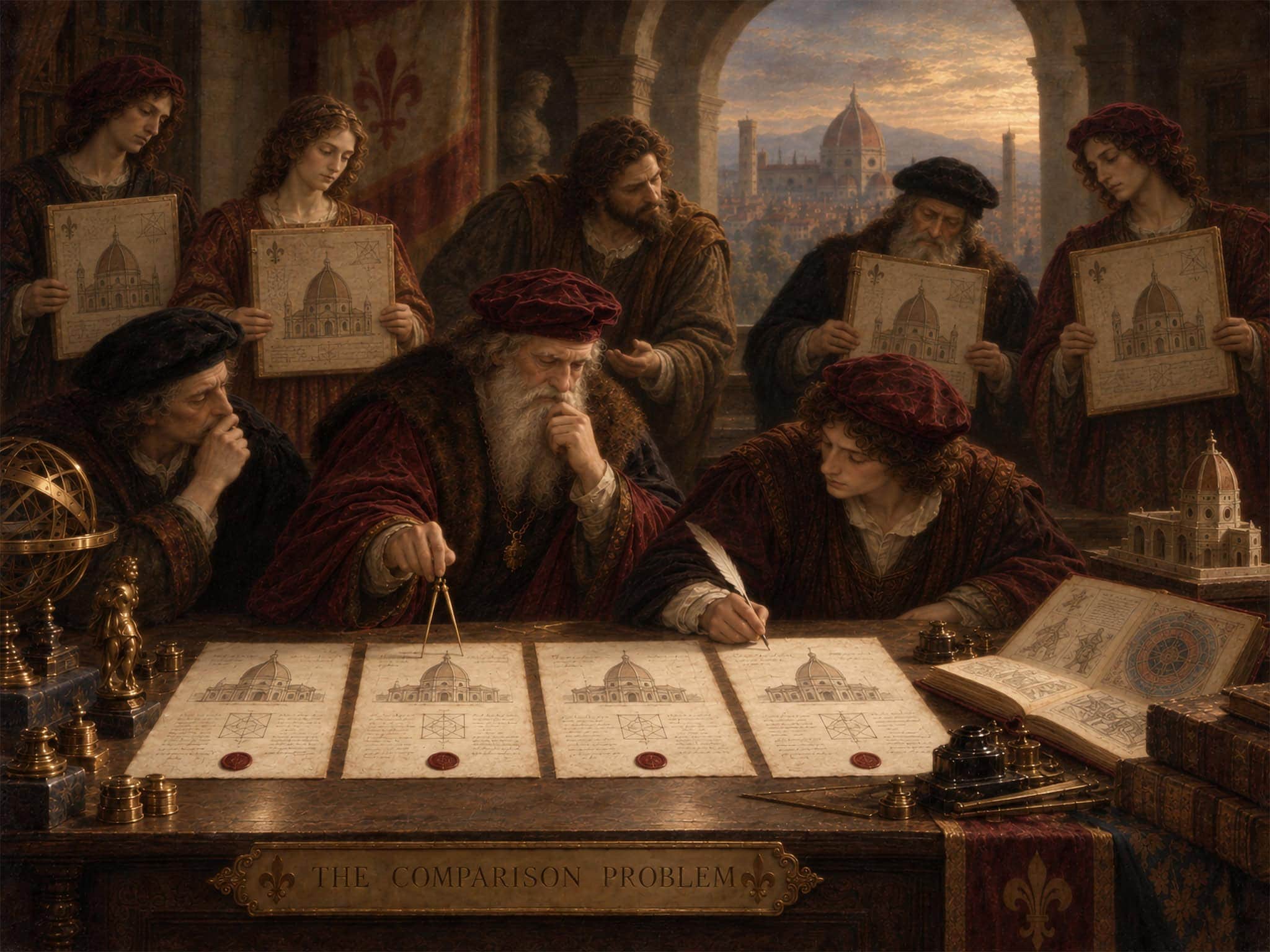
The Comparison Problem 2026. Digital renaissance-style painting.
The Vanishing Position
Professional-services firms sell something a buyer cannot inspect before buying it: expertise.
Its value lives in how a problem is diagnosed, which evidence is treated as important, the order in which the questions are asked, the exception an experienced practitioner notices before anyone else does. Almost none of that is visible from outside.
So markets build shortcuts.
A category settles what a credible provider is supposed to look like. Buyers inherit criteria they already understand. Competitors learn which claims sound persuasive, and repeat them. Over time, quite different firms end up describing themselves in the same words.
Strategic. Bespoke. Tailored. Evidence-led. Results-oriented. Senior. Commercial. Client-centered. Client-centric. Forward-looking. Future-proof. Relationship-driven.
The claims may all be true.
That is precisely the problem.

Stephen Shaw
The Vanishing Position 2026. Digital renaissance-style painting.
If several credible firms can honestly say the same thing, the language establishes competence without explaining preference.
The conventional response is sensible. Sharpen the positioning. Strengthen the proof. Publish more expertise. Build a better website.
Sometimes that is exactly what is required.
But each of those responses assumes the comparison can recognise the difference once it has been explained clearly enough. Very often it cannot. A better signal cannot restore information the comparison has already thrown away.
A business can therefore become harder to distinguish without becoming more alike. It does not have to lose its difference. The market only has to lose sight of it.

Stephen Shaw
The Market Shortcut 2026. Digital renaissance-style painting.
Where the question came from
Shaw first met this problem in places that seemed to have nothing to do with one another.
- In markets, that a strategy could still be working without still being right.
- In positioning, that a business could be different without being distinguished.
- In buyer psychology, that evidence could be correct without being believed.
- In publishing, that an archive could grow without becoming a body of work.
- In machine retrieval, that an idea could spread without its source going with it.
The subjects kept changing. The question did not. Something valuable passes through a system that simplifies it, and something important disappears on the way.
Over time the observation became more exact.

Stephen Shaw
The Question Behind the Work 2026. Digital renaissance-style painting.
An Artful Science calls its commercial form the Comparison Problem.
A business does not have to become identical to its competitors. It only has to become easy enough to compare as though it were.
That changes what competitive differentiation has to prove. The question is no longer only whether a firm’s claims are true. It is whether its difference survives the comparison.

Stephen Shaw
The Substitution Margin 2026. Digital renaissance-style painting.
Take the strongest case a business makes for being chosen, and ask how much of it a credible competitor could support from its own published material.
The answer is usually uncomfortable. A firm may be strategic, senior, rigorous and well evidenced. So may its competitors. Measuring the problem does not solve it, though.
That is where Category Demolition™ begins.
Most positioning work asks what category a business belongs to. Category Demolition™ asks a harder question:
What category logic is the business accidentally reinforcing?
A category does more than name a market. It teaches buyers which alternatives belong together, which attributes to compare, what counts as table stakes, and what can safely be ignored. A structurally different firm that describes itself in the category’s own terms will be compared on the category’s own terms — and lose the very thing that made it different.
But even removing the shared phrases is still not enough. A firm can avoid every one of them and still have nothing a competitor could not also claim. So Category Demolition goes a step further. It takes the language away altogether and asks what capability is left standing.
Shaw ran the test on An Artful Science.
It was competitor analysis turned inward.

Stephen Shaw
The Method on Itself 2026. Digital renaissance-style painting.
Of the eight claims An Artful Science made about itself, four held completely: demolishing the category before positioning inside it; understanding buyers at the level of identity rather than as a demographic target audience; a sequence in which each stage must pass its own test before the next can begin; and turning what survives into intellectual property the client owns.
Two held only in part. One depended too heavily on who was running it. Another could be copied by a competitor, with effort.
Two did not survive, and both were language rather than capability: a subtitle on the service page and the labelling.
It was the lesson the industry had taught, found this time in his own firm. The capabilities held. The language did not.
Most self-assessments stop at the verdict.
This one didn’t.
The first stage had done its work: four claims survived. On their own they were worth nothing — a list of true statements about a firm that was still operating exactly as it had the week before. Knowing what makes a business different is not the same as being built that way.
The other eight stages are where that changes.
Who the firm turns away. Where it can set a price instead of meeting one. How it grows without becoming easy to compare again. And a body of intellectual property the client owns — the kind its own rivals would have to abandon their positions to adopt.
Shaw ran all nine on An Artful Science, starting from the four capabilities that had survived.
What came out the other end was the Uniqueness Protocol itself.

The nine stages a client now works through were produced by working through them. The positioning on the service page came out of the same process, and so did the names.
The method was its own first deliverable.
So everything published about the Uniqueness Protocol is also a record of it working — not a description of the method, but its output, down to the words on the page.
Then he let someone else check
A self-assessment has an obvious weakness. The person marking it already knows what the work is trying to do.
So he handed the comparison to the Substitution Margin™ instead — a method that reads only what the pages establish, and takes no account of whose pages they are.

Stephen Shaw
The Blind Examination 2026. Digital renaissance-style painting.
Four pages from An Artful Science, four from a firm buyers genuinely weigh it against. Not a flattering comparator — a real one.
Two of the three strongest reasons to choose An Artful Science turned out to be reasons the other firm could also make, at least in part.
Both said a senior person leads the work. Both said the work is grounded in how buyers really behave.
On paper, the two firms were two-thirds interchangeable — and when two firms are interchangeable, a buyer is left comparing the one thing that is always different between them.
The fee!
That is what commoditization looks like when you measure it.
Each firm had exactly one reason the other could not claim. For An Artful Science it was what a client is left with at the end: a position turned into intellectual property the client owns, and can hand to whoever leads next.
It was the same capability that had given the Uniqueness Protocol its own names.
Then something stranger happened.
The two things the firm genuinely does — ways of working that had passed every test Shaw put them through — never appeared among the reasons to choose it.
They were not judged weak. They were not weighed at all. In positioning that has a name: a point of indifference. A difference that is real, and that the buyer does not count as a reason.
It was the problem this page describes, happening to the man who named it.
He had not been looking for a score. He had been looking for instructions, and the evaluations gave him three.
- Build the argument around the one reason no one else could claim.
- Stop leading with anything a competitor could say as well.
- And show the difference working instead of describing it — which is why this record of the protocol run on itself is published here in full.
That is what the Substitution Margin is for.
Not a grade. A list of decisions.

But difference is only the beginning
Suppose the difference is real. Suppose competitors cannot substitute it, and the market can finally see it.
The problem ought to be over.
It’s not. A different failure waits one step further on.
The strategy can outlive the market that justified it. The buyer can recognise the difference without recognising why it matters. The firm’s best ideas can be published without ever becoming a body of work. And the work can become visible while losing its connection to the people who made it.

Each looks like a separate problem.
It is one problem appearing in five places, and the five systems of The 5° Of Newness™ are built to meet it in order.
The first tests whether the market has changed beneath the strategy; the second, whether the difference survives substitution; the third, whether buyers will recognise why it matters; the fourth, whether the thinking accumulates into a body of work; and the fifth, whether all of it survives search and machine retrieval.
What one establishes, the next inherits.
Not another brief. Not another beginning.
An inheritance.

Stephen Shaw
The Fivefold Inheritance 2026. Digital renaissance-style painting.
There is one more test, and it is the hardest of them all.
Not a competitor. Not a buyer. Not an algorithm.
Time!
A founder spends decades accumulating distinctions that eventually become instinct: what to notice, what to ignore, which question to ask next, when an apparent exception changes the whole diagnosis.
Much of it is never written down.
The business has the knowledge only because the founder does.
Then the founder leaves, and the knowledge leaves too.

Stephen Shaw
The Founder Leaves, the Method Remains 2026. Digital renaissance-style painting.
There is a commercial cost to that, but there is a larger loss. A lifetime of solved problems can disappear because the architecture of how they were solved was never set down.
It doesn’t have to.
A method can be named. A diagnostic can be repeated. A framework can preserve a distinction. And judgement that once existed only inside one person’s head can become something another person can read, test, challenge and extend. The founder leaves. The method should not.
That is how An Artful Science works.
Every engagement is led by Stephen Shaw. None is delegated.
And every engagement is built so that what he does can be inherited — written down, named, and handed to the client in a form their own team can use without him.
That is the difference between a founder-led consultancy and a founder-dependent one.

What the work does not include
An Artful Science does not design visual identities, produce sales collateral or run paid media. Those are execution problems, and good firms solve them well. The work here comes before them: whether the difference is real, whether it survives comparison, and whether the business can own it.

Stephen Shaw
From Difference to Inheritance 2026. Digital renaissance-style painting.
Conclusion: From difference to inheritance
The work began with a question about difference. It became a question about what survives.
That is why Shaw ran the protocol on his own industry first, then on his own firm, and then handed the comparison to evaluators who did not know which firm was his.
A method that claims to show a business what survives comparison ought to be able to survive it. If it cannot find the weaknesses in the firm that built it, there is little reason to trust it anywhere else.
Difference is only the beginning.

Stephen Shaw
Streams compete. Systems compound.™, 2026. Digital tempera-style painting.
The Intellectual Record
The narrative above explains the question behind the work. What follows is the intellectual record: the systems built from it, the ideas they produced, and the investigations through which those ideas were tested.
Systems
The 5° Of Newness™: Five strategic investments are usually bought separately — and therefore reset separately. The 5° Of Newness™ connects strategic interpretation, differentiation, pre-decision influence, intellectual authority and digital infrastructure so each stage begins with what the last one established.
- The Fontainebleau Protocol™: A strategy can be executed well against a premise that is no longer true. The Fontainebleau Protocol™ tests the question beneath conventional strategy review: whether the assumptions that made the plan rational still describe the market.
- The Uniqueness Protocol™: Positioning usually improves the description. The Uniqueness Protocol™ starts by trying to destroy it — removing differences competitors can also claim, challenging the category that makes them comparable, and building what survives into proprietary mechanisms and intellectual property.
- The Pre-Decision Advantage™: By the time a shortlist exists, the criteria may already be settled. The Pre-Decision Advantage™ moves upstream — to the period when buyers are still forming the vocabulary, assumptions and evaluation frame through which competing providers will later be judged.
- The Canon Effect™: Publishing creates an archive automatically. It does not create authority automatically. The Canon Effect™ connects each contribution to the ones before it, turning separate articles, frameworks and evidence into a body of work whose authority can accumulate rather than restart with every piece.
- The Compounding Website™: A business can spend decades accumulating expertise while its website repeatedly resets the structure carrying it. The Compounding Website™ reverses that cycle — turning the firm’s body of work into enduring intellectual infrastructure that grows stronger as new knowledge, evidence and authority are added.
Core ideas
- The Comparison Problem: Businesses do not have to become the same to be treated as interchangeable. The Comparison Problem begins when the buyer’s method of comparison strips away the information that made one choice meaningfully different.
- The Commoditization Loop™: A self-sustaining cycle in which a business claims a difference, states it in the language its category shares, becomes indistinguishable, is compared on price, and responds by claiming harder. The loop is sustained not by weak claims but by the usual response to them.
- The Substitution Margin™: How much of a firm’s strongest published case could a credible competitor also support from its own material? The Substitution Margin™ turns that uncomfortable question into a measure of how much apparent difference belongs exclusively to the firm making the claim.
Selected concepts and instruments
- The Antioco Test™: A diagnostic for distinguishing execution failure from interpretation failure — whether a strategy is struggling because the organisation cannot deliver it, or because the market no longer rewards the premise being delivered.
- The Belief Architecture™: A better argument can lose without ever being weighed. The Belief Architecture maps five layers — Worldview, Recognition, Method, Preference and Allegiance — that influence which evidence a buyer is prepared to let matter.
- The Quiet Settlement™: The visible competition may begin after the important decisions have already been made. The Quiet Settlement™ is the earlier condition in which vocabulary, assumptions and comparison criteria have settled, causing the later shortlist to inherit a frame established upstream.
- The Category Demolition Brief™: Before a firm can establish what makes it different, it may need to discover which differences do not survive scrutiny. The Category Demolition Brief™ tests claims against competitors, category assumptions and buyer criteria, removing what cannot carry structural distinction.
- Inheritance Architecture™: An archive grows by addition. Inheritance Architecture™ grows by connection: each new publication begins from concepts, evidence and authority established before it, then leaves something the next contribution can build upon.
- The Canon Function™: The Canon Function™, A = V × (1 + ρ)ⁿ, is a conceptual model of publication inheritance. It expresses a simple proposition: the value of a body of work depends not only on how much is published, but on how densely each contribution builds on what came before.
- The Book Extraction Blueprint™: Most business books begin with a blank page and an ambition to create authority. The Book Extraction Blueprint™ reverses the order: the book is extracted from a published body of work that has already earned the argument it is meant to carry.
- Falsification Drift: A test written to be losable can stop being able to lose. Falsification Drift is the gradual loosening of a stated test’s meaning as evidence arrives — a major customer becomes any customer, a commitment becomes an expression of interest, a date becomes an approximate period — until nothing can disprove the original claim.
Selected research and writing
- When Being Right Stops Working: Intel did not present the easy version of strategic failure. Its decisions could be individually rational while the premise connecting them became harder to defend. The investigation asks a more unsettling question: what happens when execution improves faster than interpretation?
- The Belief Architecture: In 1847, evidence that could save lives failed to change behaviour. A century later, advertising and technology produced versions of the same puzzle. The Belief Architecture investigates why better evidence can lose when it threatens the beliefs that decide whether evidence is allowed to matter.
- Monet’s Method: The Impressionists did not beat the Paris Salon at its own game. In 1874, they stepped outside it. Monet’s Method follows that refusal to a harder idea about differentiation: the strongest position may begin by changing what the comparison is for.
- Seven Times Nothing: Everyone knows the Rule of 7. The difficulty begins when you look for the study that established seven. Seven Times Nothing follows the number back through advertising history and asks what repetition actually buys — and what it can never own.
- The Two-Judge Test: The most consequential judgement in high-net-worth marketing may happen before the firm enters the room. One judge is a trusted human intermediary. The other is increasingly a machine. The surprising part is how similar the evidence both require.
- The Brunelleschi Manoeuvre: Florence’s dome was not solved by one invention. It was solved by ordering different disciplines so that each constrained and enabled the next. The Brunelleschi Manoeuvre asks what happens when strategy, publishing and infrastructure are built the same way.
- Typography First: In 1930, Beatrice Warde argued that good typography should disappear behind the meaning. Typography First follows that idea from the printed page to a website with two readers now — human and machine — and asks what both need the structure to make visible.
About Stephen Shaw
Stephen Anthony Shaw publishes professionally as Stephen Shaw.
He founded An Artful Science® in 2006. He works as a brand strategy consultant, specialising in differentiation strategy for founder-led consultancies, advisory practices and professional-services firms, and leads every engagement personally.
He is the architect of The 5° Of Newness™, developed through An Artful Science. His work includes the Comparison Problem, the Substitution Margin™, Category Demolition™, the Antioco Test™, the Belief Architecture and a wider body of strategic, diagnostic and publishing methodologies.
His writing and research examine how expertise survives the systems that simplify it — markets, categories, buyer decision-making, publishing environments, search engines and generative AI — and how accumulated knowledge can become an attributable body of work capable of outlasting its originator.

